Image recently added to @Wikimedia Commons

Prostitutes were regarded with mixed feelings in the 18th century. An awareness of the vulnerability of women who had few economic options for making their way in the world owed much to the sentimental view taken of prostitutes. Ladies of pleasure were generally born into poverty and had little education or work skills. The sentimental prostitute narrative, which was common at the time, rarely condemned these women. These narratives, whether in print or on canvas, tell the story of a prostitute’s career and sexual fall, and generally end their tales in two ways: happily, through her marriage or finding acceptable employment, or tragically with her death.
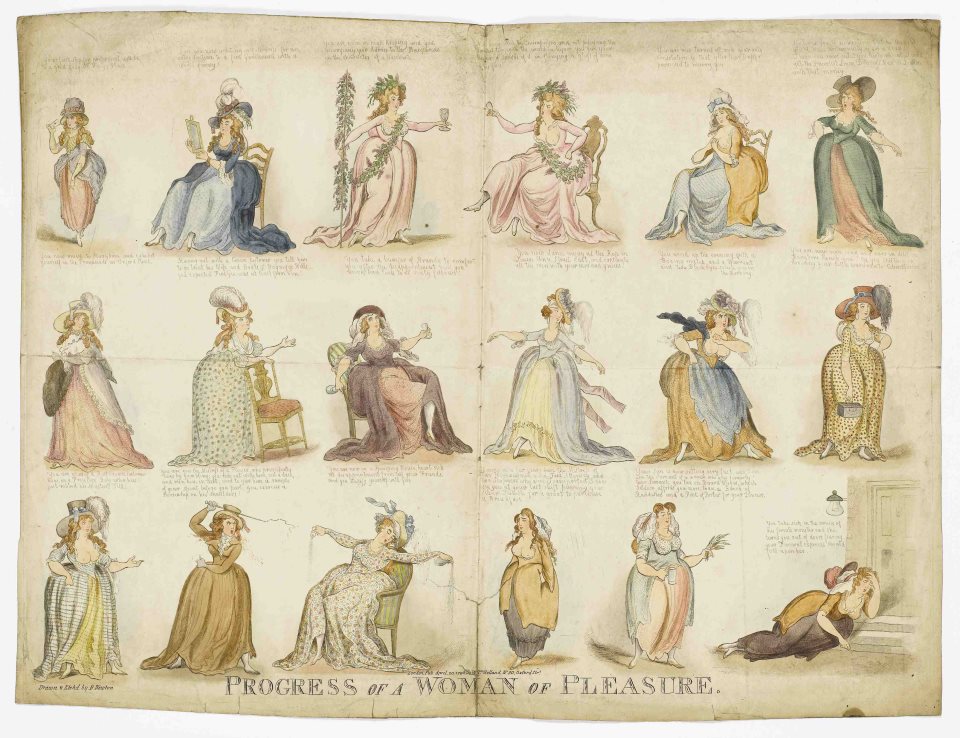
The Progress of a Woman of Pleasure was drawn by Richard Newton, a young artist who died at 21 in 1798, two years after making this illustration. The “Progress” formula, which Newton used for a variety of prints, is a familiar one to those who have viewed William Hogarth’s The Rake’s Progress, Marriage a la Mode, Industry and Idleness and A Harlot’s Progress. Progress series demonstrate in a progression of satirical paintings and prints how lives were transformed by temptation, bad luck and poor choices.
A closer look at Progress of a Woman of Pleasure reveals Newton’s sentimental take of the prostitute theme, as well as details about the life of an 18th Century lady of ill repute. For many 18th century prostitutes, their occupation was transitional, meant to economically tide them over a particularly bad hump in their lives. Many eventually married or found another occupation.
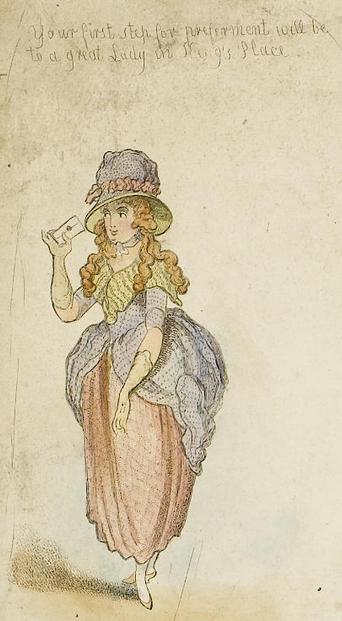
Your first step for preferment will be to a great lady in King's Place.
“A great lady in King’s Place” refers to Charlotte Hayes, who ran a high-class brothel in King’s-Place off Pall Mall. Gentlemen of the upper classes frequented this brothel located in london’s tony west end. With the use of the term ‘preferment’, Newton makes it obvious that this woman has set her sights high. Her clothes are rather simple and plain as compared to the second scene below.

We see you now waiting in full dress for an introduction to a fine gentleman with a world of money!
London was a notorious hot bed for prostitutes. Fully one in five women in London (50,000) worked as ladies of the night. Many of them worked alone, plying their trade on the streets, in their own rooms, or in brothels. One foreign traveler was amazed at the variety of ways a man could have a woman:
…dressed, bound up, hitched up, tight-laced, loose, painted, done up or raw, scented, in silk or wool, with or without sugar. – Daily Life in 18th Century England, Kirsten Olsen, p. 49

You are now in high keeping and you accompany your Adonis to the Masquerade in the character of a Bacchante.
Masquerades were wildly popular in 18th century London. Hidden behind masks and disguised in costumes, people from varying social classes freely intermingled at these events, where licentious behavior was common. Prostitutes attended these events in order to attract customers, or, as in this instance, were brought there by their benefactors.

Not being used to champagne and not possessing the sweetest temper in the world in liquor, you give your keeper a sample of it by flinging a glass of wine to his face.
As this courtesan finds out the hard way, she is with her companion for only as long as she is useful to him. In this instance, her outrageous behavior causes him to cast her off. The aim of the successful prostitute/mistress/courtesan was to find a benefactor from the highest echelons of society and to make a long-lasting arrangement that created a financially fruitful association for her. For the number of women who rose in the ranks of serving as mistress to important men, there was an equal number that had no place to go but down. The idea was to extend your association for as long as possible and retire in comfort.

You are now turned off and your only consolation is that your hair dresser promised to marry you.
Newton’s prostitute must have been a pretty woman indeed if the hair dresser was willing to marry her. The attitude towards prostitutes in the 18th century was more forgiving that it would be in the 19th century, and a former courtesan could still attain a certain level of social acceptance. At this stage, Newton could have ended his sentimental “Progress” with a happy ending and shown our heroine as being reformed and leading a happy life. Note how simple and plain her dress is compared to the previous three drawings.

He loves you to distraction but he thought you'd have an annuity of 200 a year! I hear you roar out -- "You dirty rascal! I could get the smartest linen draper's man in London with that money."
Newton’s prostitute was not only a bit dim, but her huge ego stood in the way of her success. Two hundred a year was a huge sum of money for that day and age. A single gentleman in London could live very comfortably on that sum, although it would not allow him to keep a horse in Town. Nevertheless, such an amount would have been considered staggering for a prostitute and her working class husband. Newton’s contemporary audience would have understood this. Note how much more social caché a draper’s man had over a mere hair dresser! (Well, at least for a woman of her station. A lady wouldn’t have bothered to tell the difference, I’m sure.)
Our prostitute’s pride ruins any chance of happiness she might have found as a respectable married woman. This up and down course of events is not unusual. Many prostitutes in their (generally) short careers went from rags to riches and back to rags and riches again. The cycle, in Newton’s instance, is ever downward.

You move to Marybone and exhibit yourself in the Promenade in Oxford Street.
Marylebone was once a Georgian estate in London that was developed into housing tracts. By 1792-99, Richard Horwood’s map showed that the area from Oxford Street to the Marylebone Road was covered with houses. (The Heart of Marylebone.) Prostitutes were scattered throughout London, including the “Marybone” area (as many as 30,000 in Marylebone alone by one count):
They tended to gather in areas with looser police control; when the police became stricter in the City of London in the eighteenth century, the prostitutes gravitated toward the west and east ends of the city; when police control loosened in the early nineteenth century, they returned to the City. Prostitutes also tended to congregate in areas with cheap lodging houses and lots of men. St. Giles and St. James, home to many cheap boardinghouses, were popular with prostitutes in Westminster; the Docks, where many sailors disembarked, was popular on the east side of the city. – Prostitutes in 18th-Century London
It is interesting to note that William Holland, the artist’s publisher, had his shop on 50 Oxford Street.

Having met with a Crown Customer, you tell him to go treat his Wife and Brats at Bagnigge Wells, you expected Five Guineas at least from him.
Bagnigge Wells no longer exists. It was a spa for the “middling sort”, located on the River Fleet near St. Pancras. The River Fleet is now one of London’s underground rivers. The guinea’s value was more than a pound. The coin itself was valuable, for it was made of gold and the value of a 5 guinea piece fluctuated during the 18th century. A crown was a silver coin worth five shillings, considerably less than a five guinea piece.
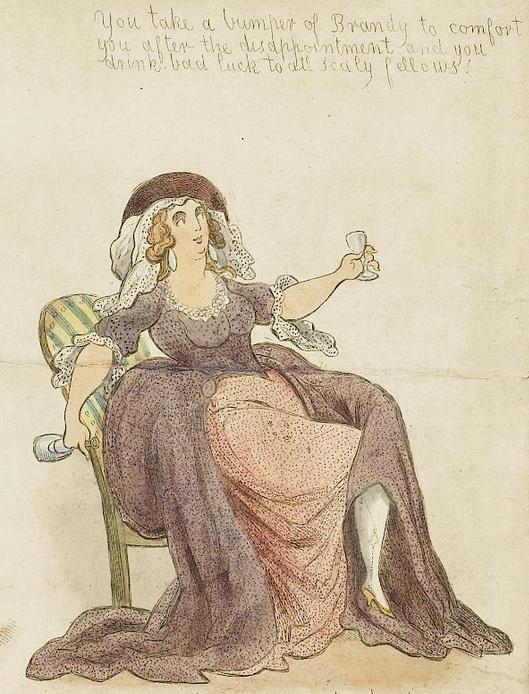
You take a bumper of Brandy to comfort you after the disappointment and you drink bad luck to all scaly fellows.
We already know that our prostitute does not take to drink well. She now turns to brandy. A bumper of brandy is no small amount, as you can see from the bottle in her hand. The Book of Scottish Anecdotes contains this little tale:
While Burns was at Moffat once with Clark the composer, the poet called for a bumper of brandy. “Oh, not a bumper,” said the musician. “I prefer two small glasses.”
“Two glasses?” cried Burns; “Why, you are like the lass in Kyle, who said she would rather be kissed twice bare-headed than once with her bonnet on.” – p81.
Scaly fellows were the lowest of the low. Also note the clocks (embroidery) on the prostitute’s stockings, which were quite fashionable in her day.

Harris’s List of Covent Garden Ladies contained a description of Miss Devonshire on Queen Anne Street. At this point, our lady of pleasure has gravitated towards a tavern on a street near Marlebone .

You wind up the evening with a boxing match and a Warrant and two Black Eyes salute you in the Morning.
Due to her inability to hold her temper, our lady’s downhill slide is guaranteed. Richard Newton was known for his drawings of bare-breasted ladies. It could not have been hard to tug a woman’s chemise down over her bosom in those days.

You are now over head and ears in debt in Marybone Parish and I see you shifting and removing your little wardrobe to Covent Garden.
Our lady of pleasure has moved from the West End to Covent Garden.
By the middle of the 18th century Covent Garden was full of seedy lodging houses and an astonishing number of Turkish baths, many of which were brothels.
Sir John Fielding, the magistrate, called Covent Garden ‘the great square of Venus’. He said, ‘One would imagine that all the prostitutes in the kingdom had picked upon the rendezvous’. – Prostitution in Maritime London

You are glad of a half-crown customer now, in a Prentice Boy who has just robbed his master's till.
And so our prostitute has fallen further. She is attracting customers of a lower sort, such as an apprentice who has taken to thievery to afford her wares. It is obvious that she no longer holds herself out for the highest bidder.

You are now the mistress of a Player, who principally lives by Gambling; you ride out with him, cut a dash, and run him in debt; and to give him a sample of your spirit before you part you exercise a Horsewhip on his shoulders.
Our lady of pleasure is on a slight uptick again, having become the mistress to a gambler. Riding outfits, made by tailors, were quite expensive. To cut a dash was to make a fine figure and to look quite smart. One assumes that the gambler took his mistress horse back riding in London’s Hyde Park, which meant that he kept her in fancy digs until his luck ran out. Once again, our lady of the night shows poor judgment and gives him a physical memory of her temper, flogging him with her riding whip.

You are now in a Sponging House, heart sick at disappointment from all your Friends, and you stupefy yourself with Gin.
One can only imagine that this prostitute is reaping what she sowed, and that she made quite a few enemies when her luck ran high. Now that she is in debt herself, she has no one to turn to.
The normal process was for the debtor to be arrested by a bailiff or sheriff’s officer, and then taken to what was called a sponging-house, usually the officer’s own house. There, the debtor would be persuaded that they should pay their debts, otherwise, they faced a court appearance, and a debtors’ prison. – The Real Little Dorrit
Gin was also known as blue ruin. Before 1734 it was the drink of choice for poor people.
Along with promiscuous and adulterous behavior, gin became associated with prostitution, an issue that ranked high on the agenda of moral reformers. The association between gin and prostitution came about because gin-shops were public places that brought prostitute and customer together. It is important to note however that gin-shops were simply places where ordinary people gathered in a city where there were few other social spaces. As such, gin-shops were perhaps unfairly associated with prostitution in the sense that prostitution occurs where people happen to frequently gather. – The Gin Craze

Having in two years been the mistress of a Two Highwaymen, a Qui Tam Attorney, Two Shopmen who were Transported, I now see you at your last shift, pawning your silver thimble for a groat to purchase your breakfast.
Our whore is so down on her luck, she’ll take any man as a customer, even criminals. Her two shopmen have been transported, to Australia no doubt. She’s most likely working in back alleys and near the ports of London. Her jewelry is gone and her clothes are old-fashioned rags. Selling her thimble, an important item for sewing, for food means that she has no resources left. I know little about ‘qui tam’ attorneys except to say that their practice had fallen into disrepute in England by the 19th century.
A groat was worth only four pence in the 1700s.

Your sun is now setting very fast, and I see you the servant of a woman who was formerly your Servant, you live on Board Wages, which seldom affords you more than a Bunch of Radishes and a Pint of Porter for your dinner.
Board wages mean that our prostitute worked very hard to earn enough money for her room, but had barely enough left over for food. Porter during this time was a strong dark beer. It was a good thing that she could afford alcohol, for I imagine that the wells in her neighborhood were contaminated with fecal matter. Water was a dangerous substance in the poorer sections of London. This prostitute’s narrative provides a cautionary tale for viewers. Her actions caused her downfall; her inability to hold her temper or her drink led to her ruin.
Our “heroine” falls sick and dies outdoors, to be buried in a potter’s field. Nothing could have been said more clearly about this unfortunate woman’s social worthlessness than her degrading end: No one, not even her former servant, now mistress, is willing to put up a single pence for her funeral.

You take sick in the service of this female monster and she turns you out of doors fearing your Funeral expenses should fall upon her.

More on the topic:
- Not so Nice Work: Prostitution in 18th century London
- John Wilmott’s A Ramble in St. James’s Park
- Nightwalkers: Prostitute Narratives from the 18th Century,Laura Jean Rosenthal, 2008
- Prostitution in London, Tufts Digital Library
- Staging the 18th Century Prostitute for the 21st Century
- Harris’s List of Covent Garden Ladies
- The Truth Behind Prostitute Fanny Hill’s Antics 200 Years Ago
- Two Nerdy History Girls also covered this topic: The Progress of a Woman of Pleasure






 Jane Austen's World
I wonder which “error” seemed worst in the 1790s: prostitution itself, or alcoholism? And did they inevitably go hand in hand, or were they separate vices?
One imagines that for the purposes of telling a moral tale, the two were joined. Alcohol was consumed in greater quantities back then. It was safer to drink alcohol than unboiled water, and it is conjectured that many people spent their days in a tipsy haze.
Contemporary UK problems in the news – from the Times of India…..
“Research by Kingston University in southwest London suggested that there has been a 50% rise in numbers [of students working as prostitutes] over the past six years in such cases.”
“The academics found that alcohol and mental problems led some women into stripping and lap-dancing. But those resorting to prostitution were simply working to earn money, it said. University tuition fees, first introduced in 1998 at ?1,000 a year, have risen to ?3,000 pounds this year.”
A modern solution to an age old problem!
Absolutely fascinating read, thank you Vic
Vic,
This is hilarious! Loved reading it.
Suzi
Yes, it made me smile too. Richard Newton had fun making fun of the sentimental prostitute narrative, while at the same time hitting all the marks of such a tale.
This woman of pleasure was stupid indeed for losing her temper and sobriety so many times. Yet underneath all that satire, is a sad story that reflected the plight of too many. Even Emma Hamilton, with all her luck and riches, died penniless in France, cast off and an alcoholic. I wrote of her death in this article: http://vic-sanborn.suite101.com/emma-lady-hamiltons-last-years-and-lonely-death-a232033
I enjoyed reading this and viewing the pictures, Thank you!
A wonderful piece of history brought to life. I enjoy reading Georgette Heyer a lot, but sometimes I found msyelf wishing for details like these. So happy to have discovered this site.
I think a Qui Tam Attorney referred to people who made a living by giving evidence for the prosecution in court cases. They were then awarded part of the compensation that the prosecuted would be made to pay. Not surprisingly, they were not looked upon very kindly.
Reblogged this on Histories & Theories of the 18th-C British Novel and commented:
Here is the post on _Progress of a Woman of Pleasure_ that I showed at the beginning of class today. How does it link to Hogarth’s _A Harlot’s Progress_ or Syrena’s adventures in Haywood’s _Anti-Pamela_?
Thank you for this, Vic. I used it in my 18th-century British Novel course today.
Thank you so much. Love your blog and the implications for your students.
What is a Cyprian – I have read of them – are they high-class prostitutes, the favorites of wealthy men?
Definitions on the Online Dictionary:
Cyp·ri·an (spr-n)
adj.
1. Of or relating to Cyprus; Cypriot.
a. Of or relating to the ancient worship of Aphrodite on Cyprus.
b. Licentious; wanton.
n.
1. See Cypriot.
2. also cyprian
a. A wanton person.
b. A prostitute.
Cyprian [ˈsɪprɪən]
adj
1. (Placename) of or relating to Cyprus
2. (Myth & Legend / Classical Myth & Legend) of or resembling the ancient orgiastic worship of Aphrodite on Cyprus
n
(often not capital) Obsolete a licentious person, esp a prostitute or dancer
n & adj
I am commenting on my own Comment! I remembered Stephanie Barron talks about a Cyprian in her book “Jane and the Barque of Frailty” – so I am expanding my question to ask where the terms Cyprian and Barque of Frailty originated and what they mean?
Georgette Heyer made up many of her own terms. According to the site: You Can’t Say That!: http://www.prismnet.com/~dierdorf/nono.html
barque of frailty
One of Heyer’s euphemisms for a female of no particular virtue. Not in the dictionary. Cf. “bit of muslin”.
I just love this site. I get so much information and ideas for my Regency books.
Thank you, Laurel. One reason I began this blog was to support Regency authors. I am happy that you glean information that is useful.
This topic was a lot closer to Jane Austen’s fiction than has previously been understood:
http://sharpelvessociety.blogspot.com/2010/12/answer-to-my-trick-question.html
http://sharpelvessociety.blogspot.com/2010/12/mrs-cole-direct-connection-between.html
and more at my blog!
Cheers, ARNIE
@JaneAustenCode on Twitter
This is like chose your own adventure for the lady bird! Love it!
Hi Jane ,
I have a question that I have been searching to find the answer to for
A long time ! I heard a late-night discussion on T.V one night while half asleep
And I would like to know if you are familiar with the french name ( title )
That was given to a particular gentleman , whose position was to service any
of the prostitutes after work at night if they so desired…….. Not to be confused with a Gigelo. It was usually an older man and possibly friends with the madam.
I may have been dreaming !! But I swear I heard a man with a heavy french accent discussing the topic openly, and claimed he was one of the select few
when younger and living in Paris…….. Any idea ?? Have you ever heard of
anything like this ?
Thank You for any help,
or comment on the subj.
Sincerely,
Brandy Paige