• Home
  • AV/E-Texts
  • History
  • Icons/Fansites
  • Links
  • Novels
  • Original Sources and 19th C. Texts
  • Podcasts
  • Social Customs During The Regency Era
  • Teacher/Student
  • Writer and Literature Resources

Jane Austen's World

This Jane Austen blog brings Jane Austen, her novels, and the Regency Period alive through food, dress, social customs, and other 19th C. historical details related to this topic.

Feeds:
Posts
Comments
« Jane Austen’s Cross Stitch Sampler
Toy Theatres: 19th Century Entertainment »

Regency Fashion: The Muslin and Net Period

March 15, 2012 by Vic

Jane Austen fans are familiar with the high-waisted muslin dresses popular during her adulthood. How many are aware that machine-made net or gauze became a “hot” item from 1810 and on?
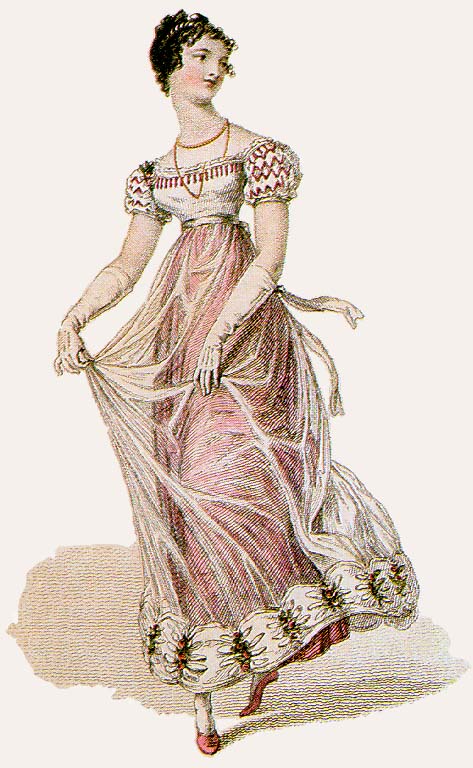
Evening dress with gauze overlay

“Net dresses were very fashionable and their popularity was spurred by new inventions. The development of machine-made net in the late 18th and early 19th centuries meant that gauzy lace effects were increasingly affordable either as trimmings or garments. The bobbin-net machine was patented by the Englishman John Heathcoat in 1808 and produced a superior net identical to the twist-net grounds of hand-made bobbin lace. It was so successful that women in the highest ranks of society, including the Emperor Napoleon’s first wife, Josephine, wore machine-net dresses. Initially, however, all machine nets were plain and had to be embroidered by hand.” – Victoria and Albert

Detail of an evening dress with net lace. Image @Victoria & Albert Collection

Machine-made bobbin net was first made in France in 1818. Until this date, lace as it was made was known as old lace. After that date, lace is categorized as being modern.

Silver embroidery on net on Empress Josephine's court gown. Image @Madame Guillotine

Machine made lace made an appearance around 1760. The nets and tulles became immediately popular. Their arrival spurred the production of other silk lace cloths, which led to a general rise in popularity of the silk lace trade – until a machine was invented that could produce silk net lace as well.

Evening dress with net overlay, 1817-1818, V&A Museum

In the 18th century the hand-made net was very expensive and was made of the finest thread from Antwerp: in 1790 this cost £70 per pound, sometimes more. At that time the mode of payment was decidedly primitive: the lace ground was spread out on the counter and the cottage worker covered it with shillings from the till of the shopman. As many coins as she could place on her work she took away with her as wages for her labour. It is no wonder that a Honiton lace veil before the invention of machine-made net often cost a hundred guineas. Heathcoat’s invention of a machine for making net dealt a crushing blow to the pillow-made net workers. The result is easily guessed. After suffering great depression for twenty years the art of hand-made net became nearly extinct, and when an order for a marriage veil of hand-made net was given, it was with the greatest difficulty that workers could be found to make it. The net alone for such a veil would cost £30. – A history of hand-made lace: Dealing with the origin of lace, the growth of the great lace centres, the mode of manufactures, the methods of distinguishing and the care of various kinds of lace, Emily Jackson, p. 170

Hem of 1817_1818 Evening Dress with net overlay, V&A Museum

The most popular European centers for lace making were located in France, the region known as Belgium today, Ireland, England,and Italy.

During the French Revolution the French textile industry had suffered and unlike in England, use of textile machinery had been non-existent.  Emperor Napoleon stopped the import of English textiles and he revived the Valenciennes lace industry so that fine fabrics like tulle and batiste could be made there. – Regency Fashion History

Black net over gold gown, 1818. Image @Defunct Fashion

Between 1806-1810, net gowns embroidered with chenille embroidery became popular. Profits rose for the manufacturers as the price for the cloth plummeted.

In 1809 Heathcoat took a patent for his bobbin net machine. But the profits realised by the manufacturers of lace were very great, and the use of the machines rapidly extended; while the price of the article was reduced from five pounds the square yard to about five pence in the course of twenty-five years. - John Heathcoat and the Bobbin Net Machine, Samuel Smiles (1859)

By 1813, the bobbinet machine had been perfected. After 1815, gauze was used over satin evening dresses, with the fabric gathered at the back. By 1816, crepe, net and tulle were worn over evening wear made of satin, silks, velvets, kerseymere, satin, lame, and both plain and shot sarcenet.

La Belle Assemblee Court and Fashionable Magazine contains this description of a lady’s dress in Her Majesty’s Drawing Room in January 1818:

Hon. Lady Codrington.—Net draperies, magnificently embroidered in gold  lama, in bouquets and sprigs, over a petticoat of white satin, with blond lace at the bottom, headed with a rouleau of gold lama; train of crimson velvet, trimmed with gold lama and blond lace. Head-dress gold lama toque, with ostrich plume, and diamonds.

1818 Evening Dress, June. La Belle Assemblée. ENGLISH. No. 1.—Evening Dress. Round dress of embossed gauze over white satin, with coriage of peach-coloured satin, elegantly ornamented with rouleau medallions and palm leaves of white satin. Mary Queen of Scots hat, ornamented with pearls, and surmounted by a full plume of white feathers. Negligé necklace of fine pearls, and gold chain beneath, with an eyeglass suspended. White satin shoes, aud white kid gloves.

Not every lady of that era was obsessed over bobbin net lace or tulle. Many began to publicly and proudly favor the old hand made lace.

…both in England and on the Continent and at Almack’s, the Assembly Rooms at Bath and Tunbridge Well, the chaperons would gossip of their lappets of Alencon or Brussels. Numerous were the anecdotes as to how this treasure or that had turned up having escaped the doom the rag-bag, which alas! was the fate of so much old lace during the muslin and net period. – Emily Jackson, A History of Hand-made Lace, 1900, p 48.

Machine made lace dealt a great blow to the industry of hand-made fabrics. In Tiverton in 1822, where once 2,400 lace makers worked, only 300 lace makers were still employed.

Evening dress with net overlay, 1818. Image @Old Rags

The Duchess of Gloucester was one of the few whose affections never swerved from her love of the old rich points towards blondes and muslins, and her collection was one of the finest in Europe. Lady Blessington, too, loved costly lace, and, at her death, left several huge chests full of it. Gradually lace began to be worn again, but it was as it were ignorantly put on, worn simply because it was again the fashion to wear lace, and lace must therefore be worn; the knowledge of its history, worth, and beauty was lacking…  - Emily Jackson, A History of Hand-made Lace, 1900, p 48.

Princess Mary, Duchess of Gloucester (Daughter of King George III) Image @Justin F. Skrebowski

Sprigs beautified the machine-made net. It is said that Queen Charlotte introduced applique on net to support the machine net industry. Honiton appliques consisted of white linen thread sprigs mounted on the net, but black  silk sprigs were applied as well. The black silk cost twice as much as the linen threads and soon went out of fashion.

The trade of lace making remained for several generations in some families, thus in 1871 an old lace maker was discovered at Honiton, whose turn or wheel for winding cotton had the date 1678 rudely carved on its foot -Old lace, a handbook for collectors: an account of the difference styles of lace, their history, characteristics & manufacture, Margaret Jourdain, 1908, p94-95

Detail of early 19th c. tamboured net shawl. Image @Vintage Textiles

Sources:

  • Fashion is My Muse
  • Black net overdress, 1817-1820, Liverpool Museum
  • Tamboured net shawl, Vintage Textiles
  • Red Gauze Dress With Chenille Embroidery: Museum of London
  • Regency Mourning Fashions shows several net dresses for half mourning and evening wear.
  • Costume photos from UK trip, 2006
  • The Grove Encyclopedia: Net Lace
  • Heathcoat’s Patent Lace Machine Model
  • The Lace Dictionary: Exquisite Linens

Share with others:

Like this:

Like Loading...

Posted in Fashions, jane austen, Jane Austen's World, Regency Life, Regency Period | Tagged 18th Century fashion, Gauze net over empire dresses, La Belle Assemblee 1818, Regency Fashion, Regency gowns with net | 26 Comments

26 Responses

  1. on March 15, 2012 at 10:50 Katharine Ashe (@KatharineAshe)

    These are beautiful! Thanks for such a terrific post. I never truly appreciated lace and netting before. I shall have to dress my heroines in more of it forthwith!


  2. on March 15, 2012 at 11:18 ellaquinnauthor

    Thank you so much. The pictures of the netting are gorgeous.


  3. on March 15, 2012 at 11:19 ellaquinnauthor

    Reblogged this on Ella Quinn ~ Author and commented:
    From Jane Austen’s World


    • on March 16, 2012 at 22:26 Vic

      Thank you for mentioning my post on your blog. Most appreciated!


  4. on March 15, 2012 at 12:49 Laura

    What a fantastic post! Thank you for this information and history. The pictures helped as well.
    Now I’m really curious to see how they’re used in the period dramas…


  5. on March 15, 2012 at 13:48 rubyandwheaky

    Thank you for publishing this blog. I’ve learned so much and the pictures are wonderful!


  6. on March 15, 2012 at 15:16 aurora

    Excellent and so interesting post. I have found out so much.


  7. on March 15, 2012 at 15:57 Amina

    What a fabulous post! It was absolutely fascinating. Thank you!!!


  8. on March 15, 2012 at 15:58 Nancy

    Beautiful gowns.
    Jane Austen mentions netting and writes of someone netting a gown. I had thought that the woman was tatting an over dress. However, now I wonder if she was embroidering machine netting for the over dress.
    Nancy


  9. on March 15, 2012 at 15:59 Kimberly

    that is very interesting


  10. on March 15, 2012 at 17:36 Heather Molinari

    It must have been amazing to be able to wear these beautiful dresses.


  11. on March 15, 2012 at 18:09 phoebe

    As what normally happens when I read your blog, I went off looking for more reference material. This time it was to find an example of lace that was mentioned in Mrs. Gaskell’s North & South. I found THE QUEEN LACE published in 1874 http://www.cs.arizona.edu/patterns/weaving/books/qun_lace.pdf

    Thought you might like to take a peek.

    I love your blog!


    • on March 16, 2012 at 22:25 Vic

      Thank you for that fabulous link. What a great book! And for your compliment.


  12. on March 15, 2012 at 18:45 Jackie Horne

    Yes, but think how easily they must have been damaged! So easy to snag those net holes… I’m surprised any of the gowns survived to be seen today…


  13. on March 15, 2012 at 20:13 Abigail Reynolds

    Thanks for the excellent and timely post. I’m in the midst of choosing fabrics for a regency dress and had been considering an overlay, so your information and lovely pictures are very helpful in my planning.


  14. on March 16, 2012 at 02:17 suzan

    Great info. I love lace and netting. Your pictures and history is a joy. I also thought of “North and South” when reading this info. like the person above. Thanks for the link by the way.


  15. on March 16, 2012 at 03:50 BluffKingHal

    So gorgeous. I remember spending an entire day at the Lace museum in Belgium and it was simply overwhelming!


  16. on March 16, 2012 at 09:59 Muslin & Net Period from Jane Austen’s World - Suzi Love

    [...] Read an excerpt here and the rest of Vic’s fascinating look at Fashion at Jane Austen’s World. [...]


  17. on March 16, 2012 at 13:37 Terese Ramin

    Reblogged at http://www.tereseramin.com and noted it’s from here. This is perfect to go with the book I’m finishing up right now. Thank you, Vic!


    • on March 16, 2012 at 22:24 Vic

      Thank you, Therese, and Suzi Love. I appreciate your support and comments!


  18. on March 17, 2012 at 14:29 Emmalena

    A fascinating history of lace and netting. Gorgeous pictures. My grandmother made lace and tried to teach me the art when I was growing up. Alas, I never quite got the hang of it!


  19. on March 18, 2012 at 19:40 Victoria

    Fantastic article. England has such an history of lacemaking. Particularly of the hand made kind, Midlands and Honiton in Devon for example in the 19th century. I always find bobbin lace a remarkable achievement, working on a pillow with hundreds of bone or wooden bobbins! The 16th & 17th centuries were the true hey day. Gorgeous ruffs and collars. So expensive to produce and worn by royalty and aristocracy. Paintings of the period show the lace in fine detail.


  20. on March 20, 2012 at 10:29 Review: The Annotated Emma by Jane Austen, Annotated by David M. Shaphard « Jane Austen's World

    [...] March 20, 2012 by Vic Note: The dress on the cover of this book is made with the machine-made net overlay that I described in an earlier post on this blog. Click here to read it. [...]


  21. on March 23, 2012 at 06:56 biscuitsplease

    This is such an interesting post I am a genealogist researching a lace maker from Nottingham and this shows just why the bobbin net lace industry took off there.


  22. on April 27, 2012 at 09:39 A Regency Ball Gown 200 Years Ago: April, 1812 « Jane Austen's World

    [...] represented the advances made in machine made lace during the late 18th and early 19th centuries. (Click here to read my article about net lace.) Early 19th century dress made with embroidered black [...]


  23. on April 16, 2013 at 23:07 Making a Regency net gown | Tea in a Teacup

    [...] Regency Fashion: The Muslin and Net Period – at Jane Austen’s World [...]


Comments are closed.

  • Enter your email address to subscribe to this blog and receive notifications of new posts by email.

    Join 3,075 other followers

  • Notice: Comments

    Due to problems with SPAM, I will no longer accept comments on posts that I published over 30 days ago.

    I regret having to take this action.

  • Blog Stats

    • 6,235,043 hits
  • Pin It!

    Follow Me on Pinterest
  • Downton Abbey Season 3 Articles

    untitled

    Click on banner image to see this season's schedule

    SEASON THREE ARTICLES

    ~ Review of Episode 6: Oh, how the mighty have fallen

    ~ Review of Episode 5: The Earl's Gone Off His Rocker and Book Giveaway

    ~ Beauty Lessons Learned from Downton Abbey

    ~ Review of Episode 4: Let the grieving begin '

    ~ Review of Episode 3: Not Enough Noses Out of Joint

    ~ Review of Episode 2: Being Tested Only Makes You Stronger

    ~ Say Yes to the Dress, Episode 2 Poll

    ~ Review of Episode One: The Mouse that Roared

    ~ 1920s Fashions

  • Downton Abbey Season 2 Articles

    Click on the banner to go to PBS Masterpiece Classic

    SEASON TWO ARTICLES

    ~ Watch Downton Abbey Season 2 Online

    ~ Viewers of Downton Abbey Season 2: How Did You Like the Christmas Ending?

    ~ Downton Abbey Season 2 Finale:Tonight you're mine completely

    ~ Highclere Castle Floor Plan: The Real Downton Abbey

    ~ The Flu Pandemic in Downton Abbey

    ~ Downton Abbey Season 2:Teagowns and Relaxation

    ~ Downton Abbey Season 2 Review:Coupling

    ~ Downton Abbey: Preview of Season 2

    ~ The Symbolism of the White Feathers

    ~ World War One Guide to Rats, Shell Shock, and Barbed Wire

    ~ Country houses in medical service

  • Downton Abbey Season One Posts on this blog

    Click on image to enter PBS's site.

    READ THIS BLOG'S ARTICLES ABOUT DOWNTON ABBEY:

    • ~ Watch Downton Abbey Online
    • ~ Downton Abbey: Preview of Season 2
    • ~ Entertaining visitors in an English country house, such as Downton Abbey
    • ~ Downstairs in Downton Abbey: The Servants
    • ~ Upstairs in Downton Abbey: The Three Crawley Sisters
    • ~ The Jane Austen Connection to Downton Abbey and Egypt
    • ~ Downton Abbey's Recycled Costumes
    • ~ Everything You Wanted to Know About the Entail in Downton Abbey, and More
    • ~ The Foxhunt: From Downton Abbey Back to Its Origins
    • ~ The Servants Quarters in 19th Century Country Houses Like Downton Abbey
    • ~ Would You Care for Weak Tea or Strong Tea? How the Dowager Countess of Grantham Served Tea to Her Guests
    • ~ The Duties of a Valet
  • The Obituary of Charlotte Collins by Andrew Capes

    Click on image to read the story.

  • Bookmark

    Add to DeliciousAdd to DiggAdd to FaceBookAdd to Google BookmarkAdd to MySpaceAdd to NewsvineAdd to RedditAdd to StumbleUponAdd to TechnoratiAdd to Twitter
  • Links to Jane Austen Blogs

    Please note my new links page. I have moved the blog roll and links to other Jane Austen and related topic - including Regency fashion, historic foods, Jane Austen societies, British sites, related topics, and more - to the top of the blog. Click on image.
  • Find Jane Austen on Google

  • Tweet
  • Jane Austen Today, My Other Blog

  • Randolph Macon Talk

    The Marriage Mart
  • This blog has no commercial purpose

    Any ads you see are placed here by Wordpress. I make no profit off my blog. I do receive books and DVDs for review.
  • Jane Austen’s Advice for Writers

    Click on image to read the article.
  • Doctors and Medical Care in the Regency Era

    Click on image.
  • Join Me on Twitter

  • Twitter Updates

    • Oh, how horrible to be enjoying #DWTS when so many people in Oklahoma are experiencing sadness and horror. #OklahomaTornadoes #tornadoes 8 hours ago
  • Join me on Facebook

    Vic Sanborn

    Create Your Badge
  • Hello, my name is Vic and I live in Richmond, VA. I work in program and professional development at Virginia Commonwealth University, and I have adored Jane Austen almost all of my life. I am a proud lifetime member of the Jane Austen Society of America. This blog is a personal blog written and edited by me. I do not accept any form of cash advertising, sponsorship, or paid topic insertions. However, I do accept and keep books, DVDs and CDs to review.

    Contributors to this blog include: Tony Grant and Shelley DeWees.

    If you would like to share a new site, or point out an error, please email me. (Yes, I am fallible. I'll own up to my mistakes and will make the corrections with a polite smile on my face.) Write me at

    Spam protecting image courtesy: Nexodyne.com

    Thank you for visiting my blog. Your comments and suggestions are most welcome.

  • Copyright Statement

    © Vic Sanborn and Jane Austen's World, 2010. Unauthorized use and/or duplication of this material without express and written permission from this blog’s author and/or owner is strictly prohibited. Excerpts and links may be used, provided that full and clear credit is given to Vic Sanborn and Jane Austen's World with appropriate and specific direction to the original content.
  • Regency Fashion: Ladies Outerwear and Shawls

    Click on the image.
  • Colors of 19th Century Wedding Dresses

    Click on image

  • Page copy protected against web site content infringement by Copyscape
  • The Distinctions of Regency Dress: Undress, Half Dress, Full Dress and Their Meaning

    Click on the image to read the article.
  • Recent Posts

    • Pride and Prejudice: Having a Ball at Chawton House
    • Nothing As it Seems – Jane Austen in Bath
    • The College of William and Mary, A Sir Christopher Wren Building in Williamsburg, Virginia?
    • The Bathing Dress: Fashion in the Georgian Era
    • Jane Austen First Editions: How Much is Yours Worth?
  • Tags

    Bath Beau Brummell Cassandra Austen Charles Dickens Chawton House Cookery Downton Abbey Downton Abbey Season 3 Elizabeth Bennet embarking on a Course of Study Emma Emma 2009 Georgette Heyer Georgette Heyer Book Reviews Holidays jane austen Jane Austen's family Jane Austen's World jane austen blogs Jane Austen Book review Jane Austen Movies Kate Beckinsale Laurie Viera Rigler London Lori Smith Masterpiece Classic Mr. Darcy PBS Masterpiece Classic PBS Masterpiece Mystery! PBS Movie Adaptation PBS Movie Review Pride and Prejudice Prince Regent Regency Bath Regency Dandy regency dress Regency Fashion Regency food Regency London Regency Servants Regency Transportation Romola Garai SourceBooks Tony Grant Working class
  • Ad Disclaimer

    Any ads that appear on this site were placed there by WordPress. I do not make money off this blog. WordPress keeps the revenue. - Vic
  • Pages

    • AV/E-Texts
      • A Proposal To Cicely, by Georgette Heyer
    • History
    • Icons/Fansites
    • Links
    • Novels
    • Original Sources and 19th C. Texts
    • Podcasts
    • Social Customs During The Regency Era
      • English Culture, 1660-1830
    • Teacher/Student
    • Writer and Literature Resources
  • Petticoats in the Regency Era

    Click on image.
  • Jane Austen’s Writing Desk and Writing Table

    The little round writing table at Chawton.

    Click on image to read this fascinating article.

  • Top Posts

    • Social Customs During The Regency Era
    • Highclere Castle Floor Plan: The Real Downton Abbey
    • Pride and Prejudice: Having a Ball at Chawton House
    • Pride and Prejudice Economics: Or Why a Single Man with a Fortune of £4,000 Per Year is a Desirable Husband
    • The Servant's Quarters in 19th Century Country Houses Like Downton Abbey
    • Social Classes in England, 1814
    • Review: Downton Abbey Season 3, Final Episode, or Bloody Hell! Why did Fellowes do it again?
    • Dressing for the Netherfield Ball in Pride and Prejudice: Regency Fashion
    • Everything You Wanted to Know About the Entail in Downton Abbey, and More
    • History
  • Geo Visitors Map
    Add to Technorati Favorites
    Cultural Blogs - BlogCatalog Blog Directory
    Blog Flux Local - Virginia
  • cool hit counter
  • The Animal Rescue Site
  • Archives

    • May 2013
    • April 2013
    • March 2013
    • February 2013
    • January 2013
    • December 2012
    • November 2012
    • October 2012
    • September 2012
    • August 2012
    • July 2012
    • June 2012
    • May 2012
    • April 2012
    • March 2012
    • February 2012
    • January 2012
    • December 2011
    • November 2011
    • October 2011
    • September 2011
    • August 2011
    • July 2011
    • June 2011
    • May 2011
    • April 2011
    • March 2011
    • February 2011
    • January 2011
    • December 2010
    • November 2010
    • October 2010
    • September 2010
    • August 2010
    • July 2010
    • June 2010
    • May 2010
    • April 2010
    • March 2010
    • February 2010
    • January 2010
    • December 2009
    • November 2009
    • October 2009
    • September 2009
    • August 2009
    • July 2009
    • June 2009
    • May 2009
    • April 2009
    • March 2009
    • February 2009
    • January 2009
    • December 2008
    • November 2008
    • October 2008
    • September 2008
    • August 2008
    • July 2008
    • June 2008
    • May 2008
    • April 2008
    • March 2008
    • February 2008
    • January 2008
    • December 2007
    • November 2007
    • October 2007
    • September 2007
    • August 2007
    • July 2007
    • June 2007
    • May 2007
    • April 2007
    • March 2007
    • February 2007
    • January 2007
    • December 2006
    • November 2006
    • October 2006
    • September 2006
    • August 2006
  • Irresistible Attraction

    An online Regency novel in serialized form. Click here to read a new chapter of Irresistible Attraction each week, and follow the story of Amanda Sinclair and James Cavendish, the Earl of Downsley.
  • My Regency Tea Cup Review Ratings

    • Five Regency tea cups: The book is not perfect (few books are), but it was well worth its purchase and possesses many outstanding qualities that makes it stand head and shoulders above its counterparts.
    • Four Regency tea cups: This book offered many hours of pleasant reading, and I found I could not put it down.
    • Three Regency tea cups: Damned with faint praise. I put the book down often, but was intrigued enough to finish it. In this instance, the movie might be better.
    • Two Regency tea cups: This book required major changes that the author and editor should have fixed before publishing deadline.
    • One Regency tea cup: Oh dear. I do so feel for the trees that sacrificed their lives for this verbal garbage.

Blog at WordPress.com.

Theme: MistyLook by WPThemes.


Follow

Get every new post delivered to your Inbox.

Join 3,075 other followers

Powered by WordPress.com
loading Cancel
Post was not sent - check your email addresses!
Email check failed, please try again
Sorry, your blog cannot share posts by email.
%d bloggers like this:

