• Home
  • AV/E-Texts
  • History
  • Icons/Fansites
  • Links
  • Novels
  • Original Sources and 19th C. Texts
  • Podcasts
  • Social Customs During The Regency Era
  • Teacher/Student
  • Writer and Literature Resources

Jane Austen's World

This Jane Austen blog brings Jane Austen, her novels, and the Regency Period alive through food, dress, social customs, and other 19th C. historical details related to this topic.

Feeds:
Posts
Comments
« The Many Faces of Georgette Heyer
Fowling for Pheasant: Mansfield Park »

Regency Medicine: Dentistry

August 11, 2011 by Vic

Jane Austen’s mother, Cassandra’s

features were aristocratic; her hair was dark and her eyes an unusual tint of grey. She had an instinctive tendency to depreciate her own appearance; it was her elder sister Jane, she always insisted, who was the beauty of the family. But Cassandra did admit to a certain vanity concerning her fine patrician blade of a nose.” - Jane Austen, a family record by Deirdre Le Faye, William Austen-Leigh

However, by 1782, when her daughter Jane was only 7 years old, she was described as having lost several foreteeth, which made her look old.

Cassandra Leigh Austen, Jane Austen's mother, with her patrician nose and missing foreteeth

Modern dentistry was still in its infancy when Cassandra Austen gave birth to her eight children. While the wealthy could afford dentists, rural folks still depended on the village blacksmith, who only knew how to pull teeth. Market fairs sold tinctures, toothpowders and abrasive dentifrices.

Lucy Baggott, of Wychwood Books, says: ‘It was not uncommon for the local farrier to draw teeth to relieve toothache of those in desperate pain, for then the blacksmith in many rural communities doubled as a tooth drawer. ‘There were many dubious practices adopted: hot coals, string, forceps, and pliers to name a few. Children were lured to sacrifice their teeth for the supposed benefit of the wealthy in exchange for only a few shillings. One print reads: “Most money given for live teeth”. – Dental Quackery Captured in Print
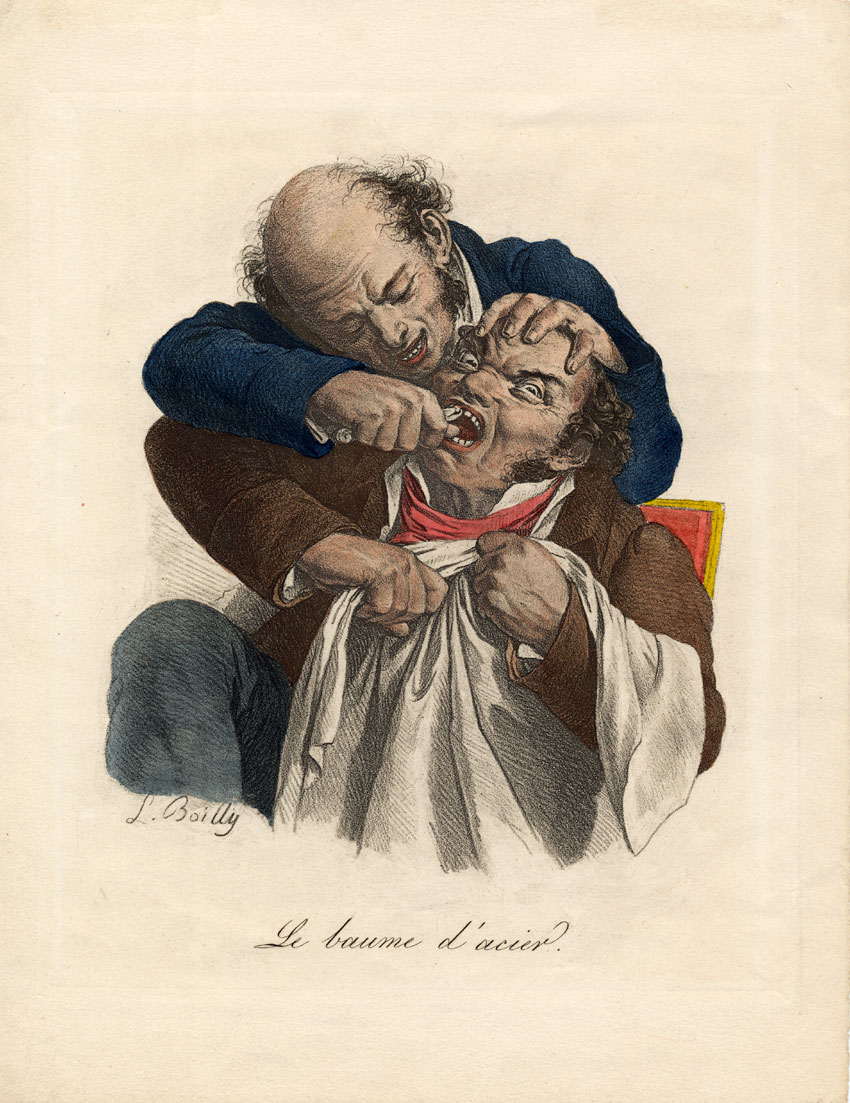
Louis-Leopold Boilly (1761-1845), Dentist Teeth Patient, 1827

We do know this: tooth extraction was painful and a most unpleasant affair before the age of ether and anesthetics.

In two letters to Cassandra, on Wednesday 15 & Thursday 16 September 1813, Jane [Austen] describes in some detail accompanying her young nieces Lizzy, Marianne and Fanny, on a visit to the London dentist Mr Spence. It was, she relates, ‘a sad business, and cost us many tears’. They attended Mr Spence twice on the Wednesday, and to their consternation had to return on the following day for yet another ‘disagreeable hour’ . Mr Spence remonstrates strongly over Lizzy’s teeth, cleaning and filing them and filling the ‘very sad hole’ between two of the front ones. But it is Marianne who suffers most: she is obliged to have two teeth extracted to make room for others to grow. - The Poor Girls and Their Teeth, A Visit to the Dentist, JASA
Tooth maintenance and dental hygiene were not a new concept. The aristocrats suffered more cavities, for they could afford sweets and foods that would eat into enamel, but they did use tooth powders, tooth picks, and toothbrushes to keep their teeth clean.

The ancient Chinese made toothbrushes with bristles from the necks of cold climate pigs. French dentists were the first Europeans to promote the use of toothbrushes in the seventeenth and early eighteenth centuries. William Addis of Clerkenwald, England, created the first mass-produced toothbrush. Toothpaste: modern toothpastes were developed in the 1800s. In 1824, a dentist named Peabody was the first person to add soap to toothpaste. John Harris first added chalk as an ingredient to toothpaste in the 1850s.- History of Dentistry
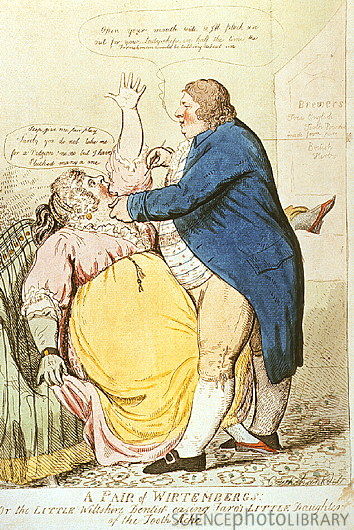
Isaac Cruikshank

The caption to the above cartoon states: Dentist. 18th century caricature of a fat dentist with his struggling, overweight female patient. The patient is begging the dentist not to pluck her teeth out like he would the feathers of a pigeon. People who eat large amounts of sugary food are often both overweight and suffer from dental decay. Image drawn in 1797 by British artist Isaac Cruikshank (1756-1811). – Science Photo Library

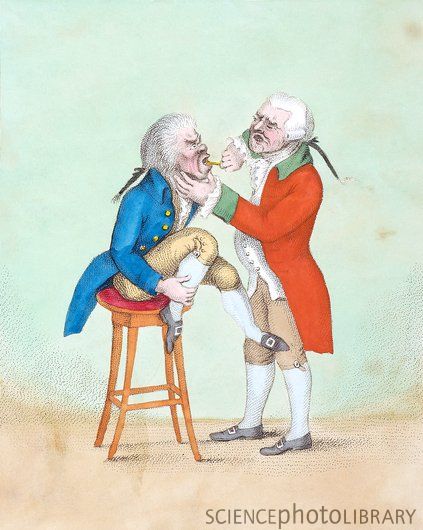
Tooth Extraction, William Henry Bunbury, mid-18th century

Extractions were by forceps or commonly keys, rather like a door key…When rotated it gripped the tooth tightly. This extracted the tooth – and usually gum and bone with it…Sometimes the jaws were also broken during an extraction by untrained people.”- BBC

A timeline of dentistry in the 18th and 19th centuries:

1780 – William Addis manufactured the first modern toothbrush. 1789 – Frenchman Nicolas Dubois de Chemant receives the first patent for porcelain teeth. 1790 – John Greenwood, one of George Washington’s dentists, constructs the first known dental foot engine. He adapts his mother’s foot treadle spinning wheel to rotate a drill. 1790 – Josiah Flagg, a prominent American dentist, constructs the first chair made specifically for dental patients. To a wooden Windsor chair, Flagg attaches an adjustable headrest, plus an arm extension to hold instruments. 19th Century 1801 – Richard C. Skinner writes the Treatise on the Human Teeth, the first dental book published in America. 1820 – Claudius Ash established his dental manufacturing company in London. 1825 – Samuel Stockton begins commercial manufacture of porcelain teeth. His S.S. White Dental Manufacturing Company establishes and dominates the dental supply market throughout the 19th century. - Nambibian Dental Association

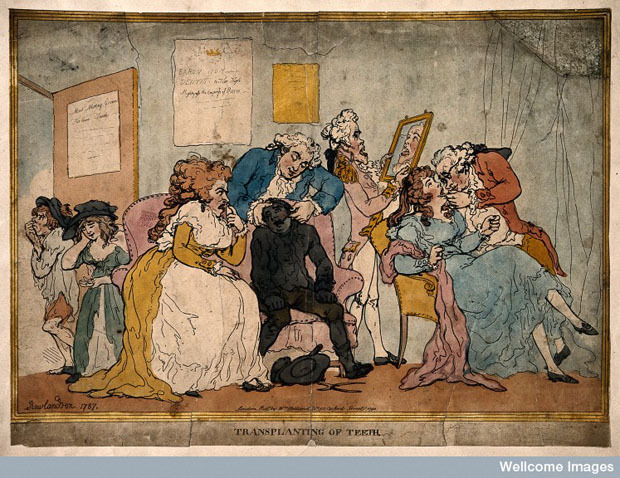
Annotation of the above cartoon by Thomas Rowlandson:

This print is by Thomas Rowlandson (1756-1827) and is dated 1787. It is a satirical comment upon the real practice of rich gentlemen and ladies of the 18th century paying for teeth to be pulled from poor children and transplanted in their gums. The dentist present is portrayed as a quack. There are even two quacking ducks on the placard advertising his fake credentials. He is busy pulling teeth from the mouth of a poor young chimney sweep. Covered in soot and exhausted, he slumps in a chair. Meanwhile the dentist’s assistant transplants a tooth into a fashionably dressed young lady’s mouth. Two children can be seen leaving the room clutching their faces and obviously in pain from having their teeth extracted. As people lost most of their teeth by age 21 due to gum disease, teeth transplants were popular for some time in England although they rarely worked. – Wellcome Images

Thomas Rowlandson – A French dentist showing a specimen of his artificial teeth and false palates Coloured engraving 1811 Image @ Rowlandson, Wellcome Library

Dentures did exist:

Perhaps the most famous false-toothed American was the first president, George Washington. Popular history gave Mr. Washington wooden teeth, though this was not the case. In fact, wooden teeth are impossible; the corrosive effects of saliva would have turned them into mushy pulp before long. As a matter of fact, the first president’s false teeth came from a variety of sources, including teeth extracted from human and animal corpses. - A Short History of Dentistry

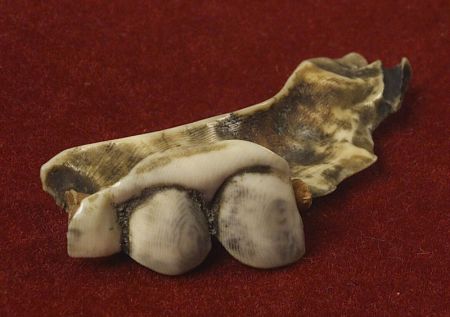
Carved ivory upper denture, late 18th century. Image @Skinner Auctioneers

As always, the upper classes had the upper hand:

The upper classes could afford a greater range of treatments, including artificial teeth (highly sought after by the sugar- consuming wealthy). Ivory dentures were popular into the 18th century, and were made from natural materials including walrus, elephant or hippopotamus ivory. Human teeth or ‘Waterloo teeth’ -sourced from battlefields or graveyards- were riveted into the base. These ill fitting and uncomfortable ivory dentures were replaced by porcelain dentures, introduced in the 1790′s. These were not successful due to their bright colours, and tendency to crack.Before the 1800′s, the practice of dentistry was still a long way from achieving professional status. This was to change in the 19th century – the most significant period in the history of dentistry to date. By 1800 there were still relatively few ‘dentists’ practicing the profession. By the middle of the 19th century the number of practicing dentists had increased markedly, although there was no legal or professional control to prevent malpractice and incompetence. Pressure for reform of the profession increased. - Thomas Rowlandson, “Transplanting Teeth (c.1790) [Engraving],” in Children and Youth in History, Item #164, http://chnm.gmu.edu/cyh/primary-sources/164 (accessed August 10, 2011). Annotated by Lynda Payne

More on This Topic:

  • Read Dental Hygiene in the Regency Era on this blog.
  • Carved Ivory Upper Denture
  • The Perfect 18th Century Smile: Waterloo Teeth
  • Science Photo Library Tooth Extraction, Henry William Bunbury Prints relating to Dentistry
  • Prints Related to Dentistry
  • The Enigma of Pain
  • George Washington’s False Teeth
About these ads

Share with others:

Like this:

Like Loading...

Posted in 18th Century England, 19th Century England, Georgian Life, jane austen, Jane Austen's World, Old English Customs, personal hygiene, Regency Customs, Regency Life, Regency Period, Regency World | Tagged 19th century dental hygiene, Cassandra Leigh Austen, History of Dentistry, Regency Medical treatment | 16 Comments

16 Responses

  1. on August 11, 2011 at 22:42 Suzan

    okay this just made me cringe all over. I’m usually not glad to go to my dentist but I rapidly had second thoughts. So much better than the past.


  2. on August 11, 2011 at 22:56 Nancy

    How about buying a denture made of Waterloo teeth? Scavengers relieved the dead of their teeth as soon as the guns fell silent.


    • on August 11, 2011 at 23:08 Vic

      So ghoulish, Nancy! Uggh.


  3. on August 11, 2011 at 23:25 silhouettesbyhand

    The [USA] National Dental Museum is here in Baltimore, a very fun visit. The exhibitions include a set of Washington’s teeth, ad descriptions, and the evolution of dentifrices. Some early dentists not only did dentistry, but also repaired saddles and cut profile portraits too.


  4. on August 12, 2011 at 00:06 Mary Simonsen

    This subject gives me the willies. I don’t like going to the dentist in the 21st century. My mom and dad grew up in a poor coal-mining town in the ’20s and ’30s, and they only went to the dentist when they had to have one pulled. Dental hygiene was poor, and that’s why so many of the WII generation wore dentures. One of my strongest memories was her asking “Did you brush your teeth?”


  5. on August 12, 2011 at 00:59 Blossom Evergreen

    This is a rather chilling article, but it gives one new information and ideas to work with :-) Thank you!


  6. on August 12, 2011 at 01:27 Karen Field

    Whew! That article’s material would give any of us the willies! I’m glad for the information, though. I had not made the correlation between wealthier diets, including the ability to imbibe wines and more sweets, to have had an impact on dental health. The average age was 21 to lose one’s teeth? How awful! And children being induced to give up their teeth for implants. Can’t you just imagine a greedy parent putting them up to it for a pint at the pub? Or even a parent just trying to make the rent that month. Oh, it is too horrible to be borne.

    This was fascinating and one of the kinds of articles that I have come to rely on you for, Vic.

    Question, will you be at JASNA’s AGM this year? I would so love to meet you in person. I’ll be coming in the Wash DC chapter as a 1st timer.


  7. on August 12, 2011 at 02:03 Caroline

    As always, a fascinating snippet back in time. Thank you for shining a light on something that we never see in the historical costume dramas on TV.


  8. on August 12, 2011 at 04:07 Anna

    This was interesting, though certainly gave me the cringe. We never imagine all these things when watching glossy costume dramas… I mean, how many of the Jane Austen films show Mrs Austen with missing front teeth? How many adaptations of her novels show people with bad teeth in the first place? Fascinating, thanks for posting!


  9. on August 13, 2011 at 18:08 Laurie

    I have an instant urge to go brush my teeth! Thanks for this really interesting article on the history of dentistry, I will appreciate my dentist more!


  10. on August 14, 2011 at 11:35 bethtrissel

    Oh how dreadful. What torment our ancestors endured. And what a fascinating post. Your images are wonderful.


  11. on August 14, 2011 at 12:48 Jean | Delightful Repast

    I’m exhausted after that ordeal, Vic! A cup of tea, then off for a bit of a lie-down for me!


  12. on August 14, 2011 at 23:33 QNPoohBear

    There’s a fascinating scene in Carolyn Meyer’s book
    The bad queen : rules and instructions for Marie-Antoinette that relates to this topic. In preparing to meet her husband she had dental work done. It sounds extraordinarily painful.


  13. on August 15, 2011 at 19:22 Nicola

    Great post. I’m always intrigued when I re-read Emma as to what kind of treatment Harriet had when she visits the dentist!


  14. on February 17, 2012 at 14:06 eRDent Dental Forum

    Interesting…
    But nowadays, we must thanks to anaesthetic for “its” contribution on dentistry.
    I also post some valuable post about dentistry on my forum. Maybe you want to visit me? I appreciate it if you visit my forum. :)


  15. on March 19, 2012 at 14:34 Regency medicine | Mongrelmovies

    [...] Regency Medicine: Dentistry « Jane Austen’s WorldRegency Medicine: Dentistry. August 11, 2011 by Vic. Jane Austen’s mother, Cassandra’s. features were aristocratic; her hair was dark and her eyes an unusual … [...]


Comments are closed.

  • Enter your email address to subscribe to this blog and receive notifications of new posts by email.

    Join 3,086 other followers

  • Notice: Comments

    Due to SPAMMERS, I will no longer accept comments on posts that I published over 30 days ago. In some instances, I will remove links from comments as well.

    I regret having to take this action.

  • Blog Stats

    • 6,244,457 hits
  • Pin It!

    Follow Me on Pinterest
  • Downton Abbey Season 3 Articles

    untitled

    Click on banner image to see this season's schedule

    SEASON THREE ARTICLES

    ~ Review of Episode 6: Oh, how the mighty have fallen

    ~ Review of Episode 5: The Earl's Gone Off His Rocker and Book Giveaway

    ~ Beauty Lessons Learned from Downton Abbey

    ~ Review of Episode 4: Let the grieving begin '

    ~ Review of Episode 3: Not Enough Noses Out of Joint

    ~ Review of Episode 2: Being Tested Only Makes You Stronger

    ~ Say Yes to the Dress, Episode 2 Poll

    ~ Review of Episode One: The Mouse that Roared

    ~ 1920s Fashions

  • Downton Abbey Season 2 Articles

    Click on the banner to go to PBS Masterpiece Classic

    SEASON TWO ARTICLES

    ~ Watch Downton Abbey Season 2 Online

    ~ Viewers of Downton Abbey Season 2: How Did You Like the Christmas Ending?

    ~ Downton Abbey Season 2 Finale:Tonight you're mine completely

    ~ Highclere Castle Floor Plan: The Real Downton Abbey

    ~ The Flu Pandemic in Downton Abbey

    ~ Downton Abbey Season 2:Teagowns and Relaxation

    ~ Downton Abbey Season 2 Review:Coupling

    ~ Downton Abbey: Preview of Season 2

    ~ The Symbolism of the White Feathers

    ~ World War One Guide to Rats, Shell Shock, and Barbed Wire

    ~ Country houses in medical service

  • Downton Abbey Season One Posts on this blog

    Click on image to enter PBS's site.

    READ THIS BLOG'S ARTICLES ABOUT DOWNTON ABBEY:

    • ~ Watch Downton Abbey Online
    • ~ Downton Abbey: Preview of Season 2
    • ~ Entertaining visitors in an English country house, such as Downton Abbey
    • ~ Downstairs in Downton Abbey: The Servants
    • ~ Upstairs in Downton Abbey: The Three Crawley Sisters
    • ~ The Jane Austen Connection to Downton Abbey and Egypt
    • ~ Downton Abbey's Recycled Costumes
    • ~ Everything You Wanted to Know About the Entail in Downton Abbey, and More
    • ~ The Foxhunt: From Downton Abbey Back to Its Origins
    • ~ The Servants Quarters in 19th Century Country Houses Like Downton Abbey
    • ~ Would You Care for Weak Tea or Strong Tea? How the Dowager Countess of Grantham Served Tea to Her Guests
    • ~ The Duties of a Valet
  • The Obituary of Charlotte Collins by Andrew Capes

    Click on image to read the story.

  • Bookmark

    Add to DeliciousAdd to DiggAdd to FaceBookAdd to Google BookmarkAdd to MySpaceAdd to NewsvineAdd to RedditAdd to StumbleUponAdd to TechnoratiAdd to Twitter
  • Links to Jane Austen Blogs

    My links page was updated May 2013 and I have removed all the dead links. Topics include Regency fashion, historic foods, Jane Austen societies, British sites, related topics. Click on image.

  • Find Jane Austen on Google

  • Tweet
  • Jane Austen Today, My Other Blog

  • Randolph Macon Talk

    The Marriage Mart
  • This blog has no commercial purpose

    Any ads you see are placed here by Wordpress. I make no profit off my blog. I do receive books and DVDs for review.
  • Jane Austen’s Advice for Writers

    Click on image to read the article.
  • Doctors and Medical Care in the Regency Era

    Click on image.
  • Join Me on Twitter

  • Twitter Updates

    • @delightfulrepas I was appalled at the woman's decision to change her baby's diaper on a dirty floor. What's wrong with her car? #Starbucks 1 day ago
  • Join me on Facebook

    Vic Sanborn

    Create Your Badge
  • Hello, my name is Vic and I live in Richmond, VA. I work in program and professional development at Virginia Commonwealth University, and I have adored Jane Austen almost all of my life. I am a proud lifetime member of the Jane Austen Society of America. This blog is a personal blog written and edited by me. I do not accept any form of cash advertising, sponsorship, or paid topic insertions. However, I do accept and keep books, DVDs and CDs to review.

    Contributors to this blog include: Tony Grant and Shelley DeWees.

    If you would like to share a new site, or point out an error, please email me. (Yes, I am fallible. I'll own up to my mistakes and will make the corrections with a polite smile on my face.) Write me at

    Spam protecting image courtesy: Nexodyne.com

    Thank you for visiting my blog. Your comments and suggestions are most welcome.

  • Copyright Statement

    © Vic Sanborn and Jane Austen's World, 2010. Unauthorized use and/or duplication of this material without express and written permission from this blog’s author and/or owner is strictly prohibited. Excerpts and links may be used, provided that full and clear credit is given to Vic Sanborn and Jane Austen's World with appropriate and specific direction to the original content.
  • Regency Fashion: Ladies Outerwear and Shawls

    Click on the image.
  • Colors of 19th Century Wedding Dresses

    Click on image

  • Page copy protected against web site content infringement by Copyscape
  • The Distinctions of Regency Dress: Undress, Half Dress, Full Dress and Their Meaning

    Click on the image to read the article.
  • Recent Posts

    • Streaming Jane Austen
    • Pride and Prejudice: Having a Ball at Chawton House
    • Nothing As it Seems – Jane Austen in Bath
    • The College of William and Mary, A Sir Christopher Wren Building in Williamsburg, Virginia?
    • The Bathing Dress: Fashion in the Georgian Era
  • Tags

    Bath Beau Brummell Cassandra Austen Charles Dickens Chawton House Cookery Downton Abbey Downton Abbey Season 3 Elizabeth Bennet embarking on a Course of Study Emma Emma 2009 Georgette Heyer Georgette Heyer Book Reviews Holidays jane austen Jane Austen's family Jane Austen's World jane austen blogs Jane Austen Book review Jane Austen Movies Kate Beckinsale Laurie Viera Rigler London Lori Smith Masterpiece Classic Mr. Darcy PBS Masterpiece Classic PBS Masterpiece Mystery! PBS Movie Adaptation PBS Movie Review Pride and Prejudice Prince Regent Regency Bath Regency Dandy regency dress Regency Fashion Regency food Regency London Regency Servants Regency Transportation Romola Garai SourceBooks Tony Grant Working class
  • Ad Disclaimer

    Any ads that appear on this site were placed there by WordPress. I do not make money off this blog. WordPress keeps the revenue. - Vic
  • Pages

    • AV/E-Texts
      • A Proposal To Cicely, by Georgette Heyer
    • History
    • Icons/Fansites
    • Links
    • Novels
    • Original Sources and 19th C. Texts
    • Podcasts
    • Social Customs During The Regency Era
      • English Culture, 1660-1830
    • Teacher/Student
    • Writer and Literature Resources
  • Petticoats in the Regency Era

    Click on image.
  • Jane Austen’s Writing Desk and Writing Table

    The little round writing table at Chawton.

    Click on image to read this fascinating article.

  • Top Posts

    • Social Customs During The Regency Era
    • Highclere Castle Floor Plan: The Real Downton Abbey
    • Streaming Jane Austen
    • Pride and Prejudice Economics: Or Why a Single Man with a Fortune of £4,000 Per Year is a Desirable Husband
    • Pride and Prejudice: Having a Ball at Chawton House
    • The Servant's Quarters in 19th Century Country Houses Like Downton Abbey
    • Review: Downton Abbey Season 3, Final Episode, or Bloody Hell! Why did Fellowes do it again?
    • Downton Abbey, Season 3: 1920s Fashions
    • Teacher/Student
    • Regency Hairstyles and their Accessories
  • Geo Visitors Map
    Add to Technorati Favorites
    Cultural Blogs - BlogCatalog Blog Directory
    Blog Flux Local - Virginia
  • cool hit counter
  • The Animal Rescue Site
  • Archives

    • May 2013
    • April 2013
    • March 2013
    • February 2013
    • January 2013
    • December 2012
    • November 2012
    • October 2012
    • September 2012
    • August 2012
    • July 2012
    • June 2012
    • May 2012
    • April 2012
    • March 2012
    • February 2012
    • January 2012
    • December 2011
    • November 2011
    • October 2011
    • September 2011
    • August 2011
    • July 2011
    • June 2011
    • May 2011
    • April 2011
    • March 2011
    • February 2011
    • January 2011
    • December 2010
    • November 2010
    • October 2010
    • September 2010
    • August 2010
    • July 2010
    • June 2010
    • May 2010
    • April 2010
    • March 2010
    • February 2010
    • January 2010
    • December 2009
    • November 2009
    • October 2009
    • September 2009
    • August 2009
    • July 2009
    • June 2009
    • May 2009
    • April 2009
    • March 2009
    • February 2009
    • January 2009
    • December 2008
    • November 2008
    • October 2008
    • September 2008
    • August 2008
    • July 2008
    • June 2008
    • May 2008
    • April 2008
    • March 2008
    • February 2008
    • January 2008
    • December 2007
    • November 2007
    • October 2007
    • September 2007
    • August 2007
    • July 2007
    • June 2007
    • May 2007
    • April 2007
    • March 2007
    • February 2007
    • January 2007
    • December 2006
    • November 2006
    • October 2006
    • September 2006
    • August 2006
  • Irresistible Attraction

    An online Regency novel in serialized form. Click here to read a new chapter of Irresistible Attraction each week, and follow the story of Amanda Sinclair and James Cavendish, the Earl of Downsley.
  • My Regency Tea Cup Review Ratings

    • Five Regency tea cups: The book is not perfect (few books are), but it was well worth its purchase and possesses many outstanding qualities that makes it stand head and shoulders above its counterparts.
    • Four Regency tea cups: This book offered many hours of pleasant reading, and I found I could not put it down.
    • Three Regency tea cups: Damned with faint praise. I put the book down often, but was intrigued enough to finish it. In this instance, the movie might be better.
    • Two Regency tea cups: This book required major changes that the author and editor should have fixed before publishing deadline.
    • One Regency tea cup: Oh dear. I do so feel for the trees that sacrificed their lives for this verbal garbage.

Blog at WordPress.com.

Theme: MistyLook by WPThemes.


Follow

Get every new post delivered to your Inbox.

Join 3,086 other followers

Powered by WordPress.com
loading Cancel
Post was not sent - check your email addresses!
Email check failed, please try again
Sorry, your blog cannot share posts by email.
%d bloggers like this: