• Home
  • AV/E-Texts
  • History
  • Icons/Fansites
  • Links
  • Novels
  • Original Sources and 19th C. Texts
  • Podcasts
  • Social Customs During The Regency Era
  • Teacher/Student
  • Writer and Literature Resources

Jane Austen's World

This Jane Austen blog brings Jane Austen, her novels, and the Regency Period alive through food, dress, social customs, and other 19th C. historical details related to this topic.

Feeds:
Posts
Comments
« Breakfast in the Regency Era and their Definition of Morning
Colin Firth: Before He Was Darcy »

Marginalia: In the 18th & 19th centuries it was the custom to write in the margins of books

July 29, 2011 by Vic

Jefferson's neat notations in the margin of "Architecture de Palladio. Image @Washington University Libraries, Department of Special Collections

Most of us have written in the margins of books, especially in our own textbooks when cramming for an exam or writing a paper, but how many of us write notes in expensive hardcovers that we treasure? These days writing inside books is heavily discouraged and frowned upon, but it was once a common practice, one that has pleased many a historian and bibliophile. Imagine coming across a dusty old book at a yard sale and finding the notes and scribblings of a famous person inside of it. Imagine the joy you would feel to come across such a connection!
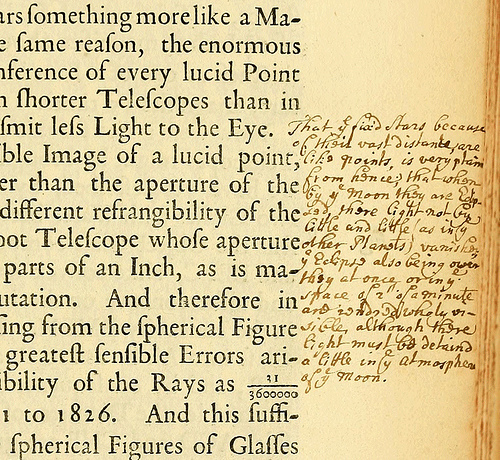
Sir Isaac Newton's marginalia

Marginalia, or the practice of writing in books, has a rich literary tradition. Samuel Taylor Coleridge’s friends lent their books to him on purpose hoping that he would write along their margins. Chances were that he did, for he was a prolific margin writer. Mark Twain often made comments, giving his opinions or hotly debating with the book’s author.  Other practitioners of margin writing were William Blake, Charles Darwin, and Thomas Jefferson. Even Jane Austen joined this select group, scribbling in her copy of Oliver Goldsmith’s book about her favorite poet, William Cowper (pronounced Cooper.)

Mark Twain's annotation of his publication of Huckleberry Fin. Image @New York Times

In Persuasions Online, Jane Austen scholar Edith Lank writes about her copy of the two-volume Lord Barbourne edition of Jane Austen’s letters, which she found at a sale. This books is filled with

detailed genealogies, marginal comments, explanations and family gossip…The first were Fanny Caroline Lefroy and her sister Mrs. Louisa Lefroy Bellas, both daughters of Jane Austen’s neice (sic) Anna Austen Lefroy. The sisters annotated the book in careful nineteenth-century script and printing.” - List of Annotations in the Bellas Copy of Lord Brabourne’s Letters of Jane Austen

Thomas Jefferson’s scribblings were as elegant and refined as his mind. He sold his book collection to the Library of Congress in 1815, and kept a personal collection of books that he built upon until his death. Those books revealed that he often corrected typographical errors.

Thomas Jefferson's neat handwriting in Greek on a note inside his book.

Marginal scribblings provided a window into the minds of its writers, for they offered an insight into what they thought and revealed personal aspects of their characters. My scribblings in college texts were boring, for they merely summarized the most important points I needed to recall. I rarely left a personal thought in the margins or wrote inside my own books, although I dog eared favorite passages or left scraps of paper between pages that I wanted to reread.

Wild scribblings

The author of an article in the New York Times feared that the advent of eBooks would end the art of marginalia, but the following passage partially assuages that fear. I say partially because part of the charm of marginalia is to see the author’s hand and his/her choice of writing implement, which is something Kindle does not yet offer (who knows what the future will hold?):

Annotations in a Kindle

When I received a Kindle as a gift earlier this year, my habits of marginalia soared to new heights. It became extremely easy to highlight passages and add notes, which are then situated in the text I’m reading but also pulled together into my Kindle account on Amazon where I can, for instance, share them with students in a course, fellow members of a book discussion group, family, and friends…even, in theory, with enemies. I’ll rebut and rebuke them with my rapier marginalia. It’s even possible to add a marginal note on a Kindle and then tweet it.-The margins of Marginalia; Books From Thomas Jefferson’s Personal Library Rediscovered

Do you write inside books? What’s your opinion about about this literary tradition? And do you think Kindle will rekindle it?

More on the Topic

  • Thomas Jefferson 
  • JASNA marginalia: List of Annotations in the Bellas copy of Lord Brabourne’s Letters of Jane Austen 
  • Isaac Newton’s marginalia 
  • Book Lovers Fear Dim Future for Notes in the Margin: New York Times
  • Trove of Thomas Jefferson Books Discovered 
  • Poem about Marginalia
  • Marginalia: Edgar Allen Poe
About these ads

Share with others:

Like this:

Like Loading...

Posted in jane austen, Jane Austen's World, Popular culture | Tagged Marginalia, Mark Twain, Thomas Jefferson | 23 Comments

23 Responses

  1. on July 29, 2011 at 09:47 Adam Stevenson

    I buy a lot of second hand books and I feel the art of marginalia ended a long time ago.

    I have read a lot of Blake’s marginalia, and his thoughts and inspirations on what he is reading is frequently more interesting than the thing he is reading itself, but the marginalia I most commonly find in books now are by students studying. This marginalia largely consists of summarising or repeating the plain and obvious point the text is making – not providing anything extra to the text.

    Worst still is when you read the marginalia and feel that the reader has so blatantly misunderstood what they were reading. So very frustrating.


  2. on July 29, 2011 at 11:29 Eileen Landau

    I wrote all over my college texts in colored pens. It helped me remember important points. Nothing worth saving…but I did pass my tests.

    Today, in my fiction reading I rarely make any kind of notations, although I would really love to correct the mistakes that I find. Sigh!

    Would they have written in pencil? That would seem to be easier than to dip a quill in ink. So, I’m guessing that they’d read at a table or desk mostly.

    Fascinating that the Kindle will permit margin writing…so in the future will we be buying used Kindles at auction in hopes of discovering an author’s thoughts?


  3. on July 29, 2011 at 12:03 Gayle Mills

    What a fascinating article. I had never thought of my marginal (literally) ramblings as following in the tradition of Thomas Jefferson and Jane Austen. And I had no idea that you could actually make notes in a kindle edition. See, I’m not too old yet to learn. That in itself is a cheerful thought. In practice, I am more likely to write in my Bible. I’ve filled up three already. I have my mother’s Bible and treasure the notes that she had made in the margins.

    Thanks for a thought-provoking article and for introducing a new word to my vocabulary — marginalia. I suppose that using WORD’s review function is the 21st century marginalia. I use that all that time, especially when I beta JAFF.

    Gayle


  4. on July 29, 2011 at 12:08 Q

    Hmm . . . marginalia seems an art form for the day when people collected books, not just bought, read, and got rid of them. I love finding notes in the margins of old books, it’s like finding a wormhole to a different time. Such a gift!


  5. on July 29, 2011 at 14:01 mefoley

    I once got a copy of “The Village in the Jungle”, a novel by Leonard Woolf (husband of, etc.) from the London Library, and was reading along when I turned the page and the text didn’t make sense. I flipped back and forth but there was just a gap in the text. And someone had lightly pencilled in the margin: “A line is missing here. In a better book, that would be a pity.”

    Ouch!

    Nice post!


  6. on July 29, 2011 at 18:17 Karen Field

    I, too, write in my Bible the things that I’ve learned either by my own study or notes from a sermon or Bible study. I don’t tend to write in my Jane Austen books because I’m still a bit in awe of them. However, I have read 2 of the annotated versions of her novels where there are footnotes galore and I have so appreciated them. I’m reading her letters now for the first time. I had already decided that the next time I read through them I will mark familiar passages and perhaps make list of the important events in her life included in them. I do write notes and date them in my devotional books that I use so in future when I reread them I can see how far I’ve come in whatever I was thinking that long ago day.


  7. on July 29, 2011 at 18:47 Birdsong

    I spent four years working as the school librarian for one of our local schools, about 20 years ago, and find it very difficult to even highlight text in a book. Such a strict tradition of not marking in books has been passed down through generations of librarians that I probably can’t undo this conditioning. Thanks for such an informative post!


  8. on July 29, 2011 at 19:37 Grace Elliot

    I wonder where they stood on ‘dog-ears’ ?
    Grace x


  9. on July 29, 2011 at 20:33 LaurenG

    It’s odd because I love old books, and enjoy reading someone else’s margin notes. However, I cannot make such notes myself, especially in hardbacks. Even highlighting in paperback study material is hard for me; I usually make my notes in a journal. Excellent article!


  10. on July 29, 2011 at 22:35 Adriana Sales Zardini

    Nice post Vic! I use to write in my books too! :)


    • on July 29, 2011 at 23:04 Vic

      I’ve stopped, Adriana, but I do dog ear favorite pages. Which is more worthwhile? Writing in the margins, or marring a page by downturning a corner without annotation. I am thinking about writing in the margins again.


  11. on July 29, 2011 at 23:39 Adriana Sales Zardini

    Oh.. don’t do dog ear in my favorite books, but… I use post it… it’s a mess! :)
    I see you’re using kingle… so… it’s difficult to return to our old addictions, isn’t it? I feel sorry about my books, but it’s something I use to do since I was teenager… :)

    I use to write commnets such as: well done (to a specific character) hahaha


  12. on July 30, 2011 at 01:05 Lee

    Very interesting and it’s true that I’ve found enjoyment from random things written in old books. Nevertheless, it was ingrained in me from a very early age that to mistreat books in any way was like committing sacrilege. To this day I cringe when I see a cover or page highlighted, dog-eared, wrinkled, or the spine broken from folding it back on itself, and although I succumbed to the habit in school, I can no longer make myself write in a book. Even my name in the cover takes a lot of debating. I guess that’s one more benefit of the digital age. Writing notes damages nothing.


  13. on July 30, 2011 at 05:05 Laura

    oh, i love your blog, it’s so interesting! :) i like to find margin notes in old books but somehow i just couldn’t write them myself.. x


  14. on July 30, 2011 at 13:00 welltrainedmom

    First of all, I LOVE your blog!!!
    And as far as marginalia (never knew there was a word for it before) goes, I never read a book without a pencil (which often serves as a bookmark as well). I love making notes and writing down my thoughts as I read, and the margin (or the blank pages in the front and back of the book for more lengthy thoughts) are perfect. That way it’s always right there next to the text that inspired it.


  15. on July 30, 2011 at 15:55 Vic

    Thank you, Laura and welltrainedmom, for your compliments. I am glad that you stopped by and left your insights!


  16. on July 30, 2011 at 23:09 jennifer

    Great post, really interesting. Love the comment from mefoley!


  17. on August 1, 2011 at 17:38 Hector Hurtado

    Funny how so many commenters (would) love reading marginalia, but would not write any themselves…

    I too was raised in the sacredness of books, but more for the knowledge they contained than for the object itself. My parents were scholars, and used notes frugally. This habit shall continue with me :)

    I write marginalia to comment on a passage I loved, or to debate with the author’s stance! Also, on books that I am certain to reuse, I append the date on said notes, followed by a new dated comment at the time of rereading. This allows me to see if my opinion has changed. If indeed so, how.

    Lovely post, thank you.


  18. on August 1, 2011 at 17:42 Hector Hurtado

    Sorry, instead of frugally, I meant liberally.


    • on August 2, 2011 at 08:59 Vic

      Hector, thank you for stopping by!


  19. on August 23, 2011 at 19:06 Laurie

    Thank you for this post. I am teaching how to annotate classics for literary analysis. Seeing what famous people did will bring the lesson to life!
    Laurie


  20. on September 24, 2011 at 11:11 Mefoley

    I’m reading a whodunit from the library witten in 1929, a classic murder-in-a-country-house mystery, and in the margin next to the description of how the bedrooms open off one hallway, someone has helpfully made a little sketch plan of the house! Unexpected and fun!


  21. on September 14, 2012 at 09:55 Teacups in the Garden » Blog Archive » IEW-Windows to the World: An Introduction to Literary Analysis

    [...] of books of notable people of the past who annotated their books!  Once my kids found out that Thomas Jefferson, Sir Isaac Newton and Mark Twain wrote in their books, my kids felt they had permis… After a few tips from the author, we looked at her example of annotation with “The Gift of [...]


Comments are closed.

  • Enter your email address to subscribe to this blog and receive notifications of new posts by email.

    Join 3,078 other followers

  • Notice: Comments

    Due to SPAMMERS, I will no longer accept comments on posts that I published over 30 days ago. In some instances, I will remove links from comments as well.

    I regret having to take this action.

  • Blog Stats

    • 6,240,411 hits
  • Pin It!

    Follow Me on Pinterest
  • Downton Abbey Season 3 Articles

    untitled

    Click on banner image to see this season's schedule

    SEASON THREE ARTICLES

    ~ Review of Episode 6: Oh, how the mighty have fallen

    ~ Review of Episode 5: The Earl's Gone Off His Rocker and Book Giveaway

    ~ Beauty Lessons Learned from Downton Abbey

    ~ Review of Episode 4: Let the grieving begin '

    ~ Review of Episode 3: Not Enough Noses Out of Joint

    ~ Review of Episode 2: Being Tested Only Makes You Stronger

    ~ Say Yes to the Dress, Episode 2 Poll

    ~ Review of Episode One: The Mouse that Roared

    ~ 1920s Fashions

  • Downton Abbey Season 2 Articles

    Click on the banner to go to PBS Masterpiece Classic

    SEASON TWO ARTICLES

    ~ Watch Downton Abbey Season 2 Online

    ~ Viewers of Downton Abbey Season 2: How Did You Like the Christmas Ending?

    ~ Downton Abbey Season 2 Finale:Tonight you're mine completely

    ~ Highclere Castle Floor Plan: The Real Downton Abbey

    ~ The Flu Pandemic in Downton Abbey

    ~ Downton Abbey Season 2:Teagowns and Relaxation

    ~ Downton Abbey Season 2 Review:Coupling

    ~ Downton Abbey: Preview of Season 2

    ~ The Symbolism of the White Feathers

    ~ World War One Guide to Rats, Shell Shock, and Barbed Wire

    ~ Country houses in medical service

  • Downton Abbey Season One Posts on this blog

    Click on image to enter PBS's site.

    READ THIS BLOG'S ARTICLES ABOUT DOWNTON ABBEY:

    • ~ Watch Downton Abbey Online
    • ~ Downton Abbey: Preview of Season 2
    • ~ Entertaining visitors in an English country house, such as Downton Abbey
    • ~ Downstairs in Downton Abbey: The Servants
    • ~ Upstairs in Downton Abbey: The Three Crawley Sisters
    • ~ The Jane Austen Connection to Downton Abbey and Egypt
    • ~ Downton Abbey's Recycled Costumes
    • ~ Everything You Wanted to Know About the Entail in Downton Abbey, and More
    • ~ The Foxhunt: From Downton Abbey Back to Its Origins
    • ~ The Servants Quarters in 19th Century Country Houses Like Downton Abbey
    • ~ Would You Care for Weak Tea or Strong Tea? How the Dowager Countess of Grantham Served Tea to Her Guests
    • ~ The Duties of a Valet
  • The Obituary of Charlotte Collins by Andrew Capes

    Click on image to read the story.

  • Bookmark

    Add to DeliciousAdd to DiggAdd to FaceBookAdd to Google BookmarkAdd to MySpaceAdd to NewsvineAdd to RedditAdd to StumbleUponAdd to TechnoratiAdd to Twitter
  • Links to Jane Austen Blogs

    My links page was updated May 2013 and I have removed all the dead links. Topics include Regency fashion, historic foods, Jane Austen societies, British sites, related topics. Click on image.

  • Find Jane Austen on Google

  • Tweet
  • Jane Austen Today, My Other Blog

  • Randolph Macon Talk

    The Marriage Mart
  • This blog has no commercial purpose

    Any ads you see are placed here by Wordpress. I make no profit off my blog. I do receive books and DVDs for review.
  • Jane Austen’s Advice for Writers

    Click on image to read the article.
  • Doctors and Medical Care in the Regency Era

    Click on image.
  • Join Me on Twitter

  • Twitter Updates

    • @delightfulrepas I was appalled at the woman's decision to change her baby's diaper on a dirty floor. What's wrong with her car? #Starbucks 17 hours ago
  • Join me on Facebook

    Vic Sanborn

    Create Your Badge
  • Hello, my name is Vic and I live in Richmond, VA. I work in program and professional development at Virginia Commonwealth University, and I have adored Jane Austen almost all of my life. I am a proud lifetime member of the Jane Austen Society of America. This blog is a personal blog written and edited by me. I do not accept any form of cash advertising, sponsorship, or paid topic insertions. However, I do accept and keep books, DVDs and CDs to review.

    Contributors to this blog include: Tony Grant and Shelley DeWees.

    If you would like to share a new site, or point out an error, please email me. (Yes, I am fallible. I'll own up to my mistakes and will make the corrections with a polite smile on my face.) Write me at

    Spam protecting image courtesy: Nexodyne.com

    Thank you for visiting my blog. Your comments and suggestions are most welcome.

  • Copyright Statement

    © Vic Sanborn and Jane Austen's World, 2010. Unauthorized use and/or duplication of this material without express and written permission from this blog’s author and/or owner is strictly prohibited. Excerpts and links may be used, provided that full and clear credit is given to Vic Sanborn and Jane Austen's World with appropriate and specific direction to the original content.
  • Regency Fashion: Ladies Outerwear and Shawls

    Click on the image.
  • Colors of 19th Century Wedding Dresses

    Click on image

  • Page copy protected against web site content infringement by Copyscape
  • The Distinctions of Regency Dress: Undress, Half Dress, Full Dress and Their Meaning

    Click on the image to read the article.
  • Recent Posts

    • Streaming Jane Austen
    • Pride and Prejudice: Having a Ball at Chawton House
    • Nothing As it Seems – Jane Austen in Bath
    • The College of William and Mary, A Sir Christopher Wren Building in Williamsburg, Virginia?
    • The Bathing Dress: Fashion in the Georgian Era
  • Tags

    Bath Beau Brummell Cassandra Austen Charles Dickens Chawton House Cookery Downton Abbey Downton Abbey Season 3 Elizabeth Bennet embarking on a Course of Study Emma Emma 2009 Georgette Heyer Georgette Heyer Book Reviews Holidays jane austen Jane Austen's family Jane Austen's World jane austen blogs Jane Austen Book review Jane Austen Movies Kate Beckinsale Laurie Viera Rigler London Lori Smith Masterpiece Classic Mr. Darcy PBS Masterpiece Classic PBS Masterpiece Mystery! PBS Movie Adaptation PBS Movie Review Pride and Prejudice Prince Regent Regency Bath Regency Dandy regency dress Regency Fashion Regency food Regency London Regency Servants Regency Transportation Romola Garai SourceBooks Tony Grant Working class
  • Ad Disclaimer

    Any ads that appear on this site were placed there by WordPress. I do not make money off this blog. WordPress keeps the revenue. - Vic
  • Pages

    • AV/E-Texts
      • A Proposal To Cicely, by Georgette Heyer
    • History
    • Icons/Fansites
    • Links
    • Novels
    • Original Sources and 19th C. Texts
    • Podcasts
    • Social Customs During The Regency Era
      • English Culture, 1660-1830
    • Teacher/Student
    • Writer and Literature Resources
  • Petticoats in the Regency Era

    Click on image.
  • Jane Austen’s Writing Desk and Writing Table

    The little round writing table at Chawton.

    Click on image to read this fascinating article.

  • Top Posts

    • Social Customs During The Regency Era
    • Streaming Jane Austen
    • Pride and Prejudice: Having a Ball at Chawton House
    • Highclere Castle Floor Plan: The Real Downton Abbey
    • Pride and Prejudice Economics: Or Why a Single Man with a Fortune of £4,000 Per Year is a Desirable Husband
    • Everything You Wanted to Know About the Entail in Downton Abbey, and More
    • The Servant's Quarters in 19th Century Country Houses Like Downton Abbey
    • Downstairs in Downton Abbey: The Servants
    • Review: Downton Abbey Season 3, Final Episode, or Bloody Hell! Why did Fellowes do it again?
    • Dressing for the Netherfield Ball in Pride and Prejudice: Regency Fashion
  • Geo Visitors Map
    Add to Technorati Favorites
    Cultural Blogs - BlogCatalog Blog Directory
    Blog Flux Local - Virginia
  • cool hit counter
  • The Animal Rescue Site
  • Archives

    • May 2013
    • April 2013
    • March 2013
    • February 2013
    • January 2013
    • December 2012
    • November 2012
    • October 2012
    • September 2012
    • August 2012
    • July 2012
    • June 2012
    • May 2012
    • April 2012
    • March 2012
    • February 2012
    • January 2012
    • December 2011
    • November 2011
    • October 2011
    • September 2011
    • August 2011
    • July 2011
    • June 2011
    • May 2011
    • April 2011
    • March 2011
    • February 2011
    • January 2011
    • December 2010
    • November 2010
    • October 2010
    • September 2010
    • August 2010
    • July 2010
    • June 2010
    • May 2010
    • April 2010
    • March 2010
    • February 2010
    • January 2010
    • December 2009
    • November 2009
    • October 2009
    • September 2009
    • August 2009
    • July 2009
    • June 2009
    • May 2009
    • April 2009
    • March 2009
    • February 2009
    • January 2009
    • December 2008
    • November 2008
    • October 2008
    • September 2008
    • August 2008
    • July 2008
    • June 2008
    • May 2008
    • April 2008
    • March 2008
    • February 2008
    • January 2008
    • December 2007
    • November 2007
    • October 2007
    • September 2007
    • August 2007
    • July 2007
    • June 2007
    • May 2007
    • April 2007
    • March 2007
    • February 2007
    • January 2007
    • December 2006
    • November 2006
    • October 2006
    • September 2006
    • August 2006
  • Irresistible Attraction

    An online Regency novel in serialized form. Click here to read a new chapter of Irresistible Attraction each week, and follow the story of Amanda Sinclair and James Cavendish, the Earl of Downsley.
  • My Regency Tea Cup Review Ratings

    • Five Regency tea cups: The book is not perfect (few books are), but it was well worth its purchase and possesses many outstanding qualities that makes it stand head and shoulders above its counterparts.
    • Four Regency tea cups: This book offered many hours of pleasant reading, and I found I could not put it down.
    • Three Regency tea cups: Damned with faint praise. I put the book down often, but was intrigued enough to finish it. In this instance, the movie might be better.
    • Two Regency tea cups: This book required major changes that the author and editor should have fixed before publishing deadline.
    • One Regency tea cup: Oh dear. I do so feel for the trees that sacrificed their lives for this verbal garbage.

Blog at WordPress.com.

Theme: MistyLook by WPThemes.


Follow

Get every new post delivered to your Inbox.

Join 3,078 other followers

Powered by WordPress.com
loading Cancel
Post was not sent - check your email addresses!
Email check failed, please try again
Sorry, your blog cannot share posts by email.
%d bloggers like this:

