
The servants in Downton Abbey. Image courtesy @ITV and PBS Masterpiece.
Downton Abbey. Gosford Hall. Manor House. Regency House. Each film follows the servants and takes the viewer up and down back stairways, into kitchens and butler’s pantries, and stables and courtyards. But how were the servants’ quarters laid out, and where were they placed in relation to the public and private rooms that the family used? Each house had a different arrangement, to be sure, but patterns did exist.

A narrow corridor leads from the kitchen. Image courtesy @PBS Masterpiece.
The interior and exterior shots of Downton Abbey were filmed in Highclere Castle,but because the servant kitchens and bedrooms below-stairs no longer existed as they once were, the servant quarters for the mini-series were reconstructed in Ealing Studios in London. The cost of reconstructing these “plain” rooms was relatively affordable. Imagine if one of the elaborate public rooms had to be reconstructed. As script writer Julian Fellowes observed: “The thing about filming in these great houses is that if you were to start from scratch, you simply couldn’t build this and if you did you would have used up all your budget in one room.”

Servant stairs in Downton Abbey. Image courtesy @PBS Masterpiece
The ground plan from Eastbury Manor House is representative of a great house. It shows the servant quarters at the right near tight round servant stairs, or back stairs, that the servants used instead of the grand staircase reserved for the family and their guests. Maids were expected to work invisibly and sweep and dust when the family was asleep, or work in a room when the family was not scheduled to use it. In fact, many of the lower servants never encountered the family during their years of service.
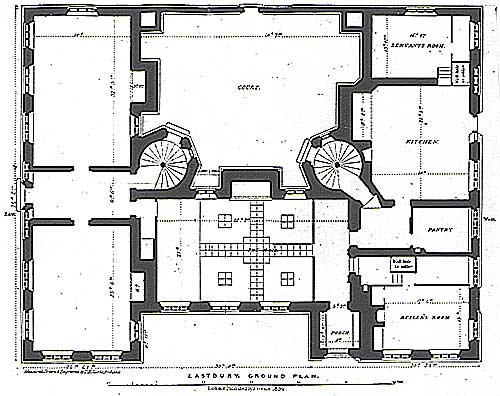
Unless they were polishing or cleaning the grand staircase, the servants would use the backstairs for all other occasions. A small housemaid’s closet would be located near the back stair on the bedroom floor to accommodate brushes, dusters, pails, and cans. In “modern” Victorian and Edwardian houses, such a closet might contain a sink that provided water for mopping. Some great houses boasted a linen-room on the bedroom floor, where clean bed linen and table linen were stored. In this instance, a dry environment was essential.

Late 19th c. maid and lad at the back entrance
Servants were expected to enter the house in their own entrance, even in smaller houses, such as townhouses. The Regency Townhouse Annex shows a typical entrance below street level. If you click on the links on the various rooms, you can see the other servant areas in this site.
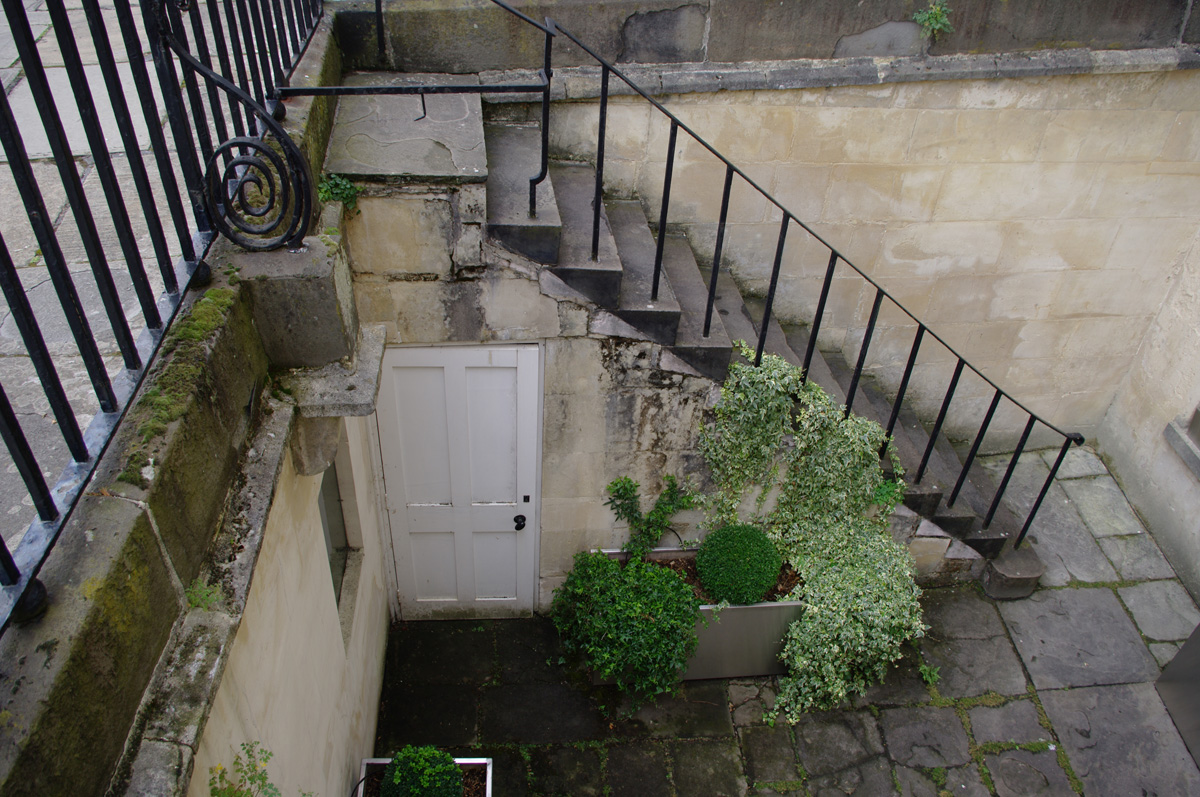
Stairs to servant’s entrance. Bath. Image @Tony Grant
In a country house, the entrance would be in the back of the building or from a courtyard, where supplies could be delivered. The philosophy of a smooth running household was that servants were out of sight and out of mind.
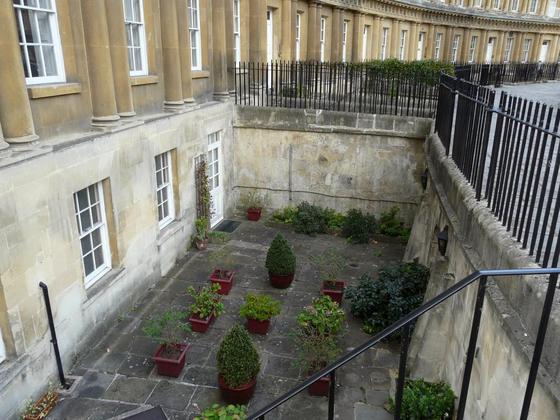
Belowstairs entrance, Bath. Image @Tony Grant
Upon entering, servants would walk along a long hallway to reach the servants’ rooms and other work areas such as the kitchen, scullery, servant’s hall, housekeeper’s room, butler’s room, storage room, etc. Country were at least two or three stories tall. Servants climbed the stairs and came down them again all day long, cleaning, hauling water, carrying meals or coal for fires, and a myriad other duties. They rose before the family, often from top floor garrets with small windows, and worked long after their employers had gone to bed.

Interior, Upstairs Downstairs web page. Notice the tiny garret bedrooms.
In this image, you can see the small garret rooms reserved for servants in the attic of a townhouse. Men’s and women’s quarters were separated, as in Downton Abbey, with the women’s quarters called the virgin’s wing. The most common servant quarters are described below.

A meal belowstairs. Downton Abbey. Notice the servant bells on the back wall. Image courtesy @PBS Masterpiece
Servant’s Hall:
The servant’s hall was a common room where the work staff congregated, ate their meals, performed small but essential tasks, like mending, darning, polishing, ect. A long table was its main feature, as well as a window that would let in enough light for the tasks that needed to be accomplished. This window is a feature in images of several servants halls, which makes me think it was essential, for many of their tasks (darning, polishing shoes, ironing, and the like) required good light.

1907 Watercolor of the windows in a servant’s hall
The servants would regard the hall as their living room, for they ate their meals there and congregated in the hall for the evening. Often the cook did not regard making the servants’ meals as part of her duty, and this task would be left to the kitchen maids. Servants would also receive the visitors’ servants here (as in Gosford Park), persons of similar rank, or their own visitors on a very rare occasion.

Image of Victorian servants eating dinner in the servants hall.
The servant bells were located in this area, as well as hooks for coats and uniforms.

Daisy puts on her coat as William speaks to her just outside the servants hall. Downton Abbey. Image courtesy @PBS masterpiece
The servants followed a hierarchy downstairs as strict as upstairs, and the upper servants, the butler, housekeeper, cook, valet and ladies maid would be served meals and tea by the lower servants. The highest ranking servant was the stewart, then came the butler and housekeeper.
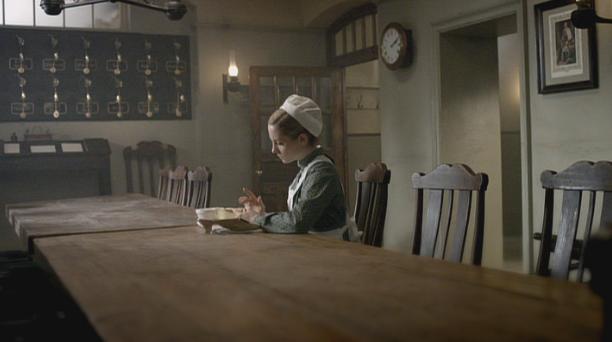
Anna completes a task in the servants hall. Downton Abbey. Image courtesy @PBS Masterpiece
The ladies maid would defer to the housekeeper and the valet to the butler. Standing low down was the scullery maid or tweeny, who often was just a young girl of twelve or thirteen. Her hours were the longest, for she would make sure that the water was boiling for the cook before she began her day.
Kitchen:

The long work table is the focal point of the kitchen. Downton Abbey. Image courtesy @PBS Masterpiece
The kitchen even in great houses were utilitarian, and positioned away from the family quarters to keep cooking smells away yet near enough for the delivery of food. Kitchens were also located near an entrance were supplies could be delivered, and near the kitchen gardens (but not always. See below.)

Harewood house and grounds. The kitchen was a 20-minute walk to the walled garden.
Kitchens tended to be oblong and dominated by a large kitchen table, where the majority of food preparation was done. The window would be ideally positioned to the left side of the range, and the kitchen dresser, where essential equipment was held, would stand close to the work table.

Kitchen suite, 1900 house.
The cook worked under the housekeeper, but the kitchen was her domain. She saw to its cleanliness and neatness, and made sure the larders were well-stocked. Not only were the floors, shelves, and work spaces scrubbed, but they had to be thoroughly dried to prevent mold and mildew from contaminating food stuffs and work tops. The arrangement of the scullery and kitchen was convenient, so that one did not need to cross the kitchen to reach the scullery. Natural light in both rooms needed to be ample.

This kitchen in the Royal Crescent in Bath needs renovation and preservation.
She (for by the end of the 19th century, most of the cooks in British households were female) oversaw the meals and kitchen staff, consisting of kitchen maids and the scullery maid.

Scullery and kitchen in the Fota House, Ireland
Scullery:
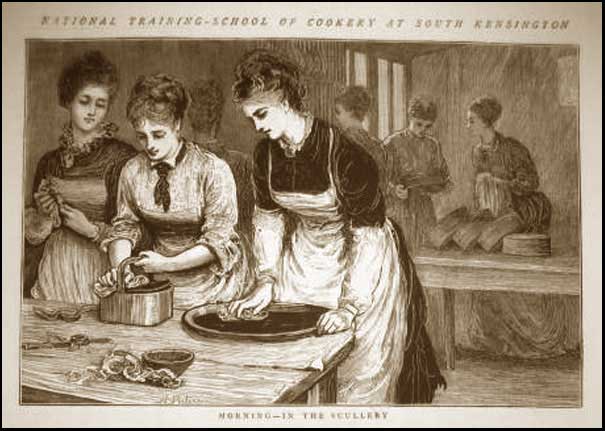
Cleaning in the scullery
The scullery was always located in a separate room from the kitchen so that food would not be contaminated by soiled water. Double stone sinks were the main feature of this room, where pots and pans and the servants’ crockery were rinsed and cleaned. The family’s fine china would be washed in a copper sink, whose softer surface prevented chipping. A cistern above the sinks was used to flush the drains, which led out of house. This was one reason that sculleries were located next to the outer walls and nearest the courtyards or an outer garden. Often, the scullery had no door into the kitchen (only a pass through), and one could enter the room only from the outside. An outside door in the scullery was also known as the “tradesmen’s entrance”.

Scullery, Image @Harewood House.
Food preparation also occurred in this area, such as chopping vegetables. Hygiene was essential in order not to contaminate existing food supplies, or the people within the house with soiled cutlery or water. This meant constant hauling of fresh water, scrubbing, washing, and cleaning. The scullery floor, made of stone, was lower than the kitchen’s, which prevented water from flowing into the cooking areas. Dry goods were stashed well away from the scullery, which also had to be kept dry in order to prevent mold. To prevent standing in water all day long, raised latticed wood mats were placed by the sink for the scullery maid to stand upon.

Panorama of a Victorian scullery with boiler and laundry features
Sculleries also contained a copper for boiling clothes on laundry day, washtubs, washboards, irons, and cabinets for cleaning supplies. In 1908, an eight-room house required 27 hours per week of labor, which did not include laundering clothes. One can only imagine how long a house the size of Downton Abbey took to manage.

Scullery sinks, Chawton
She stood at a sink behind a wooden dresser backed with choppers and stained with blood and grease, upon which were piles of coppers and saucepans that she had to scour, piles of dirty dishes she had to wash. Her frock, her cap, her face and arms were more or less wet, soiled, perspiring and her apron was a filthy piece of sacking, wet and tied round her with a cord. The den where she wrought was low, damp, ill-smelling, windowless, lighted by a flaring gas-jet……with many ugly dirty implements around her. – The History of Country House Staff

In this 17th c. image, the scullery maid stands upon a platform to keep her feet dry.
In Downton Abbey, the scullery maid is nowhere to be seen. (Daisy is the kitchen maid, with vastly different duties.) Two modern women who played the scullery maid in Manor House quit the series, unable to pursue that role for the duration of the series. Only the third person, Ellen Beard, who had a better understanding of the scullery maid’s duties of endless washing, managed to remain at her station until the very end. Click on this link to hear a short podcast of a Scottish scullery maid, who described her job as slave labor.

The butler polishes the silver, 1868.
Butler’s room and Butler’s Pantry
The duties of the butler confine him to the drawing-room and dining-room. The dining-room, however, is his particular domain; he sees that everything is in order, that the table is laid correctly, the lighting effect satisfactory, the flowers arranged, and in short that the room and appointments are in perfect readiness for a punctual meal. In this work a parlor maid assists him by sweeping and dusting, and a pantry-maid helps him by keeping everything immaculate and in readiness in the pantry. The butler serves at breakfast, luncheon and dinner.” – Vintage Maids and Butlers
Butlert’s pantry, 1896. Staatsburg House, McKim, Mead, & White

The butler’s rooms, which included the Butler’s Pantry, were located in the basement nearest the dining room upstairs and back entry, and had no connection with the kitchen, except for service. When he was summoned, even in his rooms, the butler could appear quickly. In smaller establishments, such as Matthew Crawley’s house, the butler also acted as valet. In all instances, except for the steward, he was the highest-ranking servant, answering directly to the master.

One of the duties of the butler (Mr. Carson in Downton Abbey) is to account for the wine. In this instance, he notices a discrepancy in the tally and the books. Image courtesy @PBS Masterpiece
The butler’s pantry was kept under lock and key, so that thievery was impossible at best, and at the very least deterred. A plate-closet or safe were placed there, as well as a private scullery for cleaning. The butler’s bedroom was a necessary (and lockable) adjunct in large houses for the protection of the plate.

Mrs. Hughes and Mr. Carson chat in her sitting room. Downton Abbey. Image courtesy @PBS Masterpiece
The Housekeeper’s Room
The housekeepers room in large establishments served as both a sitting- and business-room where she would take the directions of the day from the lady of the house. She would also entertain visitors of similar rank in her quarters. The housekeeper oversaw the female servants, and when she walked, a thick assortment of keys, symbols of her status and which dangled from her waist, would jiggle and certainly make a sound.

The housekeeper’s room in Uppark. At times the upper servants would congregate there for tea, and in some houses, for dinner.
Before dinner in the servants hall, the upper servants would assemble in the housekeeper’s room, also known as the Pug’s Parlour, and walk in for dinner, with the butler leading the way. This was known as the Pug’s Parade. After dinner, the upper servants would withdraw to the housekeeper’s parlor again for conversation.
Servant Bedrooms

Anna and Gwen confronted by O’Brien in their unlocked room. Downton Abbey. Image courtesy @PBS Masterpiece
In the latter half of the 19th century, servants slept in attic bedrooms. These were often cold and damp in the winter and hot in the summer, with little light coming in from small windows. Some male servants slept downstairs to guard the family silver. The furnishings in servant quarters were basic and essential. A servant might have a locked box in which personal materials were kept, but the rooms were open and subject to inspection by their employers.

The valet’s simple bedroom. Downton Abbey. Image courtesy @PBS Masterpiece
One source for servant quarters and duties of the servants cautioned that books about servant etiquette discussed ideal behavior. In reality, servant turnover was high, theft did occur, and servants did not always know their place. In this humorous Punch cartoon, the mistress arrived home unexpectedly, catching the servants eating upstairs and generally misbehaving. The truth, I suspect, is somewhere in between.

“Oh, hey, the missus! Servants eating a meal upstairs.” Cruikshank. Punch
Sources: (A long list that fleshes out the topic.)
- Downstairs in Downton Abbey: The Servants
- Archive for Servants on this blog
- The Regency Townhouse Annex
- The Scullery – Barton upon Humber
- Plantation Home Ground Floor Plan
- Harewood House: Belowstairs
- Eastbury Manor House
- Knowing Their Place: The Servants
- Servant’s Quarters
- Number One Royal Crescent
- PBS: The 1900 House: Scullery
- The Scullery
- How the Butler Did It
- Swift’s Rules for Servants 1753
- Female Servants in 18th Century England
- Waddleston Manor
- House of Dun
- Manderston
- Return to Uppark House
- The Victorian Servants of Weddington Castle
- The History of the Country House Staff






 Jane Austen's World
Wow, Vic, quite an extensive post! Interesting to read about their everyday lives and living quarters. It always makes me pause to think of how long and tedious their days must have been and they wouldn’t have had the comforts that we enjoy today to console them at day’s end.
Thanks for such a great article!
Fascinating! Thanks for the great photos and details–love it!
As always very informative and enjoyable. I think you definitely would hope for advancement in this case and I can see why the high turnover rate. I loved all the pics as well.
Really interesting. Even more interesting because we’re getting to see it in action in Downton Abbey. Can’t wait until tomorrow night’s episode.
Today’s Washington Post (01/29/11) has an interesting article on Highclere Castle, main location of Downton Abbey.
http://www.washingtonpost.com/wp-dyn/content/article/2011/01/28/AR2011012806449.html
I hope you don’t find it mean of me to correct a mistake on the word steward instead of stewart. We actually lived in the stewards house in the great Carton Desmense, Maynooth, Count Kildare. It was separate from the main house, four bedroom, and quite nice. One walked up several stairs to gain entrance. The servants lived upstairs, with lowered ceilings. They were the lucky ones considering some lived underground level, entered from the long tunnel under the main house, no outside light!
Also the tunnel served as a convienent way for the servants to run from one end of the house to the other without being seen. At one time Carton had 65 full time gardeners, untold servants! It was a wonderful time for my husband and I too live there a Year and a half. He worked as a vendor for a company that had dealings with Intel.
I don’t mind at all. This is not a word that spell check picks up. As for the underground tunnels, you are so right! In Manor House they showed the lad sleeping in the hallway on a cot. The poor guy had no privacy whatsoever.
Could u help me because I csnt find an website about victourains attic bathroom and bedroom
In addition to the 12 indoor servants pictured Downton Abbey would have needed at least as many outdoor servants – gardeners, grooms, chauffeurs, etc. No to mention the estate staff who did all the building and maintenance. The series told us very little about them and their lives.
This is well explained at Erddig, a National trust estate in No Wales; see: http://www.youtube.com/watch?v=yUk9slT2a3A and http://www.nationaltrust.org.uk/main/w-vh/w-visits/w-findaplace/w-erddig
Thank you for stopping by, Chris, and reminding us of this important fact. I explained this in another post (Dowstairs at Downtown Abbey), but it bears repeating.
In the film, one can see the hustle and bustle of the other servants – there were at least 3 other kitchen maids as well as a scullery maid that we did not get to meet. Outside, men were delivering coal, hauling coal, mending farm equipment, working in the gardens, etc. These scenes were shown, but only as background noise.
In that post, I mentioned that in 1912 Highclere Castle employed 25 maids, 14 footmen, and three chefs just to help inside the house. I had no figures for the outside staff. https://janeaustensworld.wordpress.com/2011/01/05/downstairs-in-downton-abbey-the-servants/
enjoyed your reviews and comments on this series!
Wonderful and interesting reviews. You really keep me abreast of the going ons in the lives of the “rich and famous” of the Victorian, Edwardian eras. Thanks
Vic, all your wonderfully detailed posts have added greatly to my enjoyment of Downton Abbey. I had three friends over yesterday for a Downton Abbey marathon–we started at 10 a.m. and finished at 7:00 p.m. No, it isn’t a 9-hour series–we had breaks for lunch and afternoon tea! I could have used a good scullery maid when it was all over!
What an amazing post! I’ve flagged it to share with my students…if that’s all right?
The thing I think is interesting about this is that many of the plantation homes in the Southern United States had similar systems in place for the servants who were slaves. In many homes the kitchen wasn’t necessarily downstairs, but a different out building, along with a building for doing laundry as well. Then, there was a system of stairs either built on the outside of the home that took them up back stairwells to get them to the living quarters of their masters, or that took them to the main level. It seems an interesting system wherein it was meant to be an “out of sight, out of mind” thing? It all feels very similar.
Thanks for this amazing post with all the history, information, and pictures!
Now I just need to catch up on Downtown Abbey!!!
I am really enjoying your posts and your links to more in- depth information on this period. I find myself going from link to link. I find it so interesting. Like others have said it really has made watching ‘Downton Abbey’ that much more fun to watch. I look for more things and I am more aware about different aspects of the program. I wish this wasn’t the last episode. Although I look forward to watching Upstairs/Downstairs. This is a whole new world for me. I didn’t think I would be interersted in either of these programs and now I am hooked. Thanks again for all your efforts on keeping us posted on the Regency and the Edwardian eras.
I saw the first episode only yesterday…and I just love Downton Abbey! It’s so well-made the english series like this!
This post is so full of information about Regency Period! I really thank you!
Greetings from Italy! :D
Okay so I watched Downton Abbey and now I’m curious does Carson fulfill the role of butler and steward? Or did I miss the person who plays the steward? Because it seems like Carson is the highest ranking servant at Downton. Just curious and thanks for the interesting post!
Jessica, Carson is the butler. An estate the size of Downton Abbey would have had the steward, who lived in a room by himself. Like the governess, his elevated position was such that he most likely did not eat with the servants.
This series did not choose to show the steward. I just cannot imagine that Lord Grantham managed such a vast estate without a man of business. Hope this answered your question. Vic
2 senses of ‘steward’ here:
‘1. a. An official who controls the domestic affairs of a household, supervising the service of his master’s table, directing the domestics, and regulating household expenditure; a major-domo. Obs. exc. Hist.
. . a1616 Shakespeare Twelfth Night (1623) ii. v. 151 If not, let me see thee a steward still, the fellow of servants . . ‘
and
‘ . . 5. a. One who manages the affairs of an estate on behalf of his employer.
. . 1910 C. Shorter Highways & Byways Bucks. xvi. 177 The present Manor House‥has long been given over to the Duke of Bedford’s steward.’ [OED]
Sense 1 = butler by 1900. Sense 2 = man of business = land agent. He was a professional farmer/business man and lived elsewhere on the estate.
Chris, I think we might be getting into semantics here. The butler was also know as a house steward. The man of business was the land steward. The butler was the top servant in the house and answered to the master. Since he was in charge of the books, hiring and firing of servants, and paying their salaries, he needed to be well educated. I read that the butler’s rank was considered as high as a professional, such as a lawyer.
The land steward worked with the master as well. He was generally a well-educated gentleman who was regarded as a professional employee with a status higher than the family lawyer and the house steward.
It has been my custom to say steward (meaning man of business), butler (head of the house staff), housekeeper, etc.
Vic: I think you are mistaken as to the status of the butler, but correct about his intelligence, which would have been ‘practical’, gained at the University of Life, not bookish, gained at the ‘Varsity. He would have been highly valued by his master but never thought of as a ’gent’ as the land steward was.
As to usage, the first OED citation for ’land agent’ is from 1846: ‘ . . land-agent n. a steward or manager of landed property; also, an agent for the sale of land, an estate agent.
1846 R. Cobden Speeches (1870) I. 354 We know right well that their [landlords’] land agents are their electioneering agents.’
I imagine that ‘land steward’ was still used by the ‘Old Money’ to remind everyone of the antiquity of their wealth but that ‘land agent’ was used by the Nouveaux Riches.
My uncle, the eldest son of a minor country gent, was a land agent in Warwickshire before the War; second son, my father, was put to the law; third son went off to the Colonies: a typical tale for that era.
Chris, I enjoy these debates and thank you for this one, for it has forced me to delve deeper into the topic.
Mrs. Beeton, 1861 “The number of the male domestics in a family varies according to the wealth and position of the master, from the owner of the ducal mansion, with a retinue of attendants, at the head of which is the chamberlain and house-steward.” Earlier she had said of male servants that “they are initiated step by step into the mysteries of the household, with the prospect of rising in the service, if it is a house admitting of promotion,— to the respectable position of butler or house-steward.”
Another website, more current, with no attributions, quotes the servant hierarchy in 1900 as being land steward, house steward, butler, housekeeper…. and on a similar website (that also provided no attributions) this was said:
UPPER SERVANTS
House Steward–A House Steward is employed only in larger households where the accounts are too extensive for the Housekeeper to manage. The House Steward has a sitting-room for his duties of household accounting. He may also act as a Land Steward.
Butler–The butler is the head of his department and responsible for the performance of those under him (the footmen). He has usually served his apprenticeship in domestic service, slowly working his way up the hierarchy. His responsibilities increase with the size of his establishment. … In households with only one footman, the butler assumes some of the pantry work.
Trevor May in The Victorian Domestic Servant states on p. 15, “In all establishments it is the butler’s duty to rule.”
In The Domestic Servant Class of 18th Century England, Jean Hecht makes this observation:
“Writing in 1786, Mrs. Powys describes a household that was probably not much smaller: Their establishment is very large; so numerous I style it uncomfortable–house-steward, man-cook, two gentlemen out of livery, under-butler, Mrs. Pratt’s two footmen, Mr. Pratt’s two, upper and under coachmen, two grooms, helpers, &c., &c. These are men-servants; female ones, I dare say, in proportion. 4″
I can only conclude that the size of the establishment determines the servant hierarchy and who sits on top.
Great estates would employ a steward, who sits higher than the butler (and would pay him.) In the city, there might be a house steward and butler, or house steward only, or only a butler. In smaller establishments, the butler also served as valet. And in even smaller houses, the butler’s job would indeed be hard, for he would combine the duties of butler, valet, and footman.
In addition, I found this marvelous source. I haven’t had time to look into it in detail, but it is an 1806 treatiste on The Modern Land Steward (free Google ebook.) Click on title.
The ideal type of house steward is well portrayed by Gabriel Betteredge, ‘house-steward in the service of Julia, Lady Verinder’ in The Moonstone by Wilkie Collins: http://chestofbooks.com/novel/The-Moonstone-Wilkie-Collins/index.html He was, he says at his particular request, butler as well.
I have never heard the term ‘land steward’ before reading it here. I conjecture that it was already going out of use by 1914 displaced by the modern more commercial ‘land agent’ which probably came from Ireland, where the landlords were absentee and relied on a hard-nosed local man of business to get the rents in and keep the tenants quiet.
There was a long agricultural depression from the 1880s to 1914 as cheap grain and meat flooded in from N and S America, so that attitudes hardened as estates struggled to keep rents up and get them in and to hold costs down. After 4 years of wartime prosperity prices fell again and estates were broken up and sold off on a huge scale: a whole way of life came to an abrupt end and ‘land stewards’ went extinct with its demise.
This is wonderful information. Would you possibly have any information on the servant structure in wealthy American houses in the early to mid 19th century, particularly in the north?
I recommend Mrs Woolf and the Servants by Alison Light [London : Penguin Fig Tree, 2007/ NY: Bloomsbury] to anyone interested in what it was to be ‘in service’ and to have live-in servants and how the age of service ended. The publisher writes:
‘Loathing, anger, shame – and deep affection: Virginia Woolf’s relationship with her servants was central to her life. Like thousands of her fellow Britons she relied on live-in domestics for the most intimate of daily tasks. Her cook and parlour maid relieved her of the burden of housework and without them she might never have become a writer.
But unlike many of her contemporaries Virginia Woolf was frequently tormented by her dependence on servants. Uniquely, she explored her violent, often vicious, feelings in her diaries, novels and essays. What, the reader might well wonder, was it like for the servants to live with a mistress who so hated giving her orders, and who could be generous and hostile by turns?Through the prism of the writer’s life and work, Alison Light explores the volatile, emotional territory which is the hidden history of domestic service.
Compared to most employers in Britain between the wars, Leonard and Virginia Woolf were free and easy. Life in the Bloomsbury circle of writers and artists was often fun. Yet despite being liberal in outlook, these were also households where the differences in upbringing and education were acute: employers and servants were still ‘us’ and ‘them’. The women who worked for the Woolfs, like other domestic servants, have usually been relegated to the margins of history, yet unearthing their lives reveals fascinating stories: of Sophie Farrell, the Victorian cook and ‘family treasure’, who ended her days in a London bed-sit; Lottie Hope, the parlour maid, a foundling, who’d been left on a doorstep like a parcel; and Nellie Boxall, the Woolfs’ cook, who was finally dismissed after sixteen years of rows and reconciliations, only to find herself a more glamorous job.
Mrs Woolf and the Servants is a riveting and highly original study of one of Britain’s greatest literary modernists. Ultimately, though, it is also a moving and eloquent testimony to the ways in which individual creativity always needs the support of others.’
This systme should not be as common by 1900 as earlier.
Read here
http://www.bricksandbrass.co.uk/people_of_the_period_home/domestic_staff/the_servant_as_employee.php
Female domestic workers culminated by 1871, male even earlier so the decline had been around for almost 30 years.
Please forgive my laziness and memory, but would Col. Fitzwilliam in Pride and Prejudice have been a steward of some sort to Darcy? I could never quite figure out his role in Darcy’s life.
Thanks. Great post and very interesting. I love reading the old ones and the new ones.
Mary Ellen
Thank you for this post; I’ve found it very interesting as I’m writing a family history and I was looking for information about housekeepers as my great-grandfather’s sister was a housekeeper in Gloucestershire. Congratulations!
Right listen see if u can help me could u plz help and could u tell me about the servants attic because it is homework for school and it has to be in tommorw
[…] Jak se žilo služebnictvu v panských domech […]
This is such a wonderful blog. I, too, have Downton fever, and as in GOSFORD PARK, also written by Julian Fellowes, I enjoy the ‘downstairs’ scenes and seeing authentic pantries, larders and servants’ rooms. By the way, I wrote a book on American pantries, THE PANTRY-Its HISTORY and MODERN USES [Gibbs Smith: 2007] which does discuss British pantry history somewhat (but, because I was limited to 100 pages by the publisher, including photos, I could only include so much: lots of resources, too). I now sell it exclusively from my website and for a bargain of $10 signed (plus shipping: and including full color photographs, vintage images and hardbound). For more information: http://www.InthePantry.blogspot.com ~ If you love pantries large and small, and mostly historic, you’ll like this book.
All best, Catherine Pond
I just discovered your blog today. What a treasure! I’m a big history buff, and this is my favorite period. Can’t wait to read more!
[…] you really must read this blog post about the reality of servant’s quarters in the nineteenth century, complete with floor plans and […]
So in this era, were all the communities across the world doing and experiencing the same things in terms of Trade, day to existance, living and working? How would one compare since there’s no evidence of these existence?
Since Britain deemed themself as the ‘Leader in the era’ of the world then what other types of information and cultures they came across that were more advanced than theirs and people lived normal and not servants? How did those people lived in their communities? What was the common culture for them daily?
Jacqueine, While these are good questions, this article was written from the perspective of a country house in Great Britain. Before World War One, the British Empire was regarded as the mightiest and largest empire in the world. The British at the time had no doubt that they possessed the greatest nation in the world. I doubt that many in the UK at that time would have admitted that there were other more advanced cultures than theirs.
While British royalty did intermarry with other European royalty the Royal Court at Versailles was as different from the Winter Palace in Russia as it was from Buckingham Palace in London. Each culture had its own set of rules in terms of how servants were treated and regarded.
As for the common people in Great Britain and how they lived, I do mention the working and middle classes in other posts. You can find many links to details about the middle class in the upper tab, Social Customs During the Regency Era.
What about the Christmas scene in Downton Abbey? Would the English gentry really have danced with their servants?
I really enjoyed reading the historical backgrounds from this blog.
I think that was the purpose of the servant’s ball. The Crawley family especially seemed to hold their servants in high esteem. There were upper class families, however, that would not hold such a tradition. Had Lady Mary married Sir Richard, one can be assured that he would never have contemplated holding such a dance in his house.
Where were the bedrooms for the ladies maid and valet located? Were they within the servants quarters or near where the family slept?
[…] Life of a Victorian maidservant […]
Why would the Earl give a letter to Jane, who is leaving to avoid what may become an affair, with the name of his “man of business” for her 12 year old son, who is in school? And why was she not going to take the information if he meant it for her, if the man of business runs the farm side of the estate? Did she not want to milk cows? I’m confused.