
Punctuation Personified, 1760 version of A Pretty Little Pocket Book. Image from the British Library
This post about Jane Austen’s experiences in boarding school at a young age was written by Tony Grant, who is a frequent contributor. Tony also writes for his own blog, London Calling.
In 1782 at the age of 7 Jane Austen went to school for the first time. Theories go that she wanted to go to school because her elder sister Cassandra was being sent to Mrs Cawley’s school in Oxford to accompany their cousin Jane Cooper who was being sent there. Cassandra was to go as a companion for Jane Cooper. Jane did not like to be separated from Cassandra and Mrs Austen in later years suggested that Jane was insistent that she accompany Cassandra. However this may have been defensive reasoning by Mrs Autsen because of the near disaster that befell the girls whilst in the care of Mrs Cawley. So the real reasoning for sending Jane to this school at the age of seven is obscure.
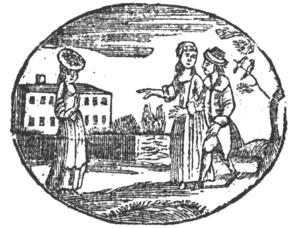
Behavior at the School, from A Pretty Little Pocketbook, 1744
Mrs Cawley moved the school to Southampton because a measles outbreak had occurred in Oxford. However in 1783 troops, returning to the port of Southampton brought an infectious disease with them and Jane, Cassandra and their cousin Jane Cooper caught it. The three of them became very ill. It was only a letter from Jane Cooper to her mother and father in Bath that alerted the Austens to the predicament. Mrs Austen and Mrs Cooper both went to Southampton to collect their daughters. Mrs Austen had to nurse Jane back to health. Mrs Cooper caught the disease and later that year,died from it.

Reading Abbey, 1783, public domain image
One wonders what sort of education the girls actually got under the direction of Mrs Cawley. Sewing and French were taught, they read a lot and I presume they were able to write letters.
The adult Jane Austen wrote scathingly of girls schools. She found it hard to see schools as anything more than places of torment.
In1784 Jane was still at home after this first experience of school. She had free run of her fathers extensive library. After a year at home with the now motherless Jane Cooper the girls were sent off to school again. This time to A Mrs La Tournelles in Reading. Madame La Tournelle, she was not French by the way and spoke no French , was really called Sarah Hackit. She used the French name to impress prospective parents. She enjoyed telling stories about actors and actresses. She involved children in drama productions. They learned spelling, needlework and did get some French from one of the other teachers. Jane might have also learned to play the piano there.
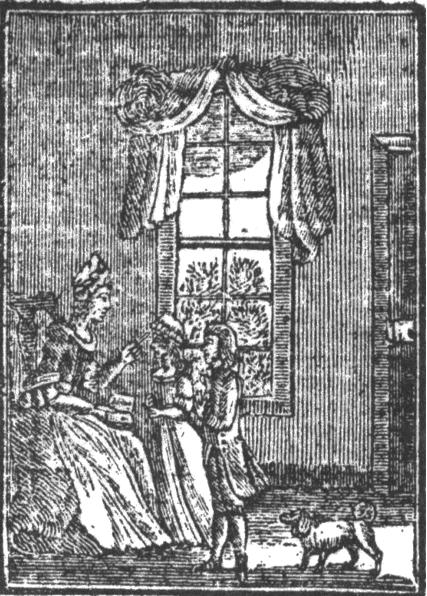
Instruction with delight, from A Pretty Little Pocketbook, 1744
In 1786 a Gloucestershire cousin of Mr Austen, the reverend Thomas Lea of Adlestrop, visited the girls while passing through Reading. Later that year The Reverend Austen removed Jane and Cassandra from the school. Maybe Thomas Lea gave a poor report of the school and Jane’s father thought he was wasting his money. Jane never had any formal education again.
From their experience of school we can gather that Jane and Cassandra had perhaps learned some social skills, had had the opportunity to read, take part in plays, learn some French and learn the piano. These were things that were all available at home anyway.

So what makes for a fantastic, brilliant, inspiring, life changing, learning experience and how did Jane Austen actually learn?
With all those intelligent older brothers Jane had some great roll models. The vitally active and mentally agile and alert Jane must have passionately absorbed and lapped up what her brothers were doing, saying and experiencing. She must have had this inner drive and force to want what they had mentally and imaginatively. Inspiration is a great motivator. An inner need and hunger for something can’t be beaten when we want to learn. Jane must have had this in spades.

Cruikshank, Alphabet book
James Austen passionately loved the theatre and plays. He organised and directed dramas in their barn at Steventon. So Jane had acting and playwriting modelled for her to copy and use as her own skill. She began to write some juvenile works.
The there was her fathers library. She had a whole range of books covering many subjests to read and peruse. Somebody with Jane’s brain and need to know and explore would have been asking questions and finding answers that created more questions and so more reading and more asking. You can imagine an explosion of questions, ideas and exploration going on in that mind of hers.
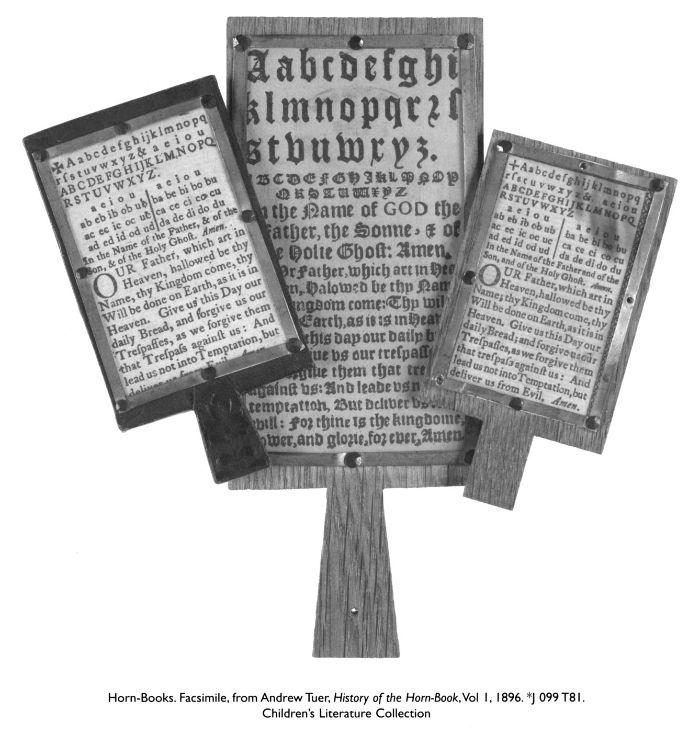
Children's horn books
From the point of view of a teacher what I aspire to do for my pupils is to make them independent, passionate learners, for life. But what gets them started? What gets that spark going? What ignites it all? I, as a teacher, have to try and provide experiences, I have to be a roll model, I have to demonstrate and model all sorts of different skills , I have to break things down into manageable learning experiences that have a progression. As an example of what I mean, here is how a might get a class to write a poem. On a fine sunny day I could take a group of children outside of the classroom to lie on the grass and look at the sky. We could talk about the clouds, the blue sky in-between, we could talk about the shapes they see, their feelings and all the while I would be coaxing them along by introducing new vocabulary, asking them, What? Why? How? What if? When? to get them to think in new ways and see and feel and think about things differently. Talking together is so important for the children. Teachers should talk less by the way.

Most of the lessons were given in a building next to the Gateway. Image from Austenized.
Then we could go back into the classroom. I would gather some vocabulary and ideas from the children and I would model the structure of a poem and maybe write a couple of lines of my own for them to see. The children now ready with words, a structure, ideas, concepts, similes and metaphors, some support materials for those who need it and with all this churning around in their heads, can write their poem.
The next time I wanted to write poem I would give them a little more independence. I would get them to tell me the process we did last time and they could use this. Those who needed my help would get more focussed support.

A little boy and girl reading, A Pretty Little Pocket Book, 1744
I can see this learning process in the story of our Jane. The way humans learn hasn’t changed, ever; it’s just that teachers through the centuries have gone against the natural process of learning. Nowadays we are far more enlightened and are actually trying to find out how our pupils can learn in the classroom and out of it. All those great learning experiences were there for Jane. Her mind was open to learning. She craved it. Children who tell me they hate school I always think is because nobody has tuned into their learning style, found out what inspires them, found out what WOWS!!! them. It’s all about close relationships really. A teacher should be able to get into the minds and feelings of their children, get under their skin.
Thank God Jane’s experiences, relationships and the world around her became her , “school,” and using the experiences and world around her, ignited her genius mind.
The idea of education in the 18th century was all about enforcing ideas and behaviours. Jane set free from that, was released into her real learning environment.
- Click here to read Austenized’s post about the Abbey School in Reading.
- A Pretty Little Pocketbook by John Newberry, 1744






 Jane Austen's World
What a thorough post, thanks for this, Tony! One does often wonder how Jane Austen will have learnt to write so beautifully and become such an informed writer (contested by herself) despite the lack of education, and you have answered this! Sometimes inspiration is all you need.
Lovely pictures, by the way! Where did you find these picture books?
You teach children, Tony? So do I. What age do you teach? I teach 7-8 year olds, 2nd graders, here in the US. I loved reading more about her schooling experience. Her father must have loved watching her soak up learning. I wonder if her mother appreciated her intelligence or took it for granted. The Austens must have been really interesting neighbors!
Well, it seems if Cruikshank’s I and J page in his alphabet book is anything to go by, social attitudes were also taught. Isaac is the stereotypical merchant, shabby, Jewish, ingratiating. John is all pink and white. Undoubtedly there is a narrative here familiar to the era, but children remember the pictures.
I think too we make the mistake of equating learning with schooling. Virginia Woolf didn’t go to school, but she was certainly learned: governess-taught, father-taught, sister and mother-taught, self-taught. Although education for genteel young ladies might have been a smattering of French, lots of needlework, a turn at water colours and enough music to be able to entertain, it also appears to have taught them social graces, something today we hardly know how to define.
Do we instinctively learn what we need to know simply to survive in whatever our lives are, school notwithstanding?
Hi Tony, thanks for writing this post! I like the pictures too!
I’m a teacher here in Brazil and I agree with you Stephanie: “I think too we make the mistake of equating learning with schooling”.
I guess people instinctively learn what we need to know! Of course, school is an important place too!
Tony,
A very very good post!
Perhaps Mrs. Austen send Jane with Cassandra to school because it will be a relief less children at home!
I know you are a teacher, then I ask same question as Karen: what age do you teach?
raquel
Yes Stephanie you are right. Schooling and learning are not necessarily the same thing. However you can’t just wander around in the world and hope to learn about history or science and maths. There has got to be inspiration,enthusiasm and structure and a focus, a certain amount of guidance and so hopefully a broad education provided.I was trying to say I thought Jane’s home life gave her that. Good schools inspire their pupils and guide their learning providing the skills they need.
Behaviour and social interaction has as much, perhaps more, to do with the home. School has it’s part to play,but, if school is fighting against the home life, it can be a losing battle.
I didn’t answer your questions about who or what I teach. I started as a secondary school teacher teaching PE(physical education) and English to 12 to 16 year olds. After a couple of years I changed to junior education and taught 7 to 11 year olds. I found junior teaching drew more on and expanded my teaching skills. You really have to know how children learn.
I also used to be in charge of the humanities curriculum leading teacher in service training in my school.
I am now retired. I do some supply teaching on a regular basis and I work freelance for a Canadian tour company and lead tours of Southern England. Mostly for Americans and Canadians.
I’ve also got a masters degree in using Museums and Galleries in Education. So if you are thinking of bringing a group of kids over here and want an educational experience for them in a museum I can do it for you.
Love the illustrations. Maybe because I write about a time when kids even got to go home from school for lunch, I find it impossible, even to this day, to imagine that sending a child off to “boarding school” wouldn’t result in lifelong trauma.
Tony, that’s a lovely idea! I guess the kids will like to learn more in a museum!
Shelley, you talked about something I can’t imagine too! I think that can a big trauma. My mother-in-law studied in a kind of “boarding school” here in Brazil, during the 50’s. As she is from a big family, the girls were sent to the catholic ‘boading schools’. There she learnt to play piano, to sing, learnt some modern languages too. When the finished high-school, she decided to be a nurse in order to help poor children. I would like to ask her if the girls, in general, had many problems and traumas.
I teach two year olds at a day care center and love watching them learn from literally everything around them,
especially outdoors. I think teaching children about poetry
while outdoors was wonderful.
We learn from the very beginning discovering through the
senses and giving children words to express themselves.
All this prepares them for their later teachers like all you wonderful peopole!
Have a great day teaching, Candace
Excellent post. I remember the scene in To Sir With Love when all those “delinquent” teenagers went to the Victoria and Albert museum. It really opened their eyes. I had the same experience when I went to the Metropolitan Museum of Fine Art in NY and saw their Egyptian exhibit (although I was not a juvenile delinquent). Thanks for the post.
Thanks for the post. I have been wondering about school in Jane Austen’s life. Amazing to see that she had so little formal school, compared to the abundance we’ve all had. And yet, she demonstrates so much knowledge (not to mention intelligence) in her novels.
[…] Jane Austen Went to School […]
[…] Austen’s Education Posted on October 5, 2010 by paperbacksnpostcards “Jane Austen Went to School” By Tony Grant, London Calling Punctuation Personified, 1760 version of A Pretty Little Pocket […]
[…] Jane Austen Went to School […]
this was not very useful for my project
Did she even go to school…im not finding much info on her school life so to me its seems as if she didnt go or she didnt go for long or her school years are not interesting
[…] Jane Austen Went to School […]