• Home
  • AV/E-Texts
  • History
  • Icons/Fansites
  • Links
  • Novels
  • Original Sources and 19th C. Texts
  • Podcasts
  • Social Customs During The Regency Era
  • Teacher/Student
  • Writer and Literature Resources

Jane Austen's World

This Jane Austen blog brings Jane Austen, her novels, and the Regency Period alive through food, dress, social customs, and other 19th C. historical details related to this topic.

Feeds:
Posts
Comments
« A Jane Austen Inspired Wedding
Georgette Heyer Month »

The Dress Maker and the Seamstress in Regency England

August 8, 2010 by Vic

Over a century ago, Douglas Jerrold asked:

Is there a more helpless, a more forlorn and unprotected, creature than, in nine cases out of ten, the Dress Maker’s Girl – the Daily Sempstress; pushed prematurely from the parental hearth, or rather no hearth, to win her miserable crust by aching fingers?

Imagine that it is the Season in London and young ladies and their mamas are ordering dresses by the dozens for balls and visits. In an age when all sewing and embroidery were done by hand, when lighting was poor and wages were so low that they barely paid for room and board, pity the poor seamstress hunched over her sewing assignments, racing against time to meet a series of deadlines that seem endless, and complying with the exacting standards of a boss and clients who cared not a whit for her comfort.

Fingers numb, backs aching, eyes straining to focus on mind numbingly repetitive work meant that burning the midnight oil was no mere phrase. For embroiderers who continued to work well past dusk, lamps were devised that amplified light. Those who sat closest to its source benefited the most. The poor women who sat in the outer circle scarcely benefited from the amplification of lacemaker lamps:

“The three legged stool (candle-block, candle-stool or pole-board are alternative names) upon which the candle and the water filled “magnifying” flasks are fitted, is placed in the middle of the room. The laceworkers then arrange themselves around the light in an orderly manner that allows each person to have at least some of the light. The best lacemakers use the highest stools and are nearest the light source. They have what is known as the “first-light” then the graded workers arrange themselves according to ability to have the “second-light” and the “third light”. Whiting tells us that in this way 18 lacemakers can be accommodated around the candle-stool.

From my own experiments with this form of lighting, I find it hard to understand how any maker who was in the third light, or even the second light come to that, could make lace from that single source of illumination!” – Brian Lemin

Mr. Jerrod’s prose is purply, like much of the writing during the Victorian era, but one gets the gist of what life must have been like for a lowly little seamstress toiling in a garret room with other seamstresses. The hours were long, and sometimes unpredictable:

Our little Dress Maker has arrived at the work room, After two or three hours she takes her bread and butter and warm adulterated water denominated tea. Breakfast hurriedly over, she works under the rigid scrutinising eye of a task mistress some four hours more, and then proceeds to the important work of dinner. A scanty slice of meat, perhaps an egg, is produced from her basket; she dines and sews again till five. Then comes again the fluid of the morning and again the needle until eight. Hark, yes, that’s eight now striking. “Thank heaven,” thinks our heroine, as she rises to put by her work, the task for the day is done.

At this moment a thundering knock is heard at the door: — The Duchess of Daffodils must have her robe by four to morrow!

Again the Dress Maker’s apprentice is made to take her place — again, she resumes her thread and needle, and perhaps the clock is “beating one”, as she again, jaded and half dead with work, creeps to her lodging, and goes to bed, still haunted with the thought that as the work “is very back”, she must be up by five to-morrow.

Pity the woman who was born to luxury who lost a father before she was comfortably married and, because of his debts or other hardship, had to work for a living. Preferred jobs included governess, chaperone, or a ladies companion, but they often led to a woman living a life of limbo. Neither servant nor family member, they spent lonely lives of servitude, fitting in nowhere. If a woman could not obtain employment in those positions, she could always turn to sewing as either an independent dressmaker or seamstress. Jane Austen’s friend, Mary Lamb, made her living as a mantua maker, sewing garments for women and men in her own home, and taking up mending. In Persuasion, Mrs. Smith knitted small souvenir objects, which Nurse Rooke sold for her.
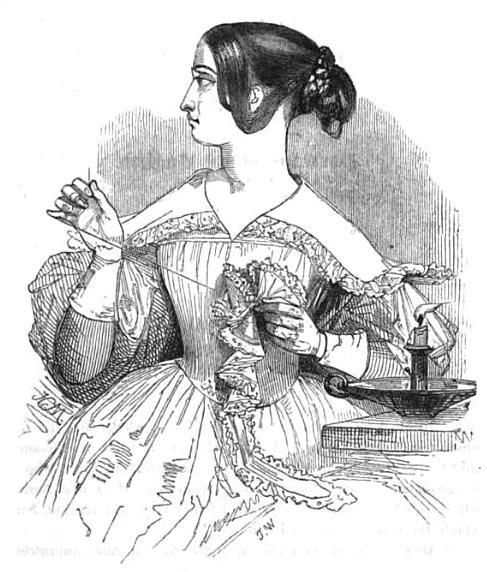
Dress maker in 1840

These women, accustomed to luxury in their earlier years, were exposed to sumptuous homes and surroundings as they visited their clients for fittings. Yet their earnings of twelve or fifteen shillings per week (1840 quote) were hardly sufficient to provide for adequate food and lodging. Independent dressmakers had to look neat and presentable, yet they could barely afford their upkeep. Her life could even turn for the worse if she never married. She would then be fated to grow old in a world that was harsh for single women.  Barely able to scrape a living together while she was young and healthy, she was fated to lose her excellent eyesight due to the strain of her work.

The Children’s Employment Commission in 1842 estimated that there were some 1000 millinery and dressmaking businesses in London (millinery is here equivalent to dressmaking; the word was not confined to hat makers until the end of the century), and Nicola Phillips estimates that 95 per cent of these were run by women. It is a common mistake to confuse one needlewoman with another, but as Kay points out, ‘the businesswoman milliner is a different creature to the jobbing sempstress’: one designed and made or had made individual garments; the other worked by the piece, either for a milliner or stitching pre-cut ready-made clothes –  (The Foundations of Female Entrepreneurship, Alison Kay, p. 48).

Dressmaker shop in 1775. Image from Regency England by Yvonne Forsling

Owning a shop was no guarantee of economic stability, for many wealthy women failed to pay their bills on time, if at all. In the 18th century, the enterprising Hannah Glasse ran a dressmaker’s shop in London with her daughter, which eventually went bankrupt. She went on to write one of the most popular cookbooks of her era, but in this venture she too lost money.

As the century progressed and with the advent of the sewing machine, life did not automatically become easier for seamstresses and dressmakers, who still worked long hours in cramped conditions, their backs bent over sewing machines in factories and piece work shops. Clothing had become more affordable. The rising middle class was purchasing more items than ever, and etiquette dictated that wealthy ladies were required to change their clothes for different functions throughout the day. Thus demand for new and fashionable clothes remained high.

Bottom image from Regency England

More reading on the topic:

  • Heads of the People, Kenny Meadows, 1840
  • The Life of a Seamstress
  • Review: The Foundations of Female Entrepreneurship. Enterprise, Home and Household in London, c.1800-1870, Alison Kaye
About these ads

Share with others:

Like this:

Like Loading...

Posted in Fashions, jane austen, Jane Austen's World, Regency Life, Regency style, Regency World | Tagged 19th Century Seamstress, Needlework and sewing, Regency Fashion, Seamstress, Sewing in the Regency era | 11 Comments

11 Responses

  1. on August 8, 2010 at 10:28 Joanna Waugh

    Fascinating stuff, Vic! Especially about the three-legged stool. I learn something from every blog you post!
    ~Jo~


  2. on August 8, 2010 at 11:13 Adriana Zardini

    Hi Vic, your posts are really inspiring!
    Actually, in these 3 weeks I am doing some needle work and cross stich too!
    Some day I will show it to you!


  3. on August 8, 2010 at 18:16 sw

    Very interesting post! I hadn’t read about the three legged stool before; that’s amazing! It makes my eyes hurt just thinking about it.

    From what I’ve read about dressmakers/mantua-makers and tailors, even those that ran their own businesses, is that there social position was rather low, that seems consistent with what you report here. The people with the real power in the fashion world were the Mercers (silk merchants, mostly men) and the marchard des modes, and off-shoot of the mercer’s guild known as milliners in England.

    Trouble is, most most of my fashion information can get into a gray area as to if it’s describing English practices, French or both.


  4. on August 9, 2010 at 12:38 Charles Bazalgette

    Very good blog, as usual, Vic. What my gggggfr charged the POW for labour (see my blogsite) in 1787 was:

    Making a frock coat: £1/11/9
    Making a waistcoat: £1/-/6
    Making a pair of breeches: £1/16/6
    Altering a coat: 5/-
    New buttoning a coat: 2/6
    Altering breeches: 1/-

    As he no doubt took a substantial chunk off the top, the people who did the work got very little.

    SW – perhaps you or someone else knows how long it took to do these jobs, so we could work out an hourly rate?

    Of course, most of the tailors here were men, so were no doubt paid much more then the women. And indeed the mercer and ‘marchand des modes’ did very nicely, as my gggggfr became a very rich from this enterprise.


  5. on August 9, 2010 at 20:18 Kristin

    Very interesting! The picture and description of the three-legged stool is fascinating.


  6. on August 10, 2010 at 11:53 Shelley

    Thanks for this. Since I write about people not very high up on the pay scale, I’m always grateful when somebody pays attention to the people in the Victorian Age who had to do more than sit around in impossible clothes.


  7. on August 10, 2010 at 14:36 Karen Field

    I am a needle worker and have been since I was about 5 years old. I have made clothes, mine and my children’s, but mostly as a pleasurable activity and saved a bit of money doing so. The idea of having to sew for others for a pittance is just galling. I’ve made a couple of things for pay and it was not fun. That 3 legged stool with the light sounds horrible. How did you get to be the best seamstress to get that prime spot of light? Thank you for letting us into this part of women’s work in the lower ranks. It sure makes me appreciate doing needlework for pleasure all the more.


  8. on October 4, 2010 at 16:20 Alison Kay

    Hi Vic,
    I was really interested to find your post, not least because you mention my book. It’s so great when my research finds its way into interesting forums like this, rather than being stuck in the pages of an academic book. Thank you! I’ve only just joined the blogosphere, so I shall be taking inspiration from your lovely blog.
    Best wishes,
    Alison
    P.S. I read Jane Austin as a teenager, over and over again. I must dust her off and get to know her again.


  9. on October 4, 2010 at 16:26 Alison Kay

    Just read that back. I meant Austen not Austin – doh!


  10. on October 1, 2011 at 16:07 The Dress Maker: From the Book of English Trades « Jane Austen's World

    [...] The Dress Maker and the Seamstress [...]


  11. on November 18, 2011 at 22:46 Regency Seamstresses « lawrenceeng275

    [...] http://janeaustensworld.wordpress.com/2010/08/08/the-dress-maker-and-the-seamstress-in-regency-engla… Share this:TwitterFacebookLike this:LikeBe the first to like this post. [...]


Comments are closed.

  • Enter your email address to subscribe to this blog and receive notifications of new posts by email.

    Join 3,072 other followers

  • Blog Stats

    • 6,231,220 hits
  • Pin It!

    Follow Me on Pinterest
  • Downton Abbey Season 3 Articles

    untitled

    Click on banner image to see this season's schedule

    SEASON THREE ARTICLES

    ~ Review of Episode 6: Oh, how the mighty have fallen

    ~ Review of Episode 5: The Earl's Gone Off His Rocker and Book Giveaway

    ~ Beauty Lessons Learned from Downton Abbey

    ~ Review of Episode 4: Let the grieving begin '

    ~ Review of Episode 3: Not Enough Noses Out of Joint

    ~ Review of Episode 2: Being Tested Only Makes You Stronger

    ~ Say Yes to the Dress, Episode 2 Poll

    ~ Review of Episode One: The Mouse that Roared

    ~ 1920s Fashions

  • Downton Abbey Season 2 Articles

    Click on the banner to go to PBS Masterpiece Classic

    SEASON TWO ARTICLES

    ~ Watch Downton Abbey Season 2 Online

    ~ Viewers of Downton Abbey Season 2: How Did You Like the Christmas Ending?

    ~ Downton Abbey Season 2 Finale:Tonight you're mine completely

    ~ Highclere Castle Floor Plan: The Real Downton Abbey

    ~ The Flu Pandemic in Downton Abbey

    ~ Downton Abbey Season 2:Teagowns and Relaxation

    ~ Downton Abbey Season 2 Review:Coupling

    ~ Downton Abbey: Preview of Season 2

    ~ The Symbolism of the White Feathers

    ~ World War One Guide to Rats, Shell Shock, and Barbed Wire

    ~ Country houses in medical service

  • Downton Abbey Season One Posts on this blog

    Click on image to enter PBS's site.

    READ THIS BLOG'S ARTICLES ABOUT DOWNTON ABBEY:

    • ~ Watch Downton Abbey Online
    • ~ Downton Abbey: Preview of Season 2
    • ~ Entertaining visitors in an English country house, such as Downton Abbey
    • ~ Downstairs in Downton Abbey: The Servants
    • ~ Upstairs in Downton Abbey: The Three Crawley Sisters
    • ~ The Jane Austen Connection to Downton Abbey and Egypt
    • ~ Downton Abbey's Recycled Costumes
    • ~ Everything You Wanted to Know About the Entail in Downton Abbey, and More
    • ~ The Foxhunt: From Downton Abbey Back to Its Origins
    • ~ The Servants Quarters in 19th Century Country Houses Like Downton Abbey
    • ~ Would You Care for Weak Tea or Strong Tea? How the Dowager Countess of Grantham Served Tea to Her Guests
    • ~ The Duties of a Valet
  • The Obituary of Charlotte Collins by Andrew Capes

    Click on image to read the story.

  • Bookmark

    Add to DeliciousAdd to DiggAdd to FaceBookAdd to Google BookmarkAdd to MySpaceAdd to NewsvineAdd to RedditAdd to StumbleUponAdd to TechnoratiAdd to Twitter
  • Links to Jane Austen Blogs

    Please note my new links page. I have moved the blog roll and links to other Jane Austen and related topic - including Regency fashion, historic foods, Jane Austen societies, British sites, related topics, and more - to the top of the blog. Click on image.
  • Find Jane Austen on Google

  • Tweet
  • Jane Austen Today, My Other Blog

  • Randolph Macon Talk

    The Marriage Mart
  • This blog has no commercial purpose

    Any ads you see are placed here by Wordpress. I make no profit off my blog. I do receive books and DVDs for review.
  • Jane Austen’s Advice for Writers

    Click on image to read the article.
  • Doctors and Medical Care in the Regency Era

    Click on image.
  • Join Me on Twitter

  • Twitter Updates

    • Pride and Prejudice: Having a Ball, a review & discussion about this BBC2 special filmed at Chawton House wp.me/p6Mf3-63L #JaneAusten 2 days ago
  • Join me on Facebook

    Vic Sanborn

    Create Your Badge
  • Hello, my name is Vic and I live in Richmond, VA. I work in program and professional development at Virginia Commonwealth University, and I have adored Jane Austen almost all of my life. I am a proud lifetime member of the Jane Austen Society of America. This blog is a personal blog written and edited by me. I do not accept any form of cash advertising, sponsorship, or paid topic insertions. However, I do accept and keep books, DVDs and CDs to review.

    Contributors to this blog include: Tony Grant and Shelley DeWees.

    If you would like to share a new site, or point out an error, please email me. (Yes, I am fallible. I'll own up to my mistakes and will make the corrections with a polite smile on my face.) Write me at

    Spam protecting image courtesy: Nexodyne.com

    Thank you for visiting my blog. Your comments and suggestions are most welcome.

  • Copyright Statement

    © Vic Sanborn and Jane Austen's World, 2010. Unauthorized use and/or duplication of this material without express and written permission from this blog’s author and/or owner is strictly prohibited. Excerpts and links may be used, provided that full and clear credit is given to Vic Sanborn and Jane Austen's World with appropriate and specific direction to the original content.
  • Regency Fashion: Ladies Outerwear and Shawls

    Click on the image.
  • Colors of 19th Century Wedding Dresses

    Click on image

  • Page copy protected against web site content infringement by Copyscape
  • The Distinctions of Regency Dress: Undress, Half Dress, Full Dress and Their Meaning

    Click on the image to read the article.
  • Recent Posts

    • Pride and Prejudice: Having a Ball at Chawton House
    • Nothing As it Seems – Jane Austen in Bath
    • The College of William and Mary, A Sir Christopher Wren Building in Williamsburg, Virginia?
    • The Bathing Dress: Fashion in the Georgian Era
    • Jane Austen First Editions: How Much is Yours Worth?
  • Tags

    Bath Beau Brummell Cassandra Austen Charles Dickens Chawton House Cookery Downton Abbey Downton Abbey Season 3 Elizabeth Bennet embarking on a Course of Study Emma Emma 2009 Georgette Heyer Georgette Heyer Book Reviews Holidays jane austen Jane Austen's family Jane Austen's World jane austen blogs Jane Austen Book review Jane Austen Movies Kate Beckinsale Laurie Viera Rigler London Lori Smith Masterpiece Classic Mr. Darcy PBS Masterpiece Classic PBS Masterpiece Mystery! PBS Movie Adaptation PBS Movie Review Pride and Prejudice Prince Regent Regency Bath Regency Dandy regency dress Regency Fashion Regency food Regency London Regency Servants Regency Transportation Romola Garai SourceBooks Tony Grant Working class
  • Ad Disclaimer

    Any ads that appear on this site were placed there by WordPress. I do not make money off this blog. WordPress keeps the revenue. - Vic
  • Pages

    • AV/E-Texts
      • A Proposal To Cicely, by Georgette Heyer
    • History
    • Icons/Fansites
    • Links
    • Novels
    • Original Sources and 19th C. Texts
    • Podcasts
    • Social Customs During The Regency Era
      • English Culture, 1660-1830
    • Teacher/Student
    • Writer and Literature Resources
  • Petticoats in the Regency Era

    Click on image.
  • Jane Austen’s Writing Desk and Writing Table

    The little round writing table at Chawton.

    Click on image to read this fascinating article.

  • Top Posts

    • Social Customs During The Regency Era
    • Highclere Castle Floor Plan: The Real Downton Abbey
    • Pride and Prejudice: Having a Ball at Chawton House
    • Pride and Prejudice Economics: Or Why a Single Man with a Fortune of £4,000 Per Year is a Desirable Husband
    • The Servant's Quarters in 19th Century Country Houses Like Downton Abbey
    • Dressing for the Netherfield Ball in Pride and Prejudice: Regency Fashion
    • Review: Downton Abbey Season 3, Final Episode, or Bloody Hell! Why did Fellowes do it again?
    • Everything You Wanted to Know About the Entail in Downton Abbey, and More
    • Social Classes in England, 1814
    • Downstairs in Downton Abbey: The Servants
  • Geo Visitors Map
    Add to Technorati Favorites
    Cultural Blogs - BlogCatalog Blog Directory
    Blog Flux Local - Virginia
  • cool hit counter
  • The Animal Rescue Site
  • Archives

    • May 2013
    • April 2013
    • March 2013
    • February 2013
    • January 2013
    • December 2012
    • November 2012
    • October 2012
    • September 2012
    • August 2012
    • July 2012
    • June 2012
    • May 2012
    • April 2012
    • March 2012
    • February 2012
    • January 2012
    • December 2011
    • November 2011
    • October 2011
    • September 2011
    • August 2011
    • July 2011
    • June 2011
    • May 2011
    • April 2011
    • March 2011
    • February 2011
    • January 2011
    • December 2010
    • November 2010
    • October 2010
    • September 2010
    • August 2010
    • July 2010
    • June 2010
    • May 2010
    • April 2010
    • March 2010
    • February 2010
    • January 2010
    • December 2009
    • November 2009
    • October 2009
    • September 2009
    • August 2009
    • July 2009
    • June 2009
    • May 2009
    • April 2009
    • March 2009
    • February 2009
    • January 2009
    • December 2008
    • November 2008
    • October 2008
    • September 2008
    • August 2008
    • July 2008
    • June 2008
    • May 2008
    • April 2008
    • March 2008
    • February 2008
    • January 2008
    • December 2007
    • November 2007
    • October 2007
    • September 2007
    • August 2007
    • July 2007
    • June 2007
    • May 2007
    • April 2007
    • March 2007
    • February 2007
    • January 2007
    • December 2006
    • November 2006
    • October 2006
    • September 2006
    • August 2006
  • Irresistible Attraction

    An online Regency novel in serialized form. Click here to read a new chapter of Irresistible Attraction each week, and follow the story of Amanda Sinclair and James Cavendish, the Earl of Downsley.
  • My Regency Tea Cup Review Ratings

    • Five Regency tea cups: The book is not perfect (few books are), but it was well worth its purchase and possesses many outstanding qualities that makes it stand head and shoulders above its counterparts.
    • Four Regency tea cups: This book offered many hours of pleasant reading, and I found I could not put it down.
    • Three Regency tea cups: Damned with faint praise. I put the book down often, but was intrigued enough to finish it. In this instance, the movie might be better.
    • Two Regency tea cups: This book required major changes that the author and editor should have fixed before publishing deadline.
    • One Regency tea cup: Oh dear. I do so feel for the trees that sacrificed their lives for this verbal garbage.

Blog at WordPress.com.

Theme: MistyLook by WPThemes.


Follow

Get every new post delivered to your Inbox.

Join 3,072 other followers

Powered by WordPress.com
loading Cancel
Post was not sent - check your email addresses!
Email check failed, please try again
Sorry, your blog cannot share posts by email.
%d bloggers like this:
