• Home
  • AV/E-Texts
  • History
  • Icons/Fansites
  • Links
  • Novels
  • Original Sources and 19th C. Texts
  • Podcasts
  • Social Customs During The Regency Era
  • Teacher/Student
  • Writer and Literature Resources

Jane Austen's World

This Jane Austen blog brings Jane Austen, her novels, and the Regency Period alive through food, dress, social customs, and other 19th C. historical details related to this topic.

Feeds:
Posts
Comments
« Of Jane Austen’s House Museum, English Country Dancing, and Austen Scholar-in-Residence at Goucher College
The 39 Steps: A Review of a PBS Masterpiece Classic Presentation »

18th & 19th Century Whitework Embroidery

February 27, 2010 by Vic

Domestic Happiness, after George Morland

We have come to associate the Regency period with fine white, high-waisted muslin dresses that were beautifully detailed and embroidered. Until quite recently in human history, a lady did not roam far from her sewing basket. She would mend, sew, and embroider whenever she had spare time. (Even the finest lady in the land could be found plying her needles.) During the day she would sit near a well lit window or even outdoors, and during the long evening hours she would sit by the fireside in a room with other family members, sharing the light from expensive candles (sometimes a single one). For entertainment, one of the men would read aloud from a book, or other family members would play musical instruments. Jane Austen was well known for her sewing skills and examples of her needlework are shown in the Jane Austen Museum in Chawton.

Diamond shaped pattern with a flower in the center

White work is a broad term, one that may be said to encompass any white-on-white needlework, that is, needlework that uses a white yarn or thread on a white ground to create a pattern. Various techniques are employed to make these patterns stand out in high relief against their monochrome background, with the result that many white work pieces have an intensely sculptural quality

All over the country, women carried their needlework with them on visits, and traded patterns among friends.

These techniques include embroidery, drawn work, pulled-fabric work, stump work, stuffed work, cording, quilting, candlewicking, and, later, weaving, both by draw loom and machine. – From Lap to Loom: The transition of Marseilles white work from hand to machine

Detail of cap with twigs and flowers on a ladder motif

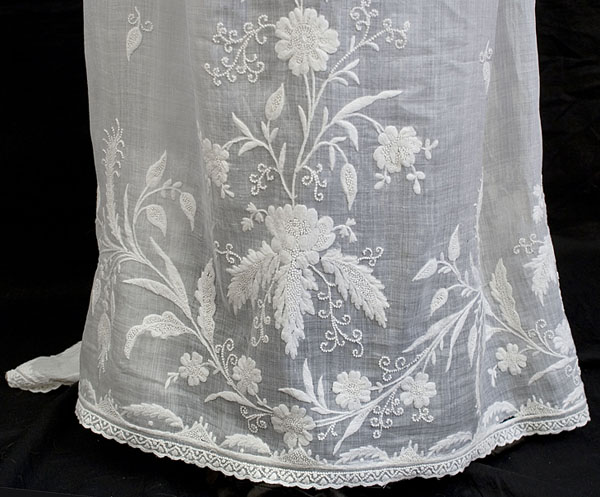
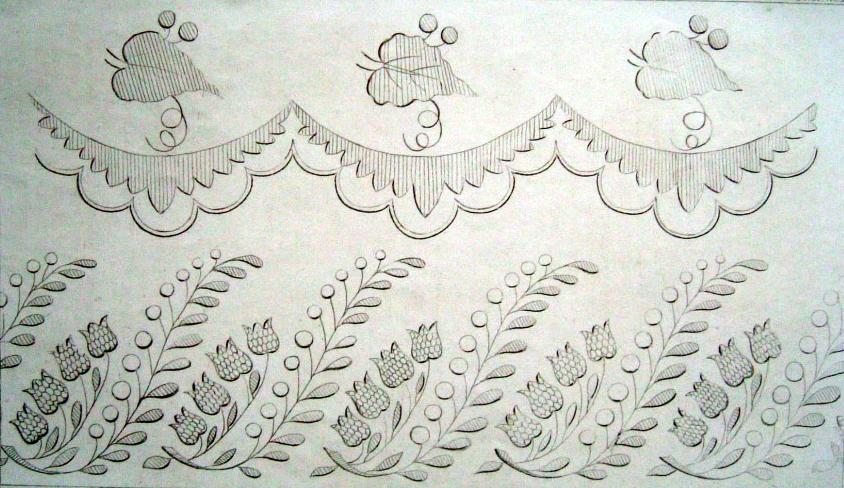
Whitework embroidery was frequently used on muslin dresses, fine lawn caps, handerkerchiefs, tablecloths, and bed linens. Patterns were featured in Ladies Periodicals, showing many different motifs, some fancier than others.
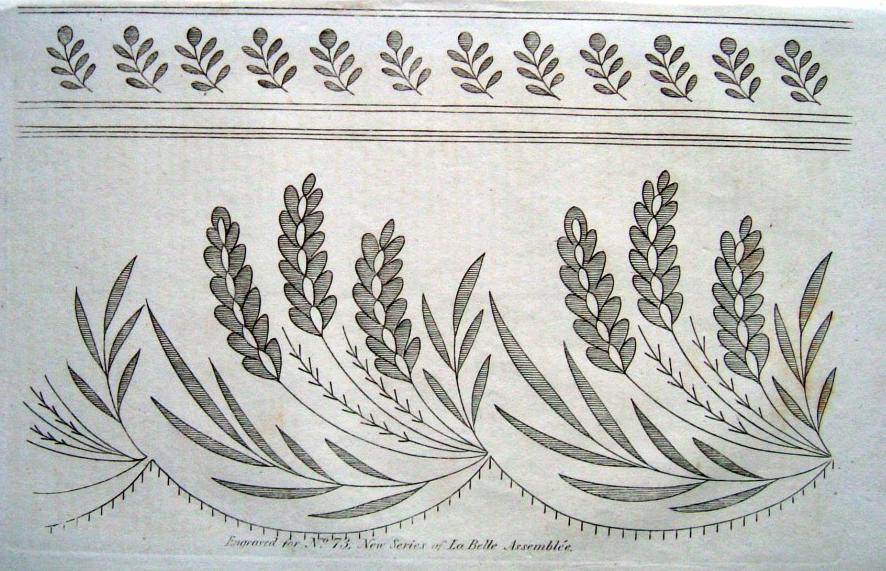
1815 La Belle Assemblee Wheat sheaf design

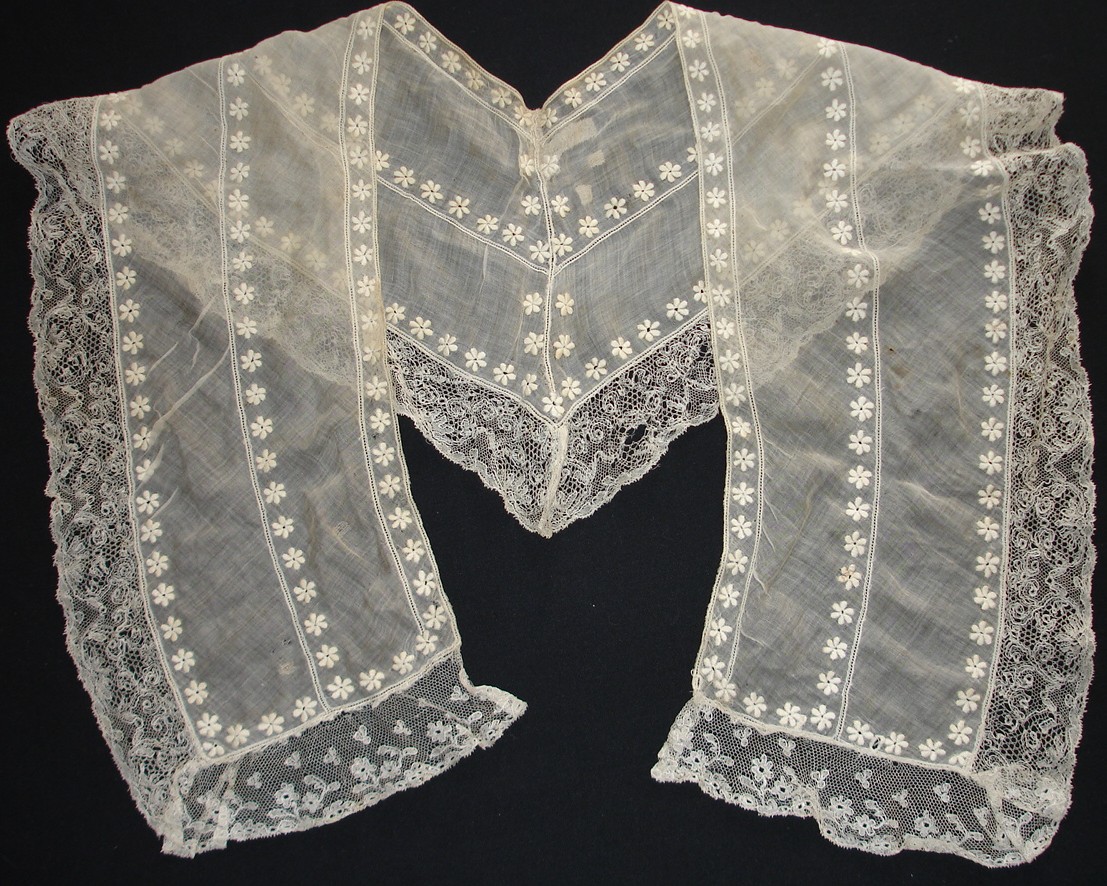
The finest whitework was done on cambric and fine muslin, or netting. This was called French embroidery, or French Hand Sewing. The most delicate threads and techniques were utilized to make gorgeous, lacy handkerchiefs, veils, bonnets, cuffs, collars and baby clothes, as well as gifts to very special friends…

1823 Ackermann embroidery pattern

Christening gowns and robes of the time were very heavily embroidered and were most treasured by their owners. Lots of different patterns and stitches were used, with lots of feather stitching all over, leading to flowers made of satin stitch, eyelets, and buttonhole stitches so tiny as to be difficult to see, and almost all with matching bonnets and slips or petticoats. French knots decorated edges.

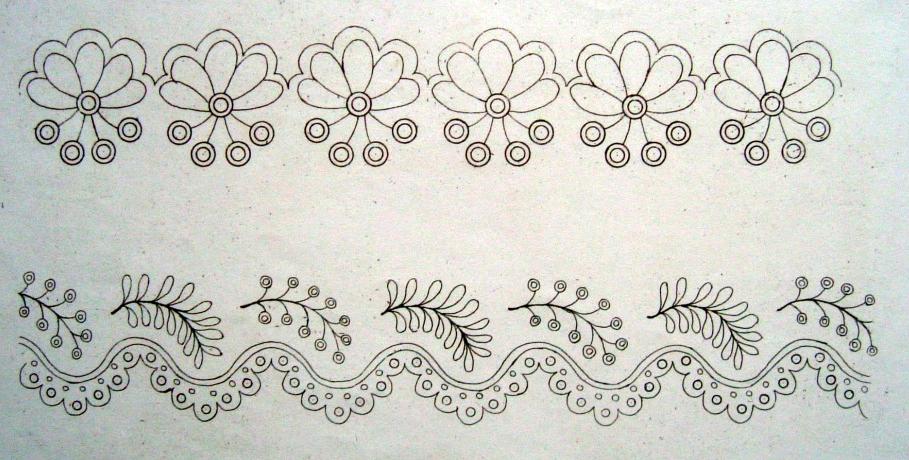
1825 Two simple muslin edging patterns

Wedding gowns, too, were embroidered with these techniques, and some of the grooms’ clothes, too, were embroidered to match! – Whitework embroidery
Embroidered collar with lace

More on the topic:

  • 19th Century Embroidery Techniques
  • 18th Century Embroidery Designs
  • Whitework techniques and 188 designs

Detail of the hem of a muslin gown. Vintage Textiles.

About these ads

Share with others:

Like this:

Like Loading...

Posted in Fashions, jane austen, Jane Austen's World, Regency Life, Regency style, Regency World, Sewing | Tagged Regency fabrics, Regency Fashion | 26 Comments

26 Responses

  1. on February 27, 2010 at 13:37 jane travers

    These examples are so beautiful! I wish I had the patience to do similar work.

    The labour of love that went into clothes in Regency times really puts us to shame with our disposable fashion mentality.


  2. on February 27, 2010 at 14:00 Charleybrown

    Thanks for the post Vic!
    I’m in awe of their attention to detail and the time spent to create such lovely needlework!


  3. on February 27, 2010 at 15:11 18th & 19th Century Whitework Embroidery « Jane Austen's World Image

    [...] more here: 18th & 19th Century Whitework Embroidery « Jane Austen's World 20th Century Steel Band: Warm Heart, Cold Steel (Mr Bongo …Unbound: Webcomics in print [...]


  4. on February 27, 2010 at 17:01 Malyss

    Practising embroidery nowadays, I can admire how difficult, and fine , this needle work is..So beautyful!


  5. on February 27, 2010 at 17:30 Melanie

    I found this just fascinating. I had never given must thought as to how all that embroidery got on the clothing. I do have a question though — How did they transfer the embroidery patterns to the fabric?

    Thanks again,
    Melanie


  6. on February 27, 2010 at 17:32 Janeen

    Beautiful examples of needlework! I hope it never becomes a lost art. GREAT POST to share!


  7. on February 27, 2010 at 21:23 Rachel

    Thanks for the post on whitework embroidery! The pictures are gorgeous!


  8. on February 27, 2010 at 22:51 Vic

    Thanks for the compliments, all. Hi Melanie. Transferring a pattern is simple. You hold the cloth up to a window or light box so that you can see the pattern through the cloth and then lightly trace it. (This works best if the cloth is affixed with tape to the surface.) You can also punch needle holes along the lines and into the paper and sprinkle a light powder over the needle holes onto a dark ground or a darker powdered substance over light cloth. I would choose the first method, and have found my large sliding doors to be invaluable in the process. First tape the pattern to the window, then the area of cloth you’d like to embroider over the pattern, trace with soft pencil (perhaps a blue one, so that the lines are faint) Repeat the process until the entire hem, or area you want to embroider has been traced. Sewers – any other suggestions?


  9. on February 28, 2010 at 09:29 Catherine Delors

    I like the picture of “domestic happiness.” Man reading, women sewing…


  10. on February 28, 2010 at 09:48 Alexa Adams

    I’m inspired to finally finish the pillow cases I began embroidering last year. I love the look of whitework – so subtle and classy! That last picture of the dress hem is unbelievably gorgeous.


  11. on February 28, 2010 at 11:17 Joanna Waugh

    Beautiful examples, Vic. Can you imagine how difficult it was to keep these articles stain-free, clean and white?
    ~Jo~


  12. on February 28, 2010 at 16:53 Annette

    I have never done white work, but I love to do black work–beside black thread, also using only red or even blue thread on white background.
    Thank you for your post, interesting info.


  13. on February 28, 2010 at 20:42 Melanie

    Vic, I should have been more clear in my comment. How would 18th Cen. ladies transfer the patterns. I can see that using a window as a “light box” would probably be used for smaller pieces. But they wouldn’t tape or blue pencils.

    And I should have said that I love your blog! I’ve been lurking here for some years now. It’s one of the places I come to when I’ve feeling down. It always takes me out of myself.
    Thanks!


    • on February 28, 2010 at 21:41 Vic

      Melanie, Thank you for your remarks. I did not want to presume to know how the Georgians transfered patterns to clothing, so I must admit I used my knowledge from art history about how painters transfered their patterns, and how I transfer my own sewing patterns..

      Painters in the Renaissance transfered their designs to walls for fresco paintings from designs on paper by puncturing holes in the paper and transferring the pattern by rubbing charcoal over the holes.

      I don’t know how long tailor’s chalk has been in existence, but by the turn of the 20th century, patterns were transferred by puncturing holes in the transfer paper and rubbing tailor’s chalk over the puncture marks. This chalk comes in three colors today: white, blue and pink. The modern seamstress can also purchase a substance called dressmaker’s carbon. The Victoria and Albert Museum says this about the technique:

      Prick and pounce is a traditional way of transferring designs on to all sorts of surfaces, for instance cartoons on to wet plaster for murals. The main lines of the design on the paper are first pierced at regular small intervals (the pricking) with a largish needle. The pricked paper is laid on to the surface to be decorated and held firmly in position. The pounce, usually a porous bag of loose charcoal powder or chalk, is dusted over the design. Some of the powder penetrates the pricked holes transferring the design on to the surface. The outline of the design can then be made permanent by either using a pencil or brush and watercolour to touch it up.


  14. on March 1, 2010 at 06:45 Cora Harrison

    Dear Vic,
    It’s almost as if you read my mind. For the last week I kept hesitating about emailing you for help and then deciding that it would be a cheek…
    ( I agree with Melanie – this is a wonderful blog.)
    I have reached the point in my sequel to ‘I Was Jane Austen’s Best Friend’ where I needed to describe a delectable wedding dress and I kept looking at Mrs Elton’s phrase in ‘Emma’ saying disdainfully: ‘very little white satin, very few lace veils..’.
    I want my heroine to have white satin and lace, paid for by her wealthy Uncle Leigh-Perrot, but did they wear the veil over their heads, or over their gowns? This is what is puzzling me.
    And what will Jane wear? In reall life, she was bridesmaid to Jenny (Jane Cooper).
    Do you know about lacemakers’ lamps? They were ordinary oil lamps with a globe filled with water for magnification purposes. I read about that when I was doing a book about the Irish Famine (thirty years after Jane’s death.
    Many thanks, again, Vic,
    Cora.


    • on March 1, 2010 at 12:22 Vic

      Cora, Again, these compliments are a boon to my soul. Thank you. Thank you for the hint about Lacemaker Lamps. Have you seen this link to lace fairy.com? What an excellent description of these lamps. http://lace.lacefairy.com/Lace/Gallery/LaceLamps.html

      Bridal Veils:

      Certain lengths of bridal veils got their names from how or where they were worn. At one time, Cathedral Veils were only worn in wedding that took place in cathedrals.

      Interestingly, veils were not always worn by brides in Regency era weddings. Look at this image of Princess Charlotte, who wore only flowers on her wedding day. http://hal.ucr.edu/~cathy/char/char1.html

      In this image (scroll down) you will see a mantilla style veil, rather short, and another illustration of a woman wearing only flowers in her hair. http://www.songsmyth.com/weddings.html

      Often the bride wore her best gown, not a special bridal gown, for her wedding. A number of colors were popular, not just white, which Queen Victoria popularized. In this image, the bride from a more ordinary family looks beautiful, but she wears neither flowers nor a veil in her hair. http://www.pemberley.com/janeinfo/krimlwdg.jpg

      Read my post about weddings in this link: http://janeaustensworld.wordpress.com/2008/11/12/regency-wedding-dresses-and-later-developments-in-bridal-fashions/

      I know I have not answered your question precisely, but it seems that you would be accurate in having Uncle Leigh-Perrot purchase machine made English lace, as opposed to handmade French lace, which was banned during the war, and to provide her with a rather modest veil, as the bride does not come from royalty. Mrs. Elton demonstrates her irrational snobbishness with that statement, for few women could afford lace veils until mass production of machine-made lace became widespread and made the material more affordable.


  15. on March 1, 2010 at 10:32 Adriana Zardini

    Nice post Vic!


  16. on March 1, 2010 at 11:36 18th & 19th Century Whitework Embroidery « Jane Austen's World | StitchArea.Com

    [...] The rest is here:  18th & 19th Century Whitework Embroidery « Jane Austen's World [...]


  17. on March 1, 2010 at 18:18 Cora Harrison

    Thank you, Vic, for a wonderful answer to my queries. I have just spent a happy hour browsing through all the leads that you have given me. It was great to see a picture of a lace-making lamp; I had read about them but not seen one pictured.
    The Hogarth portrait (early 18th century) was interesting as they all seemed to have veils there.
    My book is set in early 1790s when Jane was approaching sixteen – so not Regency.
    I think I will go for a veil for my lovely Jenny, but a very small, mantilla-type – this should be flattering and not too expensive!


  18. on March 9, 2010 at 18:27 Pam

    beautifu!!!!


    • on March 9, 2010 at 18:28 Pam

      sorry, hit enter before the L was on my beautiful!!!


  19. on June 12, 2010 at 11:21 Nancy Webber

    Delicious needlework!

    Not to mention a passion for photography!

    Love it!

    Nancy


  20. on January 24, 2011 at 20:50 tegraf

    Aziaa.com brings the world of international fashion home. The best fashion, beauty, shopping, health, travel and culture trends,


  21. on March 18, 2011 at 14:48 Shirley

    Gorgeous work. Very thin garments though, what did they wear underneath or was it always sunny in the 18th century?


  22. on April 21, 2011 at 23:54 Ali

    Aziaa.com the world wide brand in ready made women garments and wears


  23. on February 4, 2012 at 12:17 Marfochka Marina

    Very interesting!!! Thank You!


Comments are closed.

  • Enter your email address to subscribe to this blog and receive notifications of new posts by email.

    Join 3,086 other followers

  • Notice: Comments

    Due to SPAMMERS, I will no longer accept comments on posts that I published over 30 days ago. In some instances, I will remove links from comments as well.

    I regret having to take this action.

  • Blog Stats

    • 6,243,141 hits
  • Pin It!

    Follow Me on Pinterest
  • Downton Abbey Season 3 Articles

    untitled

    Click on banner image to see this season's schedule

    SEASON THREE ARTICLES

    ~ Review of Episode 6: Oh, how the mighty have fallen

    ~ Review of Episode 5: The Earl's Gone Off His Rocker and Book Giveaway

    ~ Beauty Lessons Learned from Downton Abbey

    ~ Review of Episode 4: Let the grieving begin '

    ~ Review of Episode 3: Not Enough Noses Out of Joint

    ~ Review of Episode 2: Being Tested Only Makes You Stronger

    ~ Say Yes to the Dress, Episode 2 Poll

    ~ Review of Episode One: The Mouse that Roared

    ~ 1920s Fashions

  • Downton Abbey Season 2 Articles

    Click on the banner to go to PBS Masterpiece Classic

    SEASON TWO ARTICLES

    ~ Watch Downton Abbey Season 2 Online

    ~ Viewers of Downton Abbey Season 2: How Did You Like the Christmas Ending?

    ~ Downton Abbey Season 2 Finale:Tonight you're mine completely

    ~ Highclere Castle Floor Plan: The Real Downton Abbey

    ~ The Flu Pandemic in Downton Abbey

    ~ Downton Abbey Season 2:Teagowns and Relaxation

    ~ Downton Abbey Season 2 Review:Coupling

    ~ Downton Abbey: Preview of Season 2

    ~ The Symbolism of the White Feathers

    ~ World War One Guide to Rats, Shell Shock, and Barbed Wire

    ~ Country houses in medical service

  • Downton Abbey Season One Posts on this blog

    Click on image to enter PBS's site.

    READ THIS BLOG'S ARTICLES ABOUT DOWNTON ABBEY:

    • ~ Watch Downton Abbey Online
    • ~ Downton Abbey: Preview of Season 2
    • ~ Entertaining visitors in an English country house, such as Downton Abbey
    • ~ Downstairs in Downton Abbey: The Servants
    • ~ Upstairs in Downton Abbey: The Three Crawley Sisters
    • ~ The Jane Austen Connection to Downton Abbey and Egypt
    • ~ Downton Abbey's Recycled Costumes
    • ~ Everything You Wanted to Know About the Entail in Downton Abbey, and More
    • ~ The Foxhunt: From Downton Abbey Back to Its Origins
    • ~ The Servants Quarters in 19th Century Country Houses Like Downton Abbey
    • ~ Would You Care for Weak Tea or Strong Tea? How the Dowager Countess of Grantham Served Tea to Her Guests
    • ~ The Duties of a Valet
  • The Obituary of Charlotte Collins by Andrew Capes

    Click on image to read the story.

  • Bookmark

    Add to DeliciousAdd to DiggAdd to FaceBookAdd to Google BookmarkAdd to MySpaceAdd to NewsvineAdd to RedditAdd to StumbleUponAdd to TechnoratiAdd to Twitter
  • Links to Jane Austen Blogs

    My links page was updated May 2013 and I have removed all the dead links. Topics include Regency fashion, historic foods, Jane Austen societies, British sites, related topics. Click on image.

  • Find Jane Austen on Google

  • Tweet
  • Jane Austen Today, My Other Blog

  • Randolph Macon Talk

    The Marriage Mart
  • This blog has no commercial purpose

    Any ads you see are placed here by Wordpress. I make no profit off my blog. I do receive books and DVDs for review.
  • Jane Austen’s Advice for Writers

    Click on image to read the article.
  • Doctors and Medical Care in the Regency Era

    Click on image.
  • Join Me on Twitter

  • Twitter Updates

    • @delightfulrepas I was appalled at the woman's decision to change her baby's diaper on a dirty floor. What's wrong with her car? #Starbucks 1 day ago
  • Join me on Facebook

    Vic Sanborn

    Create Your Badge
  • Hello, my name is Vic and I live in Richmond, VA. I work in program and professional development at Virginia Commonwealth University, and I have adored Jane Austen almost all of my life. I am a proud lifetime member of the Jane Austen Society of America. This blog is a personal blog written and edited by me. I do not accept any form of cash advertising, sponsorship, or paid topic insertions. However, I do accept and keep books, DVDs and CDs to review.

    Contributors to this blog include: Tony Grant and Shelley DeWees.

    If you would like to share a new site, or point out an error, please email me. (Yes, I am fallible. I'll own up to my mistakes and will make the corrections with a polite smile on my face.) Write me at

    Spam protecting image courtesy: Nexodyne.com

    Thank you for visiting my blog. Your comments and suggestions are most welcome.

  • Copyright Statement

    © Vic Sanborn and Jane Austen's World, 2010. Unauthorized use and/or duplication of this material without express and written permission from this blog’s author and/or owner is strictly prohibited. Excerpts and links may be used, provided that full and clear credit is given to Vic Sanborn and Jane Austen's World with appropriate and specific direction to the original content.
  • Regency Fashion: Ladies Outerwear and Shawls

    Click on the image.
  • Colors of 19th Century Wedding Dresses

    Click on image

  • Page copy protected against web site content infringement by Copyscape
  • The Distinctions of Regency Dress: Undress, Half Dress, Full Dress and Their Meaning

    Click on the image to read the article.
  • Recent Posts

    • Streaming Jane Austen
    • Pride and Prejudice: Having a Ball at Chawton House
    • Nothing As it Seems – Jane Austen in Bath
    • The College of William and Mary, A Sir Christopher Wren Building in Williamsburg, Virginia?
    • The Bathing Dress: Fashion in the Georgian Era
  • Tags

    Bath Beau Brummell Cassandra Austen Charles Dickens Chawton House Cookery Downton Abbey Downton Abbey Season 3 Elizabeth Bennet embarking on a Course of Study Emma Emma 2009 Georgette Heyer Georgette Heyer Book Reviews Holidays jane austen Jane Austen's family Jane Austen's World jane austen blogs Jane Austen Book review Jane Austen Movies Kate Beckinsale Laurie Viera Rigler London Lori Smith Masterpiece Classic Mr. Darcy PBS Masterpiece Classic PBS Masterpiece Mystery! PBS Movie Adaptation PBS Movie Review Pride and Prejudice Prince Regent Regency Bath Regency Dandy regency dress Regency Fashion Regency food Regency London Regency Servants Regency Transportation Romola Garai SourceBooks Tony Grant Working class
  • Ad Disclaimer

    Any ads that appear on this site were placed there by WordPress. I do not make money off this blog. WordPress keeps the revenue. - Vic
  • Pages

    • AV/E-Texts
      • A Proposal To Cicely, by Georgette Heyer
    • History
    • Icons/Fansites
    • Links
    • Novels
    • Original Sources and 19th C. Texts
    • Podcasts
    • Social Customs During The Regency Era
      • English Culture, 1660-1830
    • Teacher/Student
    • Writer and Literature Resources
  • Petticoats in the Regency Era

    Click on image.
  • Jane Austen’s Writing Desk and Writing Table

    The little round writing table at Chawton.

    Click on image to read this fascinating article.

  • Top Posts

    • Social Customs During The Regency Era
    • Highclere Castle Floor Plan: The Real Downton Abbey
    • Streaming Jane Austen
    • Pride and Prejudice: Having a Ball at Chawton House
    • Pride and Prejudice Economics: Or Why a Single Man with a Fortune of £4,000 Per Year is a Desirable Husband
    • The Servant's Quarters in 19th Century Country Houses Like Downton Abbey
    • Review: Downton Abbey Season 3, Final Episode, or Bloody Hell! Why did Fellowes do it again?
    • Downton Abbey, Season 3: 1920s Fashions
    • Everything You Wanted to Know About the Entail in Downton Abbey, and More
    • Downstairs in Downton Abbey: The Servants
  • Geo Visitors Map
    Add to Technorati Favorites
    Cultural Blogs - BlogCatalog Blog Directory
    Blog Flux Local - Virginia
  • cool hit counter
  • The Animal Rescue Site
  • Archives

    • May 2013
    • April 2013
    • March 2013
    • February 2013
    • January 2013
    • December 2012
    • November 2012
    • October 2012
    • September 2012
    • August 2012
    • July 2012
    • June 2012
    • May 2012
    • April 2012
    • March 2012
    • February 2012
    • January 2012
    • December 2011
    • November 2011
    • October 2011
    • September 2011
    • August 2011
    • July 2011
    • June 2011
    • May 2011
    • April 2011
    • March 2011
    • February 2011
    • January 2011
    • December 2010
    • November 2010
    • October 2010
    • September 2010
    • August 2010
    • July 2010
    • June 2010
    • May 2010
    • April 2010
    • March 2010
    • February 2010
    • January 2010
    • December 2009
    • November 2009
    • October 2009
    • September 2009
    • August 2009
    • July 2009
    • June 2009
    • May 2009
    • April 2009
    • March 2009
    • February 2009
    • January 2009
    • December 2008
    • November 2008
    • October 2008
    • September 2008
    • August 2008
    • July 2008
    • June 2008
    • May 2008
    • April 2008
    • March 2008
    • February 2008
    • January 2008
    • December 2007
    • November 2007
    • October 2007
    • September 2007
    • August 2007
    • July 2007
    • June 2007
    • May 2007
    • April 2007
    • March 2007
    • February 2007
    • January 2007
    • December 2006
    • November 2006
    • October 2006
    • September 2006
    • August 2006
  • Irresistible Attraction

    An online Regency novel in serialized form. Click here to read a new chapter of Irresistible Attraction each week, and follow the story of Amanda Sinclair and James Cavendish, the Earl of Downsley.
  • My Regency Tea Cup Review Ratings

    • Five Regency tea cups: The book is not perfect (few books are), but it was well worth its purchase and possesses many outstanding qualities that makes it stand head and shoulders above its counterparts.
    • Four Regency tea cups: This book offered many hours of pleasant reading, and I found I could not put it down.
    • Three Regency tea cups: Damned with faint praise. I put the book down often, but was intrigued enough to finish it. In this instance, the movie might be better.
    • Two Regency tea cups: This book required major changes that the author and editor should have fixed before publishing deadline.
    • One Regency tea cup: Oh dear. I do so feel for the trees that sacrificed their lives for this verbal garbage.

Blog at WordPress.com.

Theme: MistyLook by WPThemes.


Follow

Get every new post delivered to your Inbox.

Join 3,086 other followers

Powered by WordPress.com
loading Cancel
Post was not sent - check your email addresses!
Email check failed, please try again
Sorry, your blog cannot share posts by email.
%d bloggers like this: