Everything we now use is made [in] imitation of those models lately discovered in Italy. – Observation by an Englishman

Diana Sackville, 1777
In the late 18th century, hairstyles for women took a dramatic turn from the pouffed-up and constructed hairdos of the earlier Georgian age to the simple hair styles inspired by the Greeks, Romans, and Egyptians. Curls now framed the face and chignons replaced the complicated, almost architectural concoctions that took hairdressers hours to create. Ancient statues and works of art brought back as spoils of war or as souvenirs from grand tours revealed classical hairstyles. Women began to wear simpler hairdos with long hair pulled back in chignons or simple pony tails, long curls trailing over the shoulder, and short ringlets framing the face. Hair ornaments consisted of flower wreaths, ribbons, jewelry, tiaras, and combs.

Hairstyles on statues from antiquity
Lady Caroline Lamb (lower left) sported a saucy short bob, whose influence can be seen from the portrait in the Roman mural at the Metropolitan Museum. Madame Recamier, whose hair is longer, achieves a similar effect with ringlets around her face. Her curly hair, gathered in back, allowed the ringlets to fall. At right, the Marchioness of Queenston achieved a very similar style to Madame Recamier’s, but her bandeau sat further back on her head and the ringlets framing her face were thicker.

Longer hair, while not as prevalent as the up-do’s, usually took the form of a long curl draped over the shoulder. At second to right, Mrs. Henry Baring wore a more casual “do”, with her locks streaming around her neck and shoulders.

The long curl
Straight, simple hairstyles with few ringlets and ordinary bangs, or a style simply parted in the middle were worn, but were not drawn or painted by artists or depicted in fashion plates as often as the curlier styles.

Fashion plates of the time show how these hairstyles looked with bonnets and hair ornaments with a (l – r) walking dress, ball gown, afternoon dress, or morning dress.

The hairstyles that Kate Winslet and Emma Thompson wore in Sense and Sensibility seemed to be particularly true to the period (in my opinion). Some of you may have noticed that I use Kate Winslet’s image of Marianne as my avatar.

This image of a Roman statue (a copy of an earlier Greek statue) shows the hairstyle that would become prevalent in the later Regency/early Victorian era (1820’s to 1830’s).
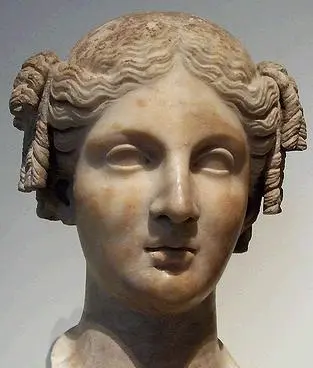
1st C. AD Roman bust
“We wore white crepe dresses trimmed with satin ribbon & the bodices & sleeves spotted with white beads. . . Thursday night, Pearl combs, necklaces, earrings, & brooches. . . Tuesday evening we had sprigged muslin. . . gold ornaments & flowers in our heads & Friday we wore yellow gauze dresses over satin, beads in our heads & pearl ornaments” – Fanny Knight Austen

Fanny Knight wrote a vivid description of how women dressed and what sort of accessories were popular when she was a young woman. The 1811 fronticepiece to The Mirror of Graces (above) shows how simple and elegant the combination of Neoclassical hair, dress, and accessories looked. Jewelry styles favored smaller, lighter forms of draped chains and classical motifs, which were reflected in hair ornaments. These days jewelry from the Georgian era is difficult to find, for many of the pieces were refitted or redesigned to reflect motifs of the neoclassical period. (Neoclassical Jewellery ). Ebay Guides can be extremely useful in researching information about this era, such as this one entitled, Georgian and Regency Combs and Hair Accessories – 1800-1814. (Click here for the PDF document.)

Georgian tiara and combs, early 19th c.
In addition to gold and silver hair ornaments, such as tiaras and diadems, young women wore silk ribbons, strands of pearls, feathers and other fancy hair ornaments in their hair, most notably for balls and formal occasions. These hair jewels were a visible sign of a family’s or husband’s wealth. Bonnets, hats, or turbans were also worn on social outings. The second image from the right (above) is of a George III silver comb, 1807. “Silver combs of this type appear to have been a speciality of Birmingham, where they were produced in a small quantity and in a collectable variety of forms.” (Cinoa)
As the Regency era progressed long hair became increasingly popular and full ringlets began to appear near the side of the face. Hair ornaments for balls included jewellery, bandeaux, turbans and wreaths of grapes and towards the latter end of the Regency era flowers, turbans and ostrich feathers were seen to adorn the hair. (Overseale House)
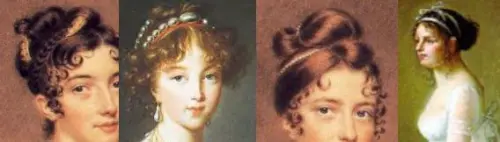
These days we achieve curls and ringlets with a hot curling iron. The use of hot irons in the 19th century was tricky, for hair could easily be singed. Back then, curls were made with pomade, a hair gel, and curling papers. The lost art of the paper curl describes how a person today can make a similar curl using old-fashioned techniques.

Perdita Weeks as Lydia Bennet in Lost in Austen
The transition from the structured hairstyles of the mid-18th Century to the Regency period was not achieved without its own set of complications, as this James Gillray cartoon shows. The cartoon was drawn in the earlier Neoclassical period, when round gowns were still worn.

A lady putting on her cap, Gillray, 1795
The fashion plate below shows how charming and uncomplicated, yet classic, the combination of the 1802 hairstyles and afternoon dresses are together, whereas the 1811 fronticepiece showed how rich both hair and fabric can be made to look using similar principles of fashion design.
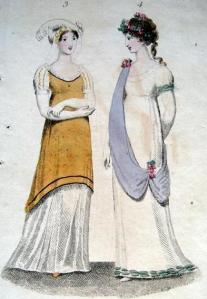
Afternoon Dress 1802 Lady's Monthly Museum
More links on this topic:
- The History of the Curl from Every Woman’s Encyclopedia offers a short discussion about hairstyles in early 1800. While the discussion is quite informative, please note that the drawings are Edwardian interpretations of Regency paintings.
- Read more: http://haircare.suite101.com/article.cfm/how_to_copy_pride_and_prejudice_hairstyles#ixzz0Vcw73tTj
- Ebay Guides can be extremely useful in researching information about a certain era, such as this one entitled, Georgian and Regency Combs and Hair Accessories – 1800-1814, Click here for the PDF document.
- Encyclopedia of hair: a cultural history by Victoria Sherrow
- Jessamyn’s Regency Costume Companion Hairstyles
- Regency Hairstyle Tutorial
- Regency hairstyles on Ups and Downs
- Vintage Styling: Regency Hair
- Barbara Anne’s Hair Comb Blog: EBay
- Her Crowning Glory: Nineteen Teen
- We Make History by Lord Scott: Series of paintings showing Regency hairstyles
- Period Hairstyles: Crowning Glory
- Victorian Hair Combs






 Jane Austen's World
I do like the idea of the whole neoclassical hair styles, I however, can never get my hair to do any of those things! Give me ribbons and combs, I swear it just falls flat in every way. Curling iron ringlets are tough to tame too.
I would be interested to hear from anyone who tests that paper curls technique.
Vic, have you experimented with any of the above styles?
[…] This post was mentioned on Twitter by Sheila Littleton and Vic , Caroline Rance. Caroline Rance said: RT @janeaustenworld Regency hairstyles and accessories on Jane Austen's World. http://bit.ly/33JWpV <– Lovely post […]
Hi Lauren, My hair is as straight as straw. I’ve tried everything, including paper curls, which show the “cricks” and bends in the paper. The technique works best if your hair is short and wet.
Only my hairdresser is able to sweep my hair in an updo that stays, using a ton of gel and hairspray. Those simple straight styles with a curl dangling in front of each ear is the best I can do on my own.
As for accessories, I have draped jeweled chains in my hair, and used combs, but I dare not use my pearls for fear of staining them with hair product.
A couple of my links show how these hairdos can be achieved. They generally sit at the bottom of the link list.
Fabulous post! I had never seen that Roman bust and the first thing I thought of was: I’ve seen this hairstyle in more Regency illustrations than Roman artwork. I’ve gone to lectures on Regency fashion but they didn’t do half as nice a job as you did with your connective images.
I must say I am quite a fan of the loose turbans and wraps (which look especially great with curls) but I can’t imagine the time it took to put them together.
Thank you, Heather. Coming from you this is a huge compliment. I have always been left feeling a bit hungry when looking up Regency hair styles, so had to create my own post. Vic
I can’t thank you enough for this post! I really appreciate it!
When I want to create an up-do on my very fine, straight hair, I find it works well to wash with baking soda and rinse with vinegar, rather than using commercial hair products. Use 1 T. baking soda in 1 c. warm water (pour on and work into scalp for several minutes before rinsing). Then rinse with 1 T. cider vinegar in 1 c. warm water, and do a final warm water rinse.
One can go completely shampoo-free using this method – it does take some time for one’s scalp to adapt to lack of stripping from commercial shampoos, but after about two weeks it “settles in”.
This method leaves the hair with more volume, and it’s less “slippery” when dry, so it can be worked with more easily in up-dos.
I also find the ornaments from France Luxe invaluable in creating a modern, yet historically-inspired, hairdo.
http://www.franceluxe.com
(If you purchase three items, they automatically throw in a freebie. No affiliation.)
Thanks again for creating this wonderfully informative post!
Stasia – thank you for the great link to France Luxe. I have been searching for a classic double headband for years. They have a beautiful selection. I wanted everything, but settled on two. Free shipping for the rest of the year. Thanks again. LA
Wonderful post! I’m a classicist (as well as a Janeite) and I love how the ideals of the Enlightenment were expressed in period fashions by imitating Greek and Roman designs. I can never tire of this subject.
Regarding paper curls – try strips of fabric instead. Use them on wet hair before going to bed and even the lankest hair will hold the ringlets (applying a bit of styling product before twisting them up never hurt either). If you have very thick hair, make sure you use a lot of curlers – if you make too few curls, the weight of your hair and the dictates of gravity will prevail by the end of the day. I learned this technique from my grandmother whose mother painstakingly twisted up her hair each night before bed in order to achieve perfect ringlets, ala Shirley Temple.
Thank you, Alexa. Those instructions are so helpful. It’s amazing, isn’t it, how quickly some skills are lost when new inventions come along?
Lurve this post about hair! Very interesting influence from all the Greek statues left behind! Great pictures too.
An other great post! From now on, I’ll look better at hair styles on classic statues..My hair is as straight as possible, I wonder how many times I would have need in those times to get such a curly hair!But the work was worth of it, all women were so pretty!
Beautiful post Vic. You have surpassed even yourself.
Try using strips of t-shirt like cotton cloth for the curls instead of paper. I used this method years ago with success even though I have straight fine hair that does not want to hold a curl no matter what.
:)
Great post. I really like learning about the day-to-day lives of people in the past. :)
Beautiful images and very interesting post! Thank you.
As did everyone else, I particularly enjoyed this post; thanks, Vic. Also, I’m throwing in my two-cents’-worth on using strips of cloth for making ringlets. I learned to do it in the ’60’s when ringlets made a brief appearance during an iron-your-hair-straight phase of hairdos, and it worked very well for all the girls in my class. I used strips of old muslin sheets for mine.
Thanks again,
Cathy Allen
Its a really a good one about hair. It is well influenced from all the Greek statues and paintings of history.
Cool article, there’s constantly things to learn. I loved reading a couple of of your articles for the last few minutes, and I guess I’m going to stay there for some time ;). In my Terminator sound : I’ll be back! ;)
I love this post! The hair accessories during this era looks very elegant, I wish I could have my own Georgian comb too.
very very great wonderful article it avery great jobs doing
I have done my hair in ringlets many times for period costumes, and YES, _anyone_ with ANY kind of hair can do this! All you have to do, is wash & dry your hair as usual. Then comb the dry hair into the four sections needed, OR just pull the front sections into a single ponytail, above the 2 back sections. Then use STRAIGHT hair setting gel and very SMALL plastic rollers, 1/2 to 3/4 inches in diameter. Wrap small sections of hair around the small rollers, one at a time. Hold them in place with bobbi pins. You can make 2 to 3 rows of curls in back, and/or several curls on each side of the face. For my long, frizzy hair, I have to set my hair like this two or three days in advance, in order to get it dry in time.
If you have to go to school, work, or any other place where you do not wish to wear rollers while it is drying, OR to make sleeping easier, simply remove the rollers, one at a time, while KEEPING the hair in the shape of the roller, and pin it to your head without the roller. It actually looks very nice this way, plus it will dry faster without the roller in. Then when you are ready to complete the hairstyle, simply remove the pins & pull gently downward on each one. DO NOT COMB THEM OUT though! Just leave them hanging loosely, and they will be bouncy & springy and will last a very long time.
I did this for my wedding, and it looked GREAT throughout our entire 5 day honeymoon. It is best, however, to wear a hairnet at night, or to pin the curls back to your head again. I have also done both of my daughter’s hair this way, and they looked TERRIFIC! The secret id to use LOTS of pure setting gel, without adding any water. You can have Marie Antoinette, Jane Austin, or Southern Belle ringlets regardless of your hair type. It does, however, help to have hair that is long enough. It not, just buy some ringlets to clip on.
Donna in ND
I’ve read that some women mixed sugar and water and put this on their hair before curling with irons for crisp curls. I’ve also read some would brush egg yoke into wet hair before rolling in papers. While I’ve never used either on my hair to set it, I find simple aloe vera gel works wonders for hold and control. Smooth a dime to quarter sized amount on damp hair, depending on how much hair you have. I also find twisting the hair as you wrap it around paper or cloth seems to help make a smoother curl without kinks and bends. I have natural african american hair and this technique work easily on my hair. If you have thin or shorter hair, pin-curls are an easy option.
My hair is long, and for normal modern times, I ~HATE~ IT, because it is naturally curley, which simply means naturally FRIZZY and grossly DISGUSTING!! But for ringlets, I will do as I have in the past, and use my modern day setting gel, straight, on dry hair, and wrap them around very small plastic rollers, about the size of a finger. The ringlets always stay very nicely for quite a while, as long as I pin them at night, into rolls without the rollers, and sleep in a hair net.
I am going to put it in the style I found on your site, where you divide the hair into four large sections, and have curls on both sides in the front, and it goes up, into the high pony tail in back, and then into a roll of some sort, or possibly more curls.
The main problem I’m havong now, is in finding a hat with a very high crown, that I can cut off & use for the crown of my bonnet. I’ve made many hats & bonnets in the past, but never with such a high crown. I am going to cover the bonnet with brown velvet, so maybe I can put two crowns together, to make one really high one…? Do you have any suggestions?
Nice to hear from you!
Bye Now,
Donna
Oh, and about the sugar & water mixture… My ex-husband used to make a really thick sugar/water syrup & then paint it onto his cowboy hat. It made it VERY stiff & hold it’s shape perfectly… That is, until it got rained on! :)
[…] Regency Hairstyles and their Accessories – by Jane Austen’s World. This blog has a compilation of fashion pictures from the era that help give you a sense of the range of hairstyles used. There is also some great information about hair accessories. […]
I like the conair soft curlers. Not the foam pink foam ones, but the ones that are foam with a wire through it covered in fabric. They’re like a high-tech paper/rag curler but the wire helps hold them in place. There are several types of setting lotions and gels you can use in conjunction with these to get a nice period-looking curl. The best way to get long lasting curls is to do a wet set and sleep on it or use a salon-style dryer to dry the hair in place. The chemical process that takes place in wet-set hair is different from that in heat-set hair and the curls last longer. Finish with a nice strong hold hair spray, and your curls should last until you wash them out!
Great post! I’ve, personally, always been intrigued by the the hairstyles portrayed on ancient Roman and Greek statues. I’ve personally never been able to replicate it but with all the great advice in the comments and in the post, I’ll be sure to give it another go soon! Thanks!
really like your effort you put in writting this blog.i like to learn about hairstyles for women in past.Its a really a good one about hair
I’ve been wondering about the hairstyles (and clothing for that matter) in the 2009 version of Emma. Harriet’s hair seems to be ahead of her time and Emma doesn’t seem to have a regular hairstyle for 1813-1816. If anything her hair looks a little like Kate Winslet’s does in S&S, but not much. Surely she had maids that would do her hair for her. I know the novel says that Emma isn’t vain about her looks, but wouldn’t she try to be fashionable? Mrs. Weston doesn’t seem to do anything with her hair. She’s married and never even wears caps! This is off the subject of hair, but I noticed that Emma and Harriet seem to wear blouses and jumpers quite abit in the 2009 mini-series. Are there any period paintings or sketches that show someone in clothing of that nature? I haven’t been able to find any at all.
really nice hairstyle article :-) I was expecting nowadays hair accessorries…
[…] internet ook genoeg afbeeldingen gevonden van kapsels in de regency tijd, zoals hier en hier. Krullen in het gezicht, het haar hoog opgestoken, versierd met linten, bloemen, juwelen, […]
[…] but in every form of creation. One only has to look at Thierry Guetta, Andy Warhol or even regency fashion, which imitated Greek and Roman styles. An abundant amount of imitative architecture from different […]
[…] years ago I wrote a post on Regency Hairstyles and their Accessories. This series of images starts much earlier than the Regency. Jane Austen, who was born in 1775, […]