• Home
  • AV/E-Texts
  • History
  • Icons/Fansites
  • Links
  • Novels
  • Original Sources and 19th C. Texts
  • Podcasts
  • Social Customs During The Regency Era
  • Teacher/Student
  • Writer and Literature Resources

Jane Austen's World

This Jane Austen blog brings Jane Austen, her novels, and the Regency Period alive through food, dress, social customs, and other 19th C. historical details related to this topic.

Feeds:
Posts
Comments
« Pride and Prejudice and Zombies: Review of a High Concept Parody
Historic Dancing Shoes and Regency Slippers »

Little Dorrit: The Father of the Marshalsea – The Prison Within the Prisoner

April 6, 2009 by Vic

Dickens recounts how when his father and he went into the prison they both wept very much and his father warned him that if a man had 20 pounds a year and spent 19 pounds, 19 shillings and sixpence, he would be happy, but that a shilling spent the other way would make him wretched. – A.S. Byat, Within Those Walls

Born in prison

Born in prison

The first surprise I encountered watching Little Dorrit on Masterpiece Classic was to see little Amy born in the Marshalsea, the debtor’s prison to which her father had been sentenced for owing £400. William Dorritt, also know as the “Father of the Marshalsea”, was incarcerated for 23 years, slowly rotting from the inside out and living a life without hope of becoming a free man again. He was allowed to bring in his family, a tradition of those bygone days. Sadly, Mrs. Dorrit died before her husband could repay his debt. Amy has never known a life other than in prison.
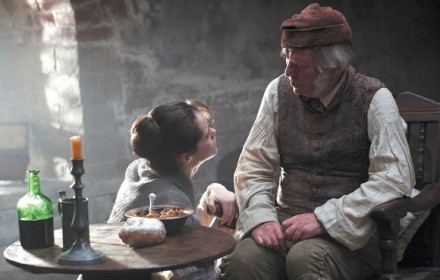
Life without hope for William Dorrit

Life without hope for William Dorrit

John Howard, a reformer, visited Marshalsea eight times between 1774 and 1783, and made the following observations:

There are in the whole near sixty rooms; and yet only six of them left for common-side debtors. Of the other rooms – five were let to a man who was not a prisoner; in one of them he kept a chandler’s shop, in two he lived with his family; the other two he let to prisoners….The chamber rent wants regulation, for in several rooms where four lie in two beds, and in some rooms where two lie in one bed, each pays 3 p 6d for his lodgings.

The prison is greatly out of repair. No infirmary. The court is well supplied with water. In it the prisoners play at rackets etc., and in a little back court, the Park, at skittles.

In March 1775 when the number of prisoners was 175, there were with them in this incommodious prison wives and children 46. – The Chronicles of London, Saint and Darley, New York, 1994, p 150.

william-dorrit

The prison had not much changed when Charles Dickens lived there, for William Dorrit’s nightmare was his own. In 1824, when Dickens was twelve, his father, John, had been taken there for debts he could not repay. Instead of going to school, Dickens left the Marshalsea each day to work at Warren’s boot-blacking factory, where he was paid six shillings a week.

The family [Dickens] writes, lived more comfortably in prison than they had done for a long time out of it, They were waited on still by the maid of all work from Bayham Street, the orphan girl from Chatham workhouse from whose sharp little worldly, yet also kindly, ways I took my first impressions of the Marchioness in The Old Curiosity Shop. Old and new London a narrative of its history, its people and its places By Walter Thornbury, Edward Walford

His father’s experience in the Marshalsea left an indelible impression. Dickens must have written these lines from the heart: “She looked down into the living grave on which the sun had risen, with her father in it.” Unlike William Dorrit, who spent nearly a quarter of a century in prison, John Dickens walked out after six months when one of his relatives died and left enough money in the will to pay off the debt.

"It was an oblong pile of barrack building, partitioned into squalid houses standing back to back, so that there were no back rooms; environed by a narrow paved yard, hemmed in by high walls duly spiked at top."

"It was an oblong pile of barrack building, partitioned into squalid houses standing back to back, so that there were no back rooms; environed by a narrow paved yard, hemmed in by high walls duly spiked at top."

Once a man of substance, William Dorrit (played by Tom Courtenay) tried to live with some dignity inside the high spiked walls, but much of his self-consequence came at the expense of his youngest daughter, Amy (Little Dorrit), who devoted her young life catering to her father.  “In his deepest heart he knows that he’s made an utter mess of his and his beloved children’s lives, but he would never openly admit to this failure. For his sake, the family all keep up the pretence of respectability.” ( BBC)  Even at his lowest ebb, William Dorrit finds comfort in the title of “Father of the Marshalsea.” He adheres to social standards, blinding himself to his son’s Edward’s dissolute lifestyle and daughter Fanny’s less than acceptable career as a dancer,  and dines in state on the food that Amy has set aside from her own repasts.

The family’s ability to come and go from prison within the curfew hours so surprised me that I wanted to research the topic. Only the debtor remained imprisoned. In reality, as Dickens attests, life inside those walls was not much worse than life outside it – for the destitute. The friendship between Amy and John Chivery was genuine. John performed his duties with humanity, and Amy recognized that the Assistant Turnkey was simply following orders.

Leaving the Marshalsea in state

Leaving the Marshalsea in state

Even when freed, William Dorrit does not step outside his prison. When he is finally released, due to an inheritance found through Arthur Clennam’s perseverance, his heart is as pinched as his confined world had once been.  Charles Dickens wrote about the character:

Crushed at first by his imprisonment, he had soon found a dull relief in it. He was under lock and key; but the lock and key that kept him in, kept numbers of his troubles out. If he had been a man with strength of purpose to face those troubles and fight them, he might have broken the net that held him, or broken his heart; but being what he was, he languidly slipped into this smooth descent, and never more took one step upward.

Instead of thanking Arthur, he avoids him and puts on airs of grandiosity. His children are given lessons of deportment by Mrs. General as they traipse across Europe on a Grand Tour. They are lessons in futility, for Fanny and Edward are beyond help, and Amy is uninterested in the trappings of wealth. And yet despite his opulent surroundings, William was unable to escape the effects of the Marshalsea and his mind remained imprisoned. He returns to London, but instead of enjoying the high life, he is constantly plagued by reminders of his past and falls into a great depression.

William Dorrit in London

William Dorrit in London

In real life, a man who was confined in the Marshalsea just like William Dorrit, reacted to his imprisonment in a much different way. John Howard recalled:

Mr. Henry Allnot, who was many years hence a prisoner here, had during his confinement a large estate bequeathed to him. He learnt sympathy by his sufferings, and left £100 a year for discharging poor debtors from hence whose debts do not exceed £4. As he bound his manor of Goring in Oxfordshire for charitable uses, this is called the Oxford charity.  Many are cleared by it every year. – The Chronicles of London, p. 150

remaining-wall-of-the-marshalsea-prison

Marshalsea Prison was closed in 1842, and all that remains today is a long brick wall and two gated arches.

In 1856 whilst engaged in the purchase of Gad’s Hill, Charles Dickens paid a visit to the Marshalsea, then in the course of demolition, to see what traces were left of the prison of which he had received such early and vivid impressions as a boy, and which he had been able to rebuild almost brick by brick in Little Dorritt by the aid of his wonderfully retentive memory. He writes to his friend John Forster, “Went to the Borough yesterday morning before going to Gad’s Hill to see if I could find any ruins of the Marshalsea. Found a great part of the original building now Marshalsea Place. I found the rooms that had been in my mind’s eye in the story…There is a room there still standing that I think of taking. It is the room through which the ever memorable signers of Captain Porter’s petition filed off in my boyhood. The spikes are gone and the wall is lowered, and any body can go out now who likes to go and is not bed ridden.”  Old and new London a narrative of its history, its people and its places By Walter Thornbury, Edward Walford

  • BBC: Little Dorrit
  • BBC Press Pack
  • Knowledge of London: The Marshalsea
  • Little Dorrit: Charles Dickens Page

My other Little Dorrit Reviews:

  • Little Dorrit and the Grand Tour
  • Little Dorrit: The Character of Flora and How She Resembles Charles Dickens’ First Love
  • Little Dorrit on PBS Masterpiece Classic
About these ads

Share with others:

Like this:

Like Loading...

Posted in Jane Austen's World, Movie review, Regency Life, Regency World | Tagged Charles Dickens, John Dickens, John Howard, Little Dorrit, Marshalsea, Marshalsea Debtor's Prison, Masterpiece Classic, PBS Masterpiece Classic, Tom Courtenay, William Dorrit | 10 Comments

10 Responses

  1. on April 6, 2009 at 22:04 Little Dorrit on PBS Masterpiece Classic « Jane Austen’s World

    [...] Little Dorrit: The Father of the Marshalsea – A Prison Within a Prison [...]


  2. on April 7, 2009 at 04:36 Little Dorrit Recap and Review Episode Two on Masterpiece Classic « Austenprose

    [...] Read about the Marshalsea Prison at Jane Austen’s World [...]


  3. on April 7, 2009 at 04:38 Little Dorrit Recap & Review of Episode Two on Masterpiece Classic « Austenprose

    [...] Read about the Marshalsea Prison at Jane Austen’s World [...]


  4. on April 7, 2009 at 09:53 Ruth

    Thank you for this excellent and informative post on Marshalsea. I really appreciated how in part two of Little Dorrit the filmmakers started to reveal the toll the long imprisonment had taken on Mr. Dorrit/Tom Courtenay. After part one I was a little frustrated with his character – but his breakdown in part two really revealed the tragedy of his situation in a heart-wrenching manner.


  5. on April 7, 2009 at 22:21 Mary

    Thank you! Your blog is wonderful reading. I’m always learning something new.


  6. on April 8, 2009 at 00:54 Vic (Jane Austen's World)

    Thank you, Ruth and Mary. I enjoy the research and it is nice to know it is appreciated.


  7. on April 12, 2009 at 12:13 Little Dorrit and The Grand Tour: PBS Masterpiece Classic « Jane Austen’s World

    [...] Little Dorrit: The Father of the Marshalsea, The Prison Within the Prisoner [...]


  8. on February 15, 2010 at 02:15 katie

    i love jane book’s she has inpired me to write novel’s


  9. on June 6, 2010 at 17:02 Sunday Illustration: Giving Alms to Prisoners in Fleet Prison « Jane Austen's World

    [...] Little Dorrit: The Father of the Marshalsea – The Prison Within the Prisoner [...]


  10. on August 10, 2010 at 04:39 Christina Marshalsea

    This is the first time I have ever looked up anything about the Marshalsea. Well, I am a “Marshalsea” !!! My ancestors contracted this prison. I don’t know much about any of this, but I will be sure to research as much as I can, and I am pleased to see that alot of people still look this stuff up!!!!


Comments are closed.

  • Enter your email address to subscribe to this blog and receive notifications of new posts by email.

    Join 3,086 other followers

  • Notice: Comments

    Due to SPAMMERS, I will no longer accept comments on posts that I published over 30 days ago. In some instances, I will remove links from comments as well.

    I regret having to take this action.

  • Blog Stats

    • 6,243,789 hits
  • Pin It!

    Follow Me on Pinterest
  • Downton Abbey Season 3 Articles

    untitled

    Click on banner image to see this season's schedule

    SEASON THREE ARTICLES

    ~ Review of Episode 6: Oh, how the mighty have fallen

    ~ Review of Episode 5: The Earl's Gone Off His Rocker and Book Giveaway

    ~ Beauty Lessons Learned from Downton Abbey

    ~ Review of Episode 4: Let the grieving begin '

    ~ Review of Episode 3: Not Enough Noses Out of Joint

    ~ Review of Episode 2: Being Tested Only Makes You Stronger

    ~ Say Yes to the Dress, Episode 2 Poll

    ~ Review of Episode One: The Mouse that Roared

    ~ 1920s Fashions

  • Downton Abbey Season 2 Articles

    Click on the banner to go to PBS Masterpiece Classic

    SEASON TWO ARTICLES

    ~ Watch Downton Abbey Season 2 Online

    ~ Viewers of Downton Abbey Season 2: How Did You Like the Christmas Ending?

    ~ Downton Abbey Season 2 Finale:Tonight you're mine completely

    ~ Highclere Castle Floor Plan: The Real Downton Abbey

    ~ The Flu Pandemic in Downton Abbey

    ~ Downton Abbey Season 2:Teagowns and Relaxation

    ~ Downton Abbey Season 2 Review:Coupling

    ~ Downton Abbey: Preview of Season 2

    ~ The Symbolism of the White Feathers

    ~ World War One Guide to Rats, Shell Shock, and Barbed Wire

    ~ Country houses in medical service

  • Downton Abbey Season One Posts on this blog

    Click on image to enter PBS's site.

    READ THIS BLOG'S ARTICLES ABOUT DOWNTON ABBEY:

    • ~ Watch Downton Abbey Online
    • ~ Downton Abbey: Preview of Season 2
    • ~ Entertaining visitors in an English country house, such as Downton Abbey
    • ~ Downstairs in Downton Abbey: The Servants
    • ~ Upstairs in Downton Abbey: The Three Crawley Sisters
    • ~ The Jane Austen Connection to Downton Abbey and Egypt
    • ~ Downton Abbey's Recycled Costumes
    • ~ Everything You Wanted to Know About the Entail in Downton Abbey, and More
    • ~ The Foxhunt: From Downton Abbey Back to Its Origins
    • ~ The Servants Quarters in 19th Century Country Houses Like Downton Abbey
    • ~ Would You Care for Weak Tea or Strong Tea? How the Dowager Countess of Grantham Served Tea to Her Guests
    • ~ The Duties of a Valet
  • The Obituary of Charlotte Collins by Andrew Capes

    Click on image to read the story.

  • Bookmark

    Add to DeliciousAdd to DiggAdd to FaceBookAdd to Google BookmarkAdd to MySpaceAdd to NewsvineAdd to RedditAdd to StumbleUponAdd to TechnoratiAdd to Twitter
  • Links to Jane Austen Blogs

    My links page was updated May 2013 and I have removed all the dead links. Topics include Regency fashion, historic foods, Jane Austen societies, British sites, related topics. Click on image.

  • Find Jane Austen on Google

  • Tweet
  • Jane Austen Today, My Other Blog

  • Randolph Macon Talk

    The Marriage Mart
  • This blog has no commercial purpose

    Any ads you see are placed here by Wordpress. I make no profit off my blog. I do receive books and DVDs for review.
  • Jane Austen’s Advice for Writers

    Click on image to read the article.
  • Doctors and Medical Care in the Regency Era

    Click on image.
  • Join Me on Twitter

  • Twitter Updates

    • @delightfulrepas I was appalled at the woman's decision to change her baby's diaper on a dirty floor. What's wrong with her car? #Starbucks 1 day ago
  • Join me on Facebook

    Vic Sanborn

    Create Your Badge
  • Hello, my name is Vic and I live in Richmond, VA. I work in program and professional development at Virginia Commonwealth University, and I have adored Jane Austen almost all of my life. I am a proud lifetime member of the Jane Austen Society of America. This blog is a personal blog written and edited by me. I do not accept any form of cash advertising, sponsorship, or paid topic insertions. However, I do accept and keep books, DVDs and CDs to review.

    Contributors to this blog include: Tony Grant and Shelley DeWees.

    If you would like to share a new site, or point out an error, please email me. (Yes, I am fallible. I'll own up to my mistakes and will make the corrections with a polite smile on my face.) Write me at

    Spam protecting image courtesy: Nexodyne.com

    Thank you for visiting my blog. Your comments and suggestions are most welcome.

  • Copyright Statement

    © Vic Sanborn and Jane Austen's World, 2010. Unauthorized use and/or duplication of this material without express and written permission from this blog’s author and/or owner is strictly prohibited. Excerpts and links may be used, provided that full and clear credit is given to Vic Sanborn and Jane Austen's World with appropriate and specific direction to the original content.
  • Regency Fashion: Ladies Outerwear and Shawls

    Click on the image.
  • Colors of 19th Century Wedding Dresses

    Click on image

  • Page copy protected against web site content infringement by Copyscape
  • The Distinctions of Regency Dress: Undress, Half Dress, Full Dress and Their Meaning

    Click on the image to read the article.
  • Recent Posts

    • Streaming Jane Austen
    • Pride and Prejudice: Having a Ball at Chawton House
    • Nothing As it Seems – Jane Austen in Bath
    • The College of William and Mary, A Sir Christopher Wren Building in Williamsburg, Virginia?
    • The Bathing Dress: Fashion in the Georgian Era
  • Tags

    Bath Beau Brummell Cassandra Austen Charles Dickens Chawton House Cookery Downton Abbey Downton Abbey Season 3 Elizabeth Bennet embarking on a Course of Study Emma Emma 2009 Georgette Heyer Georgette Heyer Book Reviews Holidays jane austen Jane Austen's family Jane Austen's World jane austen blogs Jane Austen Book review Jane Austen Movies Kate Beckinsale Laurie Viera Rigler London Lori Smith Masterpiece Classic Mr. Darcy PBS Masterpiece Classic PBS Masterpiece Mystery! PBS Movie Adaptation PBS Movie Review Pride and Prejudice Prince Regent Regency Bath Regency Dandy regency dress Regency Fashion Regency food Regency London Regency Servants Regency Transportation Romola Garai SourceBooks Tony Grant Working class
  • Ad Disclaimer

    Any ads that appear on this site were placed there by WordPress. I do not make money off this blog. WordPress keeps the revenue. - Vic
  • Pages

    • AV/E-Texts
      • A Proposal To Cicely, by Georgette Heyer
    • History
    • Icons/Fansites
    • Links
    • Novels
    • Original Sources and 19th C. Texts
    • Podcasts
    • Social Customs During The Regency Era
      • English Culture, 1660-1830
    • Teacher/Student
    • Writer and Literature Resources
  • Petticoats in the Regency Era

    Click on image.
  • Jane Austen’s Writing Desk and Writing Table

    The little round writing table at Chawton.

    Click on image to read this fascinating article.

  • Top Posts

    • Social Customs During The Regency Era
    • Highclere Castle Floor Plan: The Real Downton Abbey
    • Streaming Jane Austen
    • Pride and Prejudice: Having a Ball at Chawton House
    • Pride and Prejudice Economics: Or Why a Single Man with a Fortune of £4,000 Per Year is a Desirable Husband
    • The Servant's Quarters in 19th Century Country Houses Like Downton Abbey
    • Review: Downton Abbey Season 3, Final Episode, or Bloody Hell! Why did Fellowes do it again?
    • Downton Abbey, Season 3: 1920s Fashions
    • Everything You Wanted to Know About the Entail in Downton Abbey, and More
    • Progress of a Woman of Pleasure:Prostitutes in 18th Century London
  • Geo Visitors Map
    Add to Technorati Favorites
    Cultural Blogs - BlogCatalog Blog Directory
    Blog Flux Local - Virginia
  • cool hit counter
  • The Animal Rescue Site
  • Archives

    • May 2013
    • April 2013
    • March 2013
    • February 2013
    • January 2013
    • December 2012
    • November 2012
    • October 2012
    • September 2012
    • August 2012
    • July 2012
    • June 2012
    • May 2012
    • April 2012
    • March 2012
    • February 2012
    • January 2012
    • December 2011
    • November 2011
    • October 2011
    • September 2011
    • August 2011
    • July 2011
    • June 2011
    • May 2011
    • April 2011
    • March 2011
    • February 2011
    • January 2011
    • December 2010
    • November 2010
    • October 2010
    • September 2010
    • August 2010
    • July 2010
    • June 2010
    • May 2010
    • April 2010
    • March 2010
    • February 2010
    • January 2010
    • December 2009
    • November 2009
    • October 2009
    • September 2009
    • August 2009
    • July 2009
    • June 2009
    • May 2009
    • April 2009
    • March 2009
    • February 2009
    • January 2009
    • December 2008
    • November 2008
    • October 2008
    • September 2008
    • August 2008
    • July 2008
    • June 2008
    • May 2008
    • April 2008
    • March 2008
    • February 2008
    • January 2008
    • December 2007
    • November 2007
    • October 2007
    • September 2007
    • August 2007
    • July 2007
    • June 2007
    • May 2007
    • April 2007
    • March 2007
    • February 2007
    • January 2007
    • December 2006
    • November 2006
    • October 2006
    • September 2006
    • August 2006
  • Irresistible Attraction

    An online Regency novel in serialized form. Click here to read a new chapter of Irresistible Attraction each week, and follow the story of Amanda Sinclair and James Cavendish, the Earl of Downsley.
  • My Regency Tea Cup Review Ratings

    • Five Regency tea cups: The book is not perfect (few books are), but it was well worth its purchase and possesses many outstanding qualities that makes it stand head and shoulders above its counterparts.
    • Four Regency tea cups: This book offered many hours of pleasant reading, and I found I could not put it down.
    • Three Regency tea cups: Damned with faint praise. I put the book down often, but was intrigued enough to finish it. In this instance, the movie might be better.
    • Two Regency tea cups: This book required major changes that the author and editor should have fixed before publishing deadline.
    • One Regency tea cup: Oh dear. I do so feel for the trees that sacrificed their lives for this verbal garbage.

Blog at WordPress.com.

Theme: MistyLook by WPThemes.


Follow

Get every new post delivered to your Inbox.

Join 3,086 other followers

Powered by WordPress.com
loading Cancel
Post was not sent - check your email addresses!
Email check failed, please try again
Sorry, your blog cannot share posts by email.
%d bloggers like this:
